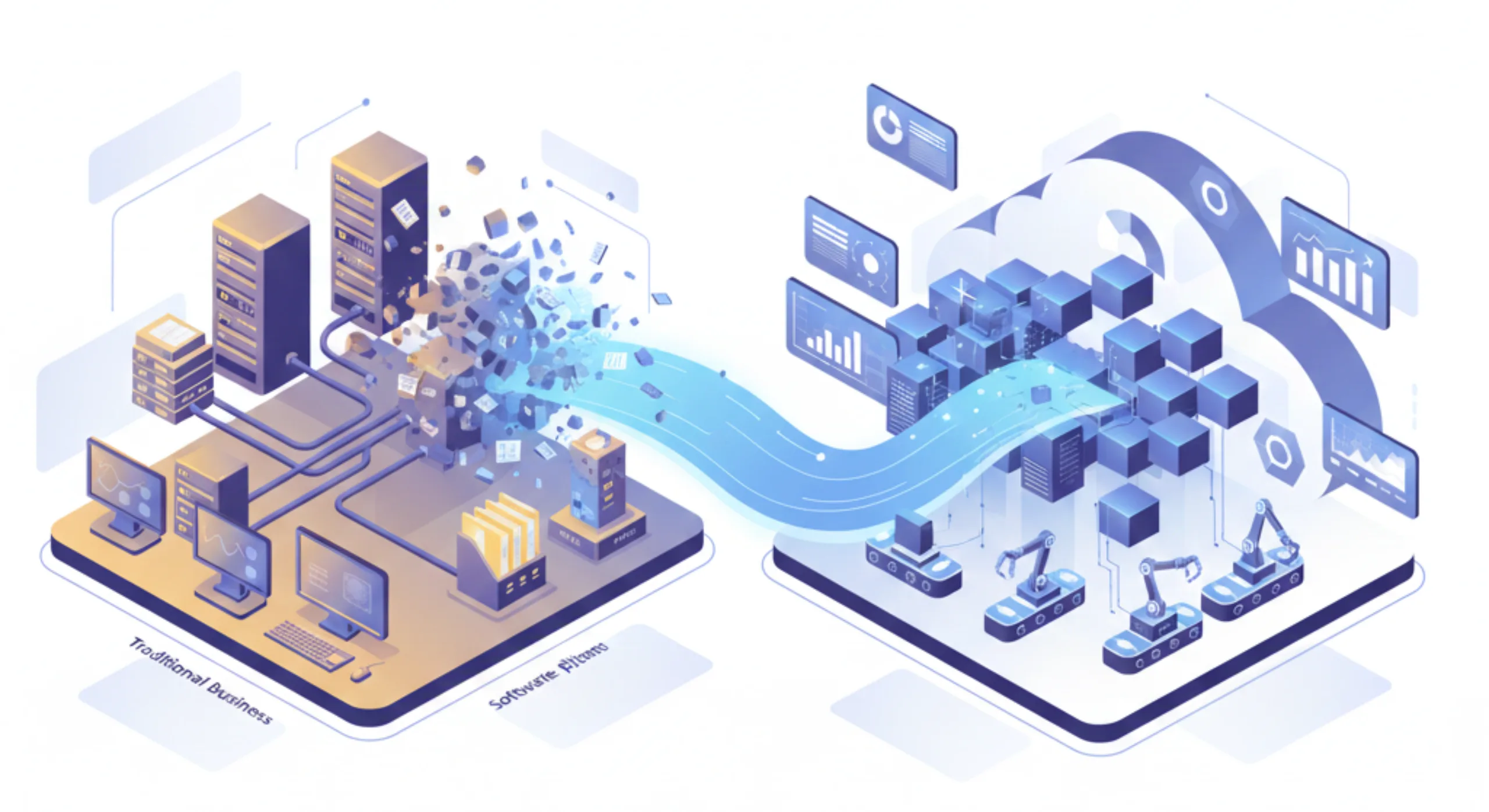

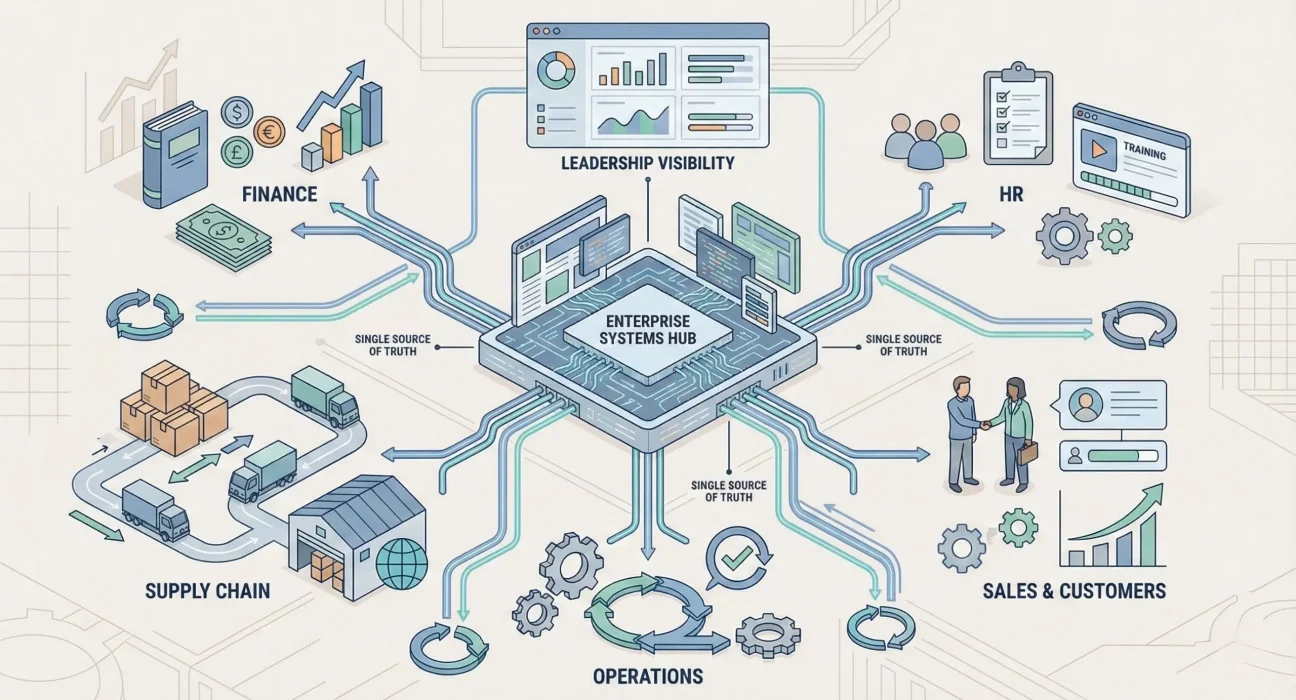
Enterprise systems are the integrated software platforms that run the core operations of large organizations. They handle everything from financial management and supply chain coordination to human resources and customer relationships. Unlike standalone applications, enterprise systems connect different business functions through shared data and standardized processes.
The terminology can be confusing. People use phrases like ERP, enterprise applications, and business systems interchangeably. What matters is the underlying concept: these are the mission-critical platforms that keep large companies running. When they work well, operations flow smoothly. When they break or underperform, the entire organization feels it.
For C-suite leaders, understanding how enterprise systems contribute to operational excellence is not an IT question. It is a fundamental business question about how your organization executes at scale.
The Operational Excellence Challenge
Operational excellence means running your business with consistency, efficiency, and quality across all locations and business units. For small companies, this is manageable through direct oversight and informal coordination. For large enterprises, it requires systematic processes and integrated technology.
The challenges multiply with scale. A retailer with five stores can manage inventory with spreadsheets and phone calls. A retailer with 500 stores needs automated replenishment, real-time visibility, and coordinated logistics. The same pattern applies across every business function. What works at small scale breaks at enterprise scale.
Without proper systems, large organizations suffer from predictable problems. Information gets trapped in departmental silos. Different teams use conflicting data to make decisions. Manual processes create bottlenecks and errors. Compliance becomes difficult to enforce consistently. Leadership lacks visibility into what is actually happening across the business.
These problems are expensive. They show up as excess inventory, missed revenue opportunities, customer service failures, and regulatory penalties. More importantly, they limit your ability to respond quickly to market changes or execute strategic initiatives effectively.
Enterprise systems exist to solve these problems. But simply buying and installing software does not automatically deliver operational excellence. The value comes from how well you implement, integrate, and operationalize these platforms.
How Enterprise Systems Enable Better Operations
Enterprise systems create operational excellence through three core mechanisms.
First, they establish a single source of truth for critical business data. When sales, finance, operations, and customer service all work from the same customer record or inventory position, coordination improves dramatically. Decisions get made faster because teams are not debating whose numbers are correct. Problems get identified sooner because anomalies become visible across the organization.
This sounds simple, but achieving it requires significant work. Data must be cleaned, standardized, and continuously validated. Integration points between systems need to be reliable. Access controls must balance security with usability. Organizations that skip this foundational work end up with enterprise systems that contain inconsistent data, which defeats the entire purpose.
Second, enterprise systems automate repeatable processes that used to require manual intervention. Order-to-cash, procure-to-pay, hire-to-retire processes involve dozens of steps across multiple departments. When these run automatically with appropriate controls and exception handling, throughput increases and error rates drop. This frees people to focus on judgment-based work that actually requires human expertise.
The automation value compounds over time. A process improvement that saves 10 minutes per transaction might seem trivial. Multiply that across 10,000 transactions per day, and you have created meaningful capacity without adding headcount. Large enterprises run on accumulated gains like this.
Third, enterprise systems provide visibility and control at scale. Leadership can monitor performance across regions, track compliance in real time, and identify operational issues before they escalate. This does not mean micromanaging. It means having the information needed to make strategic decisions and the ability to ensure consistent execution across a complex organization.
Modern systems also enable faster adaptation. When market conditions change or new regulations take effect, you need to update processes across the entire company quickly. Enterprise systems make this possible through centralized configuration instead of hunting down hundreds of local spreadsheets or regional workarounds.
Why Implementation Determines Success
Most enterprise system failures are not technology failures. They are implementation failures. The software usually has the capabilities needed. What goes wrong is how the project gets executed.
One common mistake is treating implementation as purely technical work. Organizations hand the project to IT and expect them to configure the system. But enterprise systems change how people work across the entire business. Without deep involvement from operations, finance, sales, and other functions, the implementation will not reflect actual business needs. You end up with a system that technically works but does not support real workflows.
Another problem is underestimating the data challenge. Enterprise systems require clean, complete, consistent data. Many organizations discover during implementation that their existing data is messy, with duplicates, gaps, and conflicting standards across divisions. Fixing this takes time and effort. Teams that try to skip data cleanup end up with garbage-in, garbage-out systems that erode trust from day one.
Integration complexity also catches organizations by surprise. Enterprise systems rarely operate in isolation. They need to connect with existing applications for logistics, manufacturing, e-commerce, and specialized functions. Each integration point is a potential source of failures, performance issues, and ongoing maintenance costs. Poor planning around integration leads to expensive rework and delayed go-live dates.
Change management is perhaps the most underestimated aspect. New enterprise systems change daily work for hundreds or thousands of employees. If people do not understand how to use the system properly, or if they resist because they were not involved in the design, adoption will be low and workarounds will proliferate. You cannot achieve operational excellence when half your organization is circumventing the system.
These challenges explain why enterprise system implementations so often run over budget, miss deadlines, or deliver disappointing results. The difference between success and failure is almost always execution quality, not technology selection.
What Strong Execution Looks Like
Successful enterprise system implementations start with clear objectives tied to business outcomes. The team defines what operational improvements need to happen and how success will be measured. This creates a filter for decision-making throughout the project. When design questions arise, you can evaluate options against concrete goals instead of abstract best practices.
Strong implementations also maintain senior business ownership throughout delivery. The project needs an executive sponsor who can make decisions, allocate resources, and remove organizational obstacles. This cannot be delegated to a project manager, no matter how capable. Enterprise system implementations involve trade-offs between different business units and priorities. Only senior leadership can resolve these effectively.
Realistic timelines matter more than aggressive promises. Enterprise systems take time to implement properly. Trying to compress schedules leads to cut corners, inadequate testing, and poor training. It is better to phase delivery with clear milestones than to push for a single big-bang launch that creates chaos across the organization.
Testing must be thorough and business-focused. Technical testing catches software bugs, but business testing ensures the system actually supports real workflows under realistic conditions. This means involving actual end users in testing scenarios that reflect daily operations, not just happy-path demonstrations.
Training cannot be an afterthought. People need hands-on practice with the system before go-live, documentation that addresses common questions, and accessible support during the transition period. Organizations that rush training end up with frustrated users who blame the system instead of learning how to work with it effectively.
How Ozrit Delivers Enterprise Systems at Scale
Ozrit was built specifically to handle the complexity of large-scale enterprise system implementations. The company’s approach addresses the common failure points through experienced leadership, structured delivery methods, and sufficient capacity to staff projects properly.
When you engage Ozrit, you work directly with senior delivery leaders who have implemented enterprise systems at major corporations before. These are not junior consultants learning on your project. They bring pattern recognition from previous implementations and can anticipate problems before they materialize. This experience level matters because enterprise projects involve countless judgment calls where the wrong decision creates expensive downstream consequences.
Ozrit’s onboarding process reduces one of the biggest risks in enterprise work: the ramp-up period where new teams are learning your environment. The company has developed structured methods for quickly understanding client systems, business processes, and organizational dynamics. This means the team starts adding value in weeks rather than spending months on discovery work that delays actual implementation progress.
Team capacity is another differentiator. Ozrit maintains over 200 experienced engineers and architects who can be deployed to enterprise programs. This matters because system implementations often need to scale up quickly or require specialists in specific integration technologies. Small consulting firms force you to compromise on team composition or wait for resources. Ozrit can staff projects appropriately from the start.
The delivery approach emphasizes realistic planning with clear phase gates and regular checkpoint reviews. Ozrit does not promise unrealistic timelines to win contracts. They structure implementations with achievable milestones that allow for course correction as the project evolves. This transparency helps leadership manage expectations and maintain confidence even when challenges arise.
Support extends beyond go-live. Ozrit provides 24/7 coverage for production systems because enterprise operations do not stop at 5pm. When issues occur, you need people available immediately who understand your specific implementation and can resolve problems without lengthy escalation processes.
The Path to Sustainable Excellence
Operational excellence through enterprise systems is not a one-time achievement. It requires ongoing attention as your business evolves, new capabilities become available, and user needs change.
The organizations that get sustained value from enterprise systems treat them as living platforms that need continuous improvement. This means budgeting for regular enhancements, not just break-fix maintenance. It means keeping internal expertise so you are not entirely dependent on external partners. It means monitoring system performance and user satisfaction to identify issues before they become critical.
Technology continues advancing in ways that create new opportunities. Automation capabilities that were expensive and complex five years ago are now standard features. Analytics tools provide insights that used to require separate business intelligence implementations. Cloud platforms enable flexibility that was impossible with on-premise systems.
But these advances only deliver value when integrated thoughtfully into your operations. Chasing every new technology trend is as dangerous as ignoring innovation completely. The right approach is selective adoption based on clear business cases and careful implementation that maintains system stability while adding new capabilities.
Building Operational Excellence
Enterprise systems are essential infrastructure for operational excellence at scale. They provide the data integration, process automation, and operational visibility that large organizations need to execute consistently across complex operations.
The technology itself is widely available. What separates successful implementations from expensive failures is execution quality. This comes down to experienced leadership, realistic planning, thorough implementation work, and sustained support after go-live.
For senior leaders evaluating enterprise system initiatives, the critical questions are not about software features or vendor pricing. They are about implementation capability, delivery certainty, and long-term partnership quality. The organizations that achieve operational excellence through enterprise systems are those that invest in strong execution, not just technology purchases.