

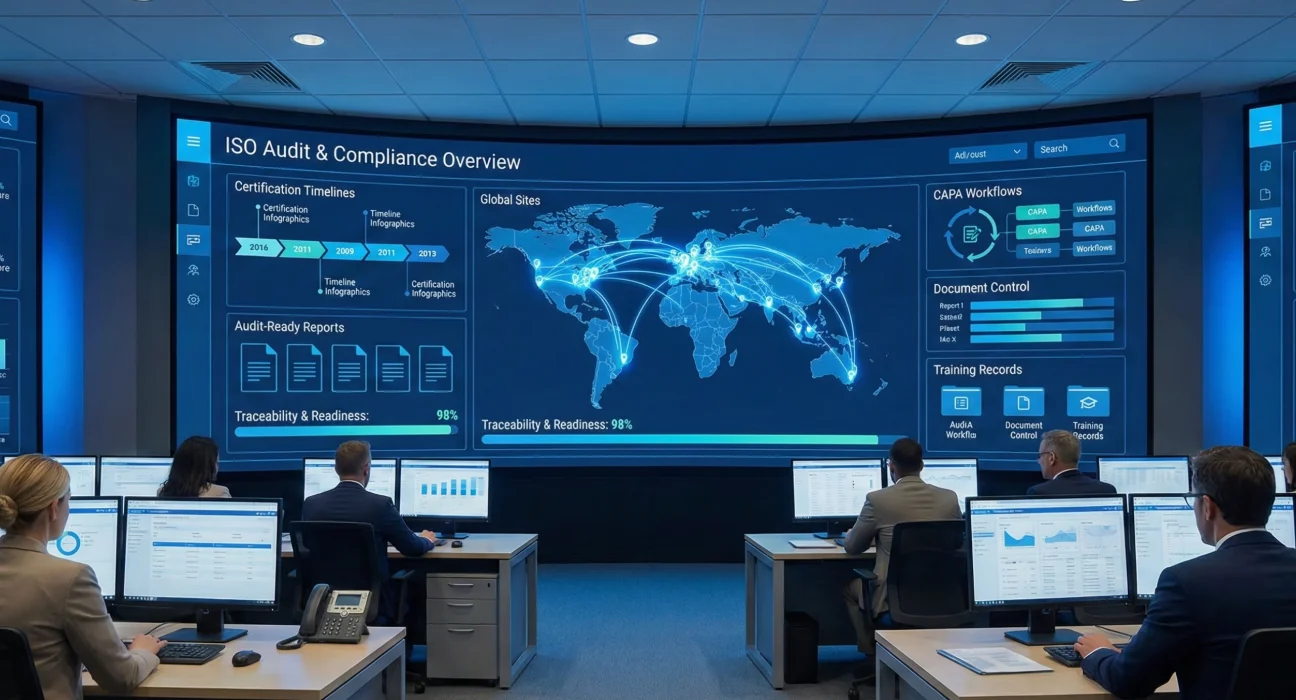
ISO audits are expensive, disruptive, and stressful for most large enterprises. Not because the standards are unreasonable, but because gathering evidence of compliance across multiple sites, business units, and years of operation is operationally difficult when your quality management system is fragmented, manual, or outdated.
The typical scenario looks like this. An audit is scheduled three months out. Quality teams start gathering documentation from shared drives, email archives, spreadsheets, and paper files. They discover that some records are incomplete, some procedures are outdated, and some required evidence does not exist in a form that auditors will accept. The weeks before the audit become a scramble to reconstruct compliance evidence, update documentation, and prepare staff for auditor questions.
This pattern repeats for internal audits, external audits, customer audits, and regulatory inspections. Each one consumes weeks of preparation time from quality personnel who should be focused on actual quality improvement rather than audit preparation. The cost is not just the direct time spent. It is the opportunity cost of quality teams operating in reactive mode instead of proactively preventing issues.
Modern QMS software changes this dynamic fundamentally. When your quality system is properly implemented, compliance evidence is generated continuously as part of normal operations. Audit preparation shifts from weeks of document gathering to hours of report generation. Auditors get the evidence they need efficiently, and your quality teams stay focused on their actual work.
This article explains what makes ISO audits difficult at enterprise scale, how modern QMS software addresses these challenges, and what it takes to implement a system that actually delivers on this promise.
Why ISO Compliance Gets Harder at Enterprise Scale
For a single-site organization with straightforward operations, ISO compliance is manageable even with basic systems. You have one set of processes, one quality team, and a limited volume of records to maintain. Auditors can review your operation in a day or two, and preparing evidence is a contained exercise.
At enterprise scale, every dimension of complexity increases. You have multiple sites, each with different processes, equipment, and personnel. You have business units operating in different regulatory environments with different ISO certification requirements. You might have ISO 9001 for general quality, ISO 13485 for medical devices, ISO 14001 for environmental management, and industry-specific standards all applying to different parts of your organization.
Your quality records are distributed across these sites and systems. Training records might be in one system, CAPA records in another, document control in a third, and audit findings scattered across email and spreadsheets. When an auditor asks to see evidence of corrective actions related to supplier quality issues at a specific site over the past year, reconstructing that evidence requires manually searching multiple sources and compiling information that was never designed to be aggregated.
Then there is the problem of process consistency. ISO standards require that processes are defined, followed, and continuously improved. At enterprise scale, demonstrating this consistency across dozens of sites and thousands of employees is difficult when each location has implemented quality processes slightly differently. Auditors will find these inconsistencies, and explaining why they exist without undermining your claim of having a controlled quality system becomes a delicate exercise.
Document control presents another challenge. ISO compliance requires that procedures, work instructions, and quality records are controlled, current, and accessible to those who need them. In manual systems, this means managing version control across sites, ensuring obsolete documents are removed from use, and maintaining audit trails of document changes. The larger the organization, the harder this becomes and the more likely auditors are to find examples of outdated documents still in circulation.
Finally, there is the challenge of demonstrating continual improvement. ISO standards expect organizations to analyze quality data, identify trends, and take action to improve. This is difficult when your quality data is fragmented and inconsistent. Generating meaningful analysis requires manually compiling data from multiple sources, which takes so much time that it rarely happens outside of audit preparation periods.
What Modern QMS Software Actually Provides for ISO Compliance
Modern quality management software is designed specifically to address these enterprise-scale ISO compliance challenges. The difference from legacy systems or manual processes is not just automation. It is systematic evidence generation that happens as part of normal quality operations.
Start with integrated record keeping. A properly implemented QMS captures all quality-related activities in a single system including CAPAs, non-conformances, supplier quality issues, internal audits, training completions, document changes, and management reviews. When an auditor asks for evidence of a specific process or requirement, that evidence exists in the system with complete audit trails showing who did what, when, and why.
This integration eliminates the manual compilation work that dominates traditional audit preparation. Instead of searching through email, spreadsheets, and shared drives, quality staff generate reports directly from the QMS that show exactly what the auditor needs to see. What previously took weeks now takes hours.
Document control becomes systematic rather than manual. The QMS manages document versions, approval workflows, distribution, and obsolescence automatically. When a procedure is updated, the old version is archived with a complete audit trail, the new version is distributed to relevant personnel, and training can be automatically triggered for affected staff. Auditors get clear evidence that document control is working consistently across the organization.
Process standardization is also enforced through the system. When your CAPA process is configured in the QMS, all sites follow the same workflow. Local variations can still be accommodated where necessary, but the core process remains consistent. This consistency is exactly what ISO auditors look for, and having it systematically enforced through software is more credible than policy documents that might or might not be followed in practice.
Reporting and analysis capabilities transform how you demonstrate continual improvement. Modern QMS platforms can generate trend analysis, identify recurring issues, and produce management review reports automatically. This means continual improvement shifts from something you demonstrate during audits to something you actually do continuously. Auditors notice this difference, and it significantly strengthens your compliance position.
Traceability is another critical capability. ISO auditors often trace specific examples through your quality system to verify that processes are being followed. In a modern QMS, this traceability is built in. An auditor can start with a customer complaint, trace it to the investigation, see the root cause analysis, follow the corrective actions, verify training was completed, and confirm effectiveness checks were performed. All of this evidence exists in the system with timestamps, responsible parties, and supporting documentation.
The Implementation Reality for ISO-Ready QMS
Understanding what modern QMS software provides is different from actually implementing a system that delivers these benefits. Many enterprises purchase quality management software expecting it to solve their ISO compliance challenges, only to discover that poor implementation creates as many problems as it solves.
The first requirement is that your quality processes need to be defined and standardized before you implement the software. The QMS will enforce the processes you configure into it. If those processes are poorly designed, inconsistent, or do not align with ISO requirements, the software will not fix those problems. It will just make them permanent and harder to change.
This means successful QMS implementations require process design work before technical configuration begins. You need to map current processes, identify gaps against ISO requirements, design standardized processes that will work across your organization, and gain agreement from quality leaders at different sites that these processes are workable. This preparation work takes time but is essential for successful adoption.
Integration with other enterprise systems is also critical for ISO compliance. Your QMS needs employee data from your HR system to manage training records. It needs supplier data from your procurement system for vendor quality management. It may need production data from manufacturing systems for traceability and analysis. Without these integrations, you end up with a quality system that is isolated from actual operations, which limits its value for both compliance and quality improvement.
Data migration from existing systems presents another significant challenge. Your historical quality records are evidence of compliance over time. When implementing a new QMS, you need to decide what historical data to migrate, how to structure it in the new system, and how to validate that the migration preserved data integrity. For organizations with years of quality history, this work is substantial and needs to be planned carefully.
Training and change management determine whether your new QMS actually gets used consistently across the organization. Quality staff need to understand not just how to use the system, but why processes are designed the way they are and how the system supports ISO compliance. Site quality managers need confidence that the system will work for their specific operations. Without this organizational buy-in, people work around the system rather than through it, which undermines compliance.
Realistic timelines for implementing enterprise QMS for ISO compliance typically range from six to twelve months depending on organizational complexity, the number of sites involved, and integration requirements. Organizations that try to compress these timelines usually create systems that are technically functional but operationally problematic.
How Ozrit Delivers ISO-Ready QMS Implementations
Ozrit is a global technology services company that implements quality management systems for enterprises in regulated industries. We have delivered QMS platforms that have successfully supported ISO certification audits for multinational manufacturers across multiple standards and regulatory jurisdictions.
Our approach starts with understanding your ISO compliance requirements and current compliance challenges before designing technical solutions. We review your quality processes against applicable ISO standards, identify gaps, and work with your quality leadership to design processes that will satisfy both ISO requirements and operational needs. This work is led by senior consultants who have supported ISO implementations and audits in large enterprises.
We treat process standardization as a prerequisite for implementation, not something that happens during deployment. We facilitate the difficult conversations about what will be standardized globally versus what will remain locally flexible. We document agreed processes in sufficient detail that they can be configured into the QMS correctly. And we validate that these processes will actually work in your operating environment before committing to technical build.
Integration work is planned and executed as a core workstream, not an optional add-on. We have connected QMS platforms with HR systems, ERP systems, and manufacturing systems for large enterprises with complex technology landscapes. We understand the data flows needed to support ISO compliance and build integration architecture that provides reliable, auditable connections between systems.
Our implementation methodology includes validation that the system is generating the compliance evidence ISO auditors will require. We do not just configure the system and assume it will work for audits. We simulate audit scenarios, generate sample evidence packages, and verify that the system is capturing the right information with appropriate audit trails and traceability.
We also provide guidance on data migration strategies that preserve compliance evidence while moving to the new system. For organizations with significant quality history that needs to be retained for regulatory or customer requirements, we build migration processes that maintain data integrity and provide continuity of compliance records.
After go-live, we provide 24/7 support to ensure your quality system operates reliably. Our support teams understand ISO compliance requirements and can respond quickly to issues that could affect audit readiness. For organizations with upcoming certification audits or regulatory inspections, this level of responsive support provides critical assurance.
We have delivered these implementations for organizations with dozens of sites across multiple countries, supporting ISO 9001, ISO 13485, ISO 14001, AS9100, and other industry-specific standards. Our senior team stays involved throughout these programs because ISO compliance is too important to delegate entirely to junior delivery resources.
Final Perspective
Modern QMS software can fundamentally change how enterprises approach ISO compliance, shifting from reactive audit preparation to continuous evidence generation that happens as part of normal quality operations. But this transformation only happens when the system is implemented properly with well-designed processes, proper integration, adequate training, and organizational commitment to using the system consistently.
The enterprises that get this right are the ones that treat QMS implementation as a quality program, not just a technology project. They invest in process design, they engage quality leadership from across their organization, they build realistic implementation plans, and they work with partners who understand both ISO requirements and enterprise delivery. The result is not just easier audits, but fundamentally better quality management that actually supports business objectives rather than just satisfying compliance obligations.