

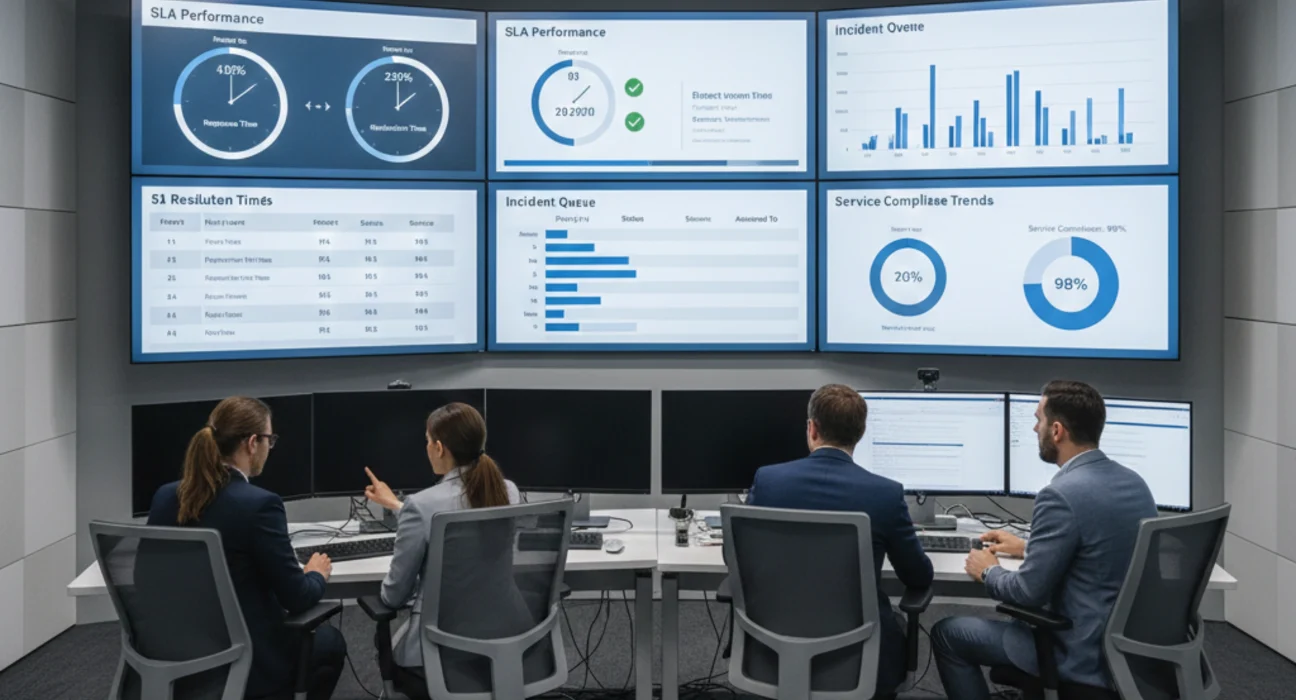
Service level agreements define the performance expectations for your IT support organization. They specify how quickly different types of issues should be acknowledged and resolved, what availability you commit to, and what happens when targets aren’t met.
In theory, SLAs create accountability and align service delivery with business needs. In practice, most enterprise SLAs are either too aggressive to meet consistently or too lenient to drive meaningful performance. They’re often set based on what sounds good in a presentation rather than what’s actually achievable given your resources, tools, and operating model.
The result is either constant SLA breaches that nobody takes seriously anymore, or comfortably met targets that mask underlying service quality problems. Neither situation helps your organization deliver better service or make informed decisions about where to invest in improvements.
Setting realistic SLAs requires understanding your actual operational capabilities, not your aspirations. Meeting them consistently requires the right processes, tools, capacity, and governance. This isn’t complicated in principle, but it requires honesty about current performance and discipline to address the gaps.
Why Most SLAs Don’t Work
The most common problem with enterprise SLAs is that they’re disconnected from operational reality. Someone decides that critical incidents should be resolved within four hours because that sounds reasonable or because a vendor promised it. Nobody checks whether your team has ever actually resolved critical incidents that quickly on average, or what would need to change to make it possible.
The SLA gets implemented. Breaches start immediately. Teams scramble to close tickets faster, sometimes by reclassifying issues to lower priority levels or by marking tickets resolved before the actual problem is fixed. The metric improves, but service quality doesn’t. Leadership sees decent SLA compliance numbers and doesn’t realize the underlying issues remain unaddressed.
The opposite problem is equally common. SLAs are set so loosely that they’re meaningless. A priority 2 incident can take three business days to resolve. That target is easy to meet, but it doesn’t push the organization to improve. It also doesn’t reflect what users actually need. When a department VP can’t access a critical system for three days, the fact that you met your SLA doesn’t make them satisfied with IT service delivery.
Another frequent issue is insufficient differentiation between priority levels. Everything above the lowest priority has similar targets, so there’s no real prioritization. Or the priority definitions are so vague that tickets get classified inconsistently. One engineer’s priority 2 is another engineer’s priority 3. The SLA targets become arbitrary because the prioritization itself is arbitrary.
Finally, many organizations set SLAs without considering their capacity to meet them. You commit to specific response and resolution times, but you haven’t staffed appropriately for the volume and complexity of tickets you receive. During normal periods, you might meet targets, but when volume spikes or key people are out, performance degrades significantly. The SLAs don’t account for realistic operational variation.
Setting SLAs Based on Real Data
Effective SLAs start with understanding your current performance. Pull six months of ticket data and analyze actual response and resolution times by category and priority. Not the averages, but the distribution. What percentage of tickets are you resolving within various timeframes? Where are the outliers and why?
This analysis reveals what’s actually achievable with your current setup. If you’re resolving 75% of priority 2 incidents within eight hours today, setting an SLA of four hours means you need to fundamentally change something about your operation. If you’re resolving 95% within six hours, that’s a reasonable target with some buffer for variation.
The priority definitions need to be specific and tied to business impact. Priority 1 should mean a clear, significant business impact. Revenue-affecting outages, security breaches, and complete service failures affecting large user populations. Priority 2 means a substantial impact on specific teams or degraded service affecting many users. Priority 3 means individual user issues that don’t block critical work. Priority 4 is requests and minor issues.
These definitions should include examples so classification is consistent. Not “major incident” or “high impact,” but specific scenarios that different engineers would classify the same way. When classification is consistent, the SLA targets become meaningful.
Your SLA targets should reflect both response time and resolution time. Response time is when someone first engages with the ticket. This should be relatively aggressive because it’s mostly about queue management and capacity. Resolution time is when the actual issue is fixed. This needs to be realistic about problem complexity and the work required.
For a typical enterprise, reasonable SLA targets might look like: Priority 1 response within 15 minutes, resolution within 4 hours. Priority 2 response within 1 hour, resolution within 8 hours. Priority 3 response within 4 hours, resolution within 24 hours. Priority 4 response within 1 business day, resolution within 3 business days. These are starting points, not prescriptions. Your numbers should reflect your environment, resources, and business requirements.
Building Operations That Meet SLAs
Setting realistic targets is necessary but not sufficient. You need operational capabilities that deliver consistent performance.
Proper ticket routing is foundational. Tickets need to reach the right team immediately based on clear categorization. Manual triage adds delays and introduces errors. Automated routing based on service affected, issue type, and user location eliminates this delay and ensures specialized teams handle the work they’re equipped for.
Queue management and workload balancing prevent tickets from sitting unassigned. Each team needs clear ownership of their queue and accountability for response times. When queues back up, managers need visibility to rebalance work or escalate for additional support. Real-time dashboards showing queue depths, aging tickets, and approaching SLA breaches allow proactive management instead of reactive firefighting.
Escalation procedures ensure complex issues get proper attention without missing SLAs. Clear escalation criteria and paths prevent tickets from bouncing between teams or sitting while people debate who should handle them. When an engineer can’t resolve something within a reasonable timeframe, the escalation process should be straightforward and fast.
Knowledge management directly impacts resolution speed. Common issues should have documented solutions that engineers can apply quickly. Self-service capabilities let users resolve simple problems themselves, reducing ticket volume and freeing support staff for complex work. Effective knowledge management can reduce resolution time for recurring issues by 40 to 60 percent.
Automation handles routine work that doesn’t require human judgment. Auto-classification of tickets, auto-assignment based on attributes, and auto-remediation for known issues with clear fixes. These reduce the active work time required and eliminate delays. They also improve consistency because automated processes don’t vary based on who’s working the ticket.
Capacity planning ensures you have enough staff to handle realistic workload variations. This means understanding your ticket patterns throughout the day, week, month, and year. Monday mornings are different from Thursday afternoons. Month-end and quarter-end have different volumes. You need enough capacity to meet SLAs during peaks, not just during average periods.
Monitoring and Governance
SLAs need continuous monitoring and regular review. Real-time dashboards should show each team’s current SLA performance, tickets approaching breach, and queue health. This allows managers to intervene before problems become SLA violations.
The monitoring needs to distinguish between different breach reasons. Are tickets sitting in queues because of insufficient capacity? Are they being assigned to the wrong teams? Are engineers spending too much time gathering information? Are specific issue types consistently breaching? Each pattern requires different remediation.
Regular SLA reviews with business stakeholders ensure the targets remain aligned with actual business needs. Technology and business requirements change. What was appropriate two years ago might not be appropriate today. The review should examine whether the SLA levels are right, whether classification is happening correctly, and whether performance is meeting expectations.
When SLA breaches occur, treat them as operational data, not failures to punish. Analyze the root causes systematically. If breaches are concentrated in specific areas, that’s where to focus improvement efforts. If they’re random and distributed, you might have a capacity problem or targets that are too aggressive.
Exception handling processes are necessary for situations that genuinely can’t meet standard SLAs. Complex problems that require vendor engagement, issues that need parts or external dependencies, problems that surface during maintenance windows. These need documented exception processes so they don’t distort your performance metrics or create unrealistic expectations.
The Financial Implications of SLAs
SLAs have cost implications that need to be understood explicitly. More aggressive targets require more capacity, better tools, more automation, and more specialized expertise. These investments are justifiable if they align with business needs, but they need to be made consciously.
Organizations sometimes set aggressive SLAs without funding the operational capabilities to meet them consistently. The result is either chronic breaches or constant crisis management. Both are expensive in different ways. Breaches damage trust with business users and can affect productivity or revenue. Crisis management burns out staff and prevents long-term improvements.
The right approach is connecting SLA targets to the investment you’re willing to make in service delivery capabilities. If meeting a four-hour resolution target for priority 2 incidents requires adding staff, implementing automation, or improving integration between tools, that cost should be part of the SLA decision. Leadership can then make informed tradeoffs between service levels and costs.
Some organizations implement financial penalties for SLA breaches, either charged back to IT or paid to business units. This creates strong incentives to meet targets, but it can also create perverse incentives. Teams might game the system by reclassifying tickets, closing them prematurely, or focusing exclusively on SLA compliance at the expense of actual service quality. Financial penalties work better when combined with strong governance and outcome-focused metrics.
How Ozrit Approaches SLA Implementation
Ozrit’s work on SLA programs starts with a thorough analysis of current performance data and operational capabilities. The team reviews six to twelve months of ticket history, examines resolution patterns, identifies where delays occur, and assesses whether current tools and processes can support realistic SLA targets.
This analysis produces specific, data-driven recommendations for SLA levels that are achievable with appropriate improvements. Not aspirational targets that would require wholesale transformation, but realistic targets that push performance improvement while remaining operationally viable.
The implementation program addresses the operational gaps that prevent consistent SLA achievement. This typically includes routing optimization, queue management improvements, knowledge base development, targeted automation for high-volume issue types, and capacity adjustments where needed. The work is structured as a cohesive program rather than disconnected initiatives.
A senior delivery lead owns the entire program from assessment through implementation and stabilization. They coordinate across IT teams, manage dependencies, track progress, and ensure the work delivers measurable improvement in SLA performance. You’re not coordinating multiple workstreams yourself or trying to align different teams independently.
The team size is typically five to eight people during active implementation. Service delivery consultants who design the operational model, process engineers who optimize workflows, technical specialists who implement automation and integration improvements, and change management professionals who drive adoption of new procedures.
Realistic timelines for comprehensive SLA improvement programs run three to five months. That includes current state assessment, operational design, technical implementation, testing, training, and transition to steady state operations. Quick wins can be delivered earlier, but sustainable SLA performance requires addressing multiple operational factors systematically.
Ozrit maintains 24/7 support for critical operations because SLA performance doesn’t pause at night or on weekends. When performance issues arise or support teams encounter problems with new processes, they need immediate access to people who understand the design and can troubleshoot effectively.
The goal isn’t just helping you meet SLAs once. It’s building sustainable operational capabilities that deliver consistent performance over time. This includes establishing the monitoring, governance, and continuous improvement practices that prevent backsliding after the initial implementation.
Making SLAs Work Long Term
SLA performance requires ongoing attention. It’s not a set-it-and-forget-it metric. Service delivery operations need regular reviews, continuous improvement initiatives, and leadership attention.
This means monthly reviews of SLA performance with operations managers, quarterly business reviews with stakeholders, and immediate investigation when trends start deteriorating. It means updating knowledge bases regularly, refining automation as patterns change, and adjusting capacity as volumes evolve.
It also means maintaining the discipline to classify tickets correctly, even when SLAs are at risk. Gaming the metrics to show better performance defeats the entire purpose of having SLAs. They’re meant to provide honest visibility into service delivery performance so you can make informed decisions about where to improve.
Your SLAs reflect what service delivery commitments you’re willing to make and fund appropriately. When they’re set realistically and supported by proper operational capabilities, they drive meaningful improvement and build trust with your business stakeholders. When they’re aspirational or disconnected from operational reality, they become meaningless numbers that everybody ignores. The difference is whether you’re honest about what’s achievable and willing to invest in the capabilities needed to deliver it consistently.