
Integration is the hidden constraint on most enterprise technology initiatives. Leadership approves a project, teams begin development, and then progress stalls when integration work turns out to be far more complex than anticipated. What looked like a three-month project became nine months, with most of the extra time spent on integration challenges that weren’t visible in the initial planning.
This pattern repeats across enterprises. Customer experience improvements wait for backend integrations. New product launches get delayed because order systems can’t be connected in time. Digital transformation initiatives bog down in the complexity of integrating modern applications with legacy infrastructure. The business wants to move faster, but integration capacity becomes the limiting factor on what’s actually achievable.
The frustrating part is that integration problems are predictable. Every enterprise faces them. Yet most still underestimate integration complexity, under-resource integration work, and discover the problems too late in delivery cycles to adjust effectively. Breaking this pattern requires understanding why integration is so consistently difficult and building the capabilities to handle it better.
Why Integration Gets Underestimated
Integration work gets underestimated because it’s largely invisible until you’re deep into implementation. When planning a new customer portal, the visible work is designing screens, building features, and deploying infrastructure. The integration work that connects the portal to customer databases, order systems, product catalogs, and inventory platforms isn’t as obvious but often represents more effort than the visible development.
The complexity comes from several sources. Systems being integrated were designed at different times with different assumptions and data models. They use different identifiers for the same business entities. They have different data quality levels and update frequencies. They expose integration points that weren’t designed for the specific use case you’re trying to implement. And they’re maintained by different teams with different priorities and availability.
Each of these factors adds complexity that’s hard to estimate accurately. You discover that the customer data structure in the CRM doesn’t match what the order system expects. You find that inventory updates only happen hourly, but your portal needs real-time information. You learn that the product catalog API has undocumented rate limits that affect your implementation approach. None of these problems is insurmountable, but each takes time to understand and work around.
By the time these issues become clear, project timelines are already committed, and changing them is difficult. Teams work longer hours trying to meet original deadlines. Quality suffers as shortcuts are taken to stay on schedule. And the delivered solution often has limitations or workarounds that wouldn’t have been necessary with more realistic integration planning.
The Hidden Dependencies
Integration work creates dependencies that ripple through project schedules in ways that aren’t immediately obvious. You need data from System A to complete your integration with System B. System A is being upgraded next quarter, and the team requests you wait until after the upgrade. The upgrade gets delayed by two months. Your project timeline just slipped by two months because of a dependency you didn’t control.
These dependencies multiply in large enterprises. The systems you need to integrate with are maintained by teams with their own roadmaps and priorities. Getting time on their calendar for integration work can take weeks. Getting changes made to accommodate your integration needs might require formal change requests and approval processes. And coordinating testing windows when all the required systems and teams are available becomes a complex scheduling challenge.
The larger the enterprise, the more of these dependencies exist. A project that looks straightforward based on the work your team controls becomes complex when you account for all the coordination required with other teams. And because these dependencies aren’t always visible upfront, they create schedule surprises that are hard to recover from.
Smart program planning accounts for integration dependencies explicitly. This means identifying all the systems that need integration early, engaging with the teams that maintain them, understanding their availability and constraints, and building realistic schedules that account for coordination overhead. It also means having contingency plans for when dependencies cause delays, such as building mock interfaces that can be swapped for real integrations later.
The Testing Complexity
Integration testing is fundamentally more complex than testing isolated components. You need test environments that include all the systems being integrated. You need test data that exercises realistic scenarios, including edge cases. You need coordination across teams to run tests that span multiple systems. And you need to troubleshoot failures that might be caused by any component in the integration chain.
Many enterprises lack adequate integration testing environments. Production systems can’t be used for testing. Complete replicas are too expensive. So test environments become simplified versions that don’t accurately represent production conditions. Tests pass in these environments and then fail in production because of differences nobody anticipated.
Even with good test environments, coordinating integration testing is difficult. The teams maintaining different systems have limited availability for testing support. Test data setup requires coordination across systems. Test execution needs to happen when all systems are available, which might mean off-hours or weekend work. And when tests fail, troubleshooting requires expertise across multiple systems that might not be readily available.
The result is that integration testing takes longer than expected, finds problems late in delivery cycles, and often doesn’t catch all the issues that emerge in production. Better to accept this reality upfront and plan accordingly with adequate time, resources, and realistic expectations about what testing can achieve.
The Data Transformation Challenge
Integration almost always requires transforming data between different formats and structures. The customer record in your CRM has different fields from the customer record in your order system. Product codes use different formats in different systems. Addresses are structured differently. Even dates and times might be represented in incompatible ways.
Building reliable data transformation logic is more difficult than it appears. You need to handle missing data gracefully. You need to validate that transformations produce sensible results. You need to manage data quality issues in source systems. You need to handle edge cases that occur rarely but break integration when they happen.
Many integration projects underestimate data transformation effort because it seems straightforward when looking at typical cases. The complexity emerges when you encounter the full variety of data in production systems. Null values where you expected data. Strings where you expected numbers. Character encodings that cause corruption. Legacy data that doesn’t conform to current formats. Each of these requires additional logic and testing.
The enterprises that handle integration well invest in understanding source data quality before building transformations. They analyze actual production data to identify the edge cases and quality issues they’ll need to handle. They build comprehensive validation to catch transformation errors early. And they monitor transformed data in production to detect quality issues that testing missed.
Performance at Integration Points
Integration points often become performance bottlenecks. You’re calling external systems with response times you don’t control. You might be making multiple integration calls to render a single page or process a single transaction. Network latency and system processing time accumulate across these calls.
At low volumes, this might be acceptable. At enterprise scale, it becomes a serious problem. A checkout flow that makes six integration calls, each taking 200 milliseconds, adds over a second to checkout time before considering any processing in your own system. Under load, those integration calls might slow down further, creating cascading performance problems.
Addressing integration performance requires architectural decisions about caching, batching, and async processing. Some integration calls can be cached to reduce load. Some can be batched to improve efficiency. Some can happen asynchronously after the user interaction completes. But each of these patterns adds complexity and requires careful consideration of data freshness and consistency requirements.
The mistake many projects make is discovering performance problems after going live. Load testing that includes realistic integration behavior needs to happen earlier, when there’s still time to make architectural changes. This requires test environments that realistically represent integration performance characteristics, which is often a challenge with simplified test infrastructure.
The Ownership Problem
Integration work often falls into gaps between teams. The team building a new application expects the teams maintaining existing systems to provide integration support. Those teams see integration as the application team’s responsibility. Neither has clear ownership of integration success, so problems don’t get addressed until they become critical.
This ownership ambiguity slows delivery and reduces integration quality. Nobody takes responsibility for integration architecture across systems. Nobody monitors integration health proactively. Nobody coordinates improvements that would benefit multiple integration consumers. Integration becomes something that happens as a side effect of individual projects rather than a capability that’s actively managed.
Better to establish clear ownership models for integration work. This might mean dedicated integration teams that own connectivity between systems. It might mean platform teams that provide well-supported integration interfaces. Or it might mean explicitly assigning integration ownership to specific teams with appropriate resources and authority.
The key is ensuring someone is accountable for integration success and can deliver it. Without clear ownership and adequate resources, integration will continue to be a bottleneck regardless of how much leadership emphasizes its importance.
How Ozrit Breaks Integration Bottlenecks
At Ozrit, we’ve delivered integration-intensive programs for enterprises across industries. We’ve learned that breaking integration bottlenecks requires both technical expertise and organizational coordination.
We start by conducting a detailed integration assessment early in program planning. This goes beyond identifying what systems need integration. We examine the actual integration points, assess data quality and compatibility, understand team availability and dependencies, evaluate testing capabilities, and identify likely complexity areas. This assessment typically takes two to three weeks and involves our senior integration architects working with teams across your organization.
The goal is surfacing integration complexity before commitments are made, not discovering it during implementation. This allows realistic planning that accounts for integration work explicitly rather than treating it as an afterthought.
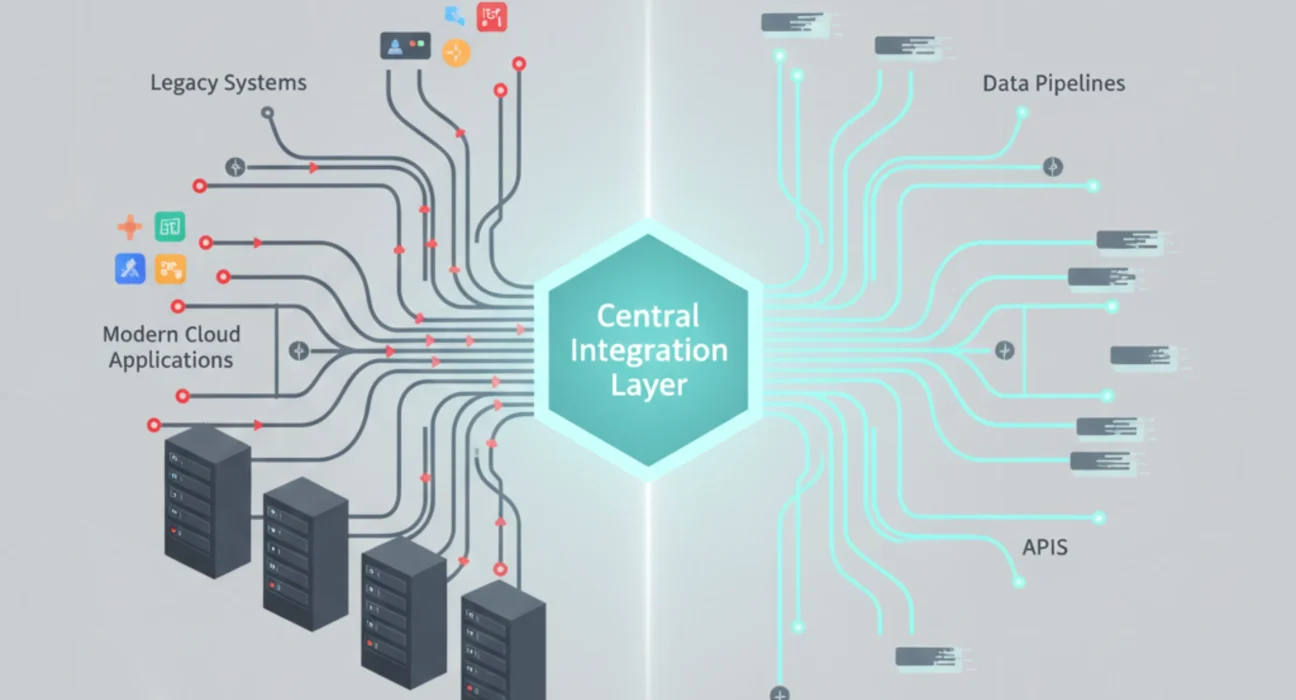
Based on this assessment, we develop integration approaches that minimize complexity and manage unavoidable complexity effectively. This might include building abstraction layers that simplify integration for consuming applications, implementing caching strategies that reduce dependency on slow systems, or creating mock interfaces that allow parallel development before real integrations are ready.
Each integration program has a dedicated senior delivery lead from our team who owns the end-to-end integration success. This person coordinates across teams, manages dependencies, and ensures integration work stays on track. They’re experienced integration architects who have delivered similar programs and understand both the technical patterns and the organizational coordination required.
Our onboarding process accounts for integration complexity. We assign engineers from our team of 250+ developers and specialists who have deep experience with enterprise integration patterns, data transformation, and the specific platforms common in your environment. They spend their first two to three weeks understanding your systems, data models, and organizational structure. By week four, they’re delivering working integrations.
We handle the difficult technical work that creates integration bottlenecks. Building resilient integration layers that handle failures gracefully. Implementing complex data transformations reliably. Optimizing integration performance. Managing backward compatibility as systems evolve. Our engineers have solved these problems at scale and know the patterns that work.
Because we operate across time zones with 24/7 coverage, we can coordinate integration work across global teams and respond quickly when integration issues arise. Integration problems often block multiple teams, so rapid resolution has an outsized impact on program velocity.
Our integration programs typically show measurable progress within six to eight weeks, with initial integrations complete and delivering value. Complex multi-system integration programs generally take four to six months to deliver fully, with the timeline depending on the number of systems, data complexity, and organizational dependencies involved.
Building Integration Capacity
Breaking integration bottlenecks isn’t about a single project. It’s about building organizational capacity to handle integration consistently well across all initiatives.
This requires investing in integration platforms and patterns that make common integration scenarios straightforward. It requires developing expertise in integration architecture and data transformation. It requires establishing clear ownership and governance for integration work. And it requires treating integration as a capability that needs ongoing investment, not just something that happens as part of individual projects.
The enterprises that no longer struggle with integration bottlenecks are those that made these investments deliberately. They have reusable integration capabilities that accelerate new projects. They have teams with deep integration expertise. They have realistic planning processes that account for integration complexity upfront. And they have monitoring and operational practices that keep integrations running reliably.
Integration becomes a competitive advantage when it’s no longer a constraint. The enterprises that can integrate systems quickly and reliably can launch new capabilities faster than competitors still struggling with integration challenges. That advantage compounds over time as integration capability enables initiatives that would otherwise be impractical.