
Financial services executives understand a reality that leaders in other industries are just beginning to grasp. When your applications handle money, regulatory compliance, and customer trust simultaneously, there’s no such thing as an acceptable failure rate. A retail application that goes down for twenty minutes creates frustrated customers. A banking application that goes down for twenty minutes can trigger regulatory inquiries, financial losses, and damage to reputation that takes years to repair.
This zero-tolerance environment has forced financial institutions to develop application development practices that differ fundamentally from standard enterprise software approaches. The requirements aren’t just more stringent. They’re different in kind. Every transaction needs to be exactly right, not approximately right. Every system interaction needs complete audit trails. Every release needs validation that goes far beyond typical testing. These aren’t nice-to-have qualities. They’re the minimum standard for applications that touch financial transactions or customer accounts.
Why Financial Applications Can’t Afford Normal Failure Rates
Most enterprise applications operate with failure rates that would be unacceptable in financial services. A customer service application might have bugs that affect five percent of users. An inventory system might have data quality issues that require manual corrections. These problems create work and frustration, but they don’t typically threaten the business. Fix them in the next release and move forward.
Financial applications operate under different mathematics. If your payment processing system has a failure rate of one percent, you’re creating financial discrepancies, customer complaints, and reconciliation problems at scale. If your account balance calculations are wrong in even a tiny fraction of cases, you’re violating regulatory requirements and customer agreements. If your fraud detection system misses suspicious patterns, you’re exposed to losses and compliance violations.
The transaction volumes make small error rates catastrophic. A large financial institution processes millions of transactions daily. An error rate that sounds negligible in percentage terms translates to thousands of problems that need investigation, correction, and documentation. Each error creates operational cost, regulatory risk, and potential customer impact. At financial services scale, you can’t afford to fix things later. You need to get them right the first time.
The Compounding Complexity of Financial System Integration
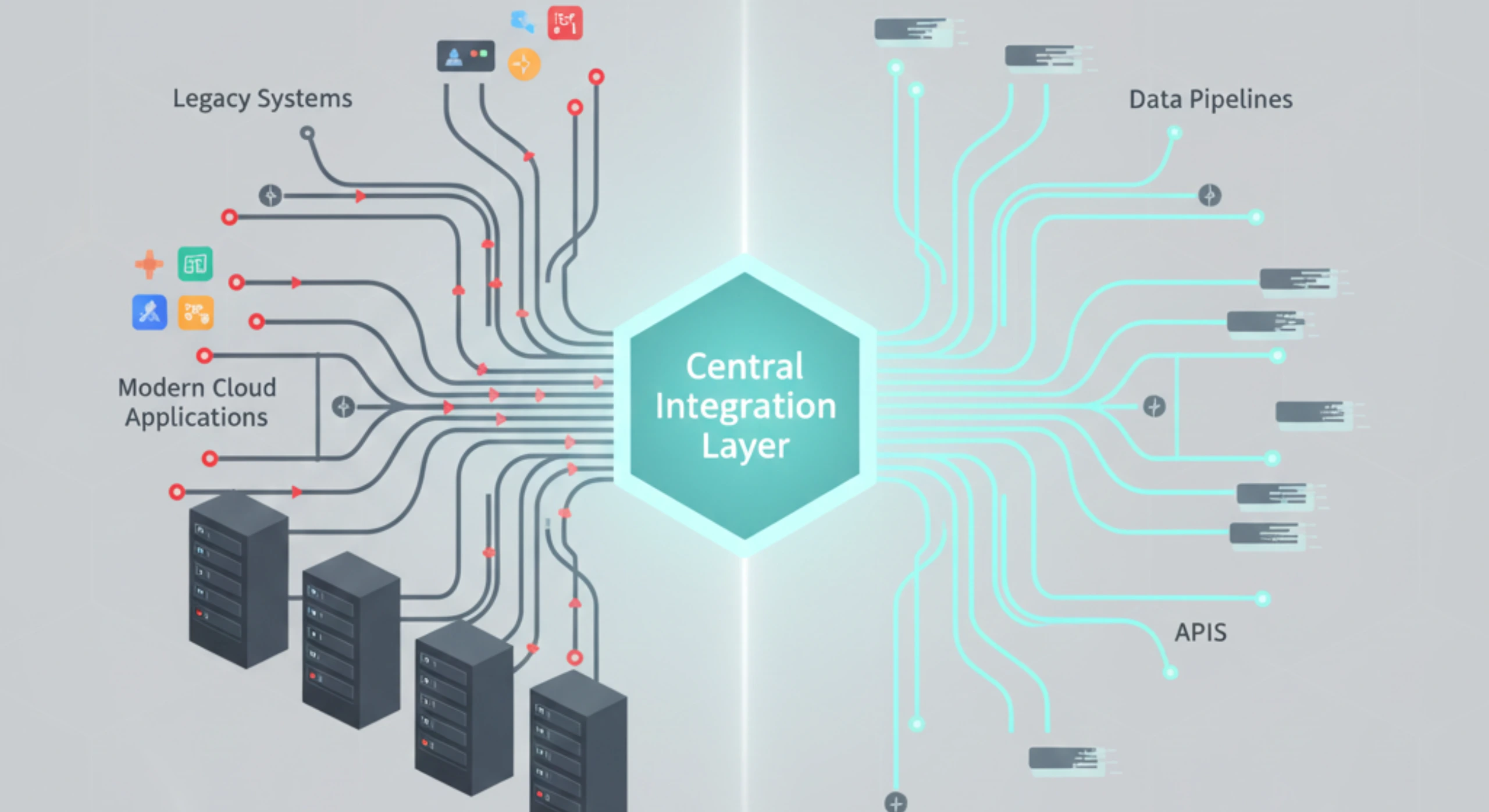
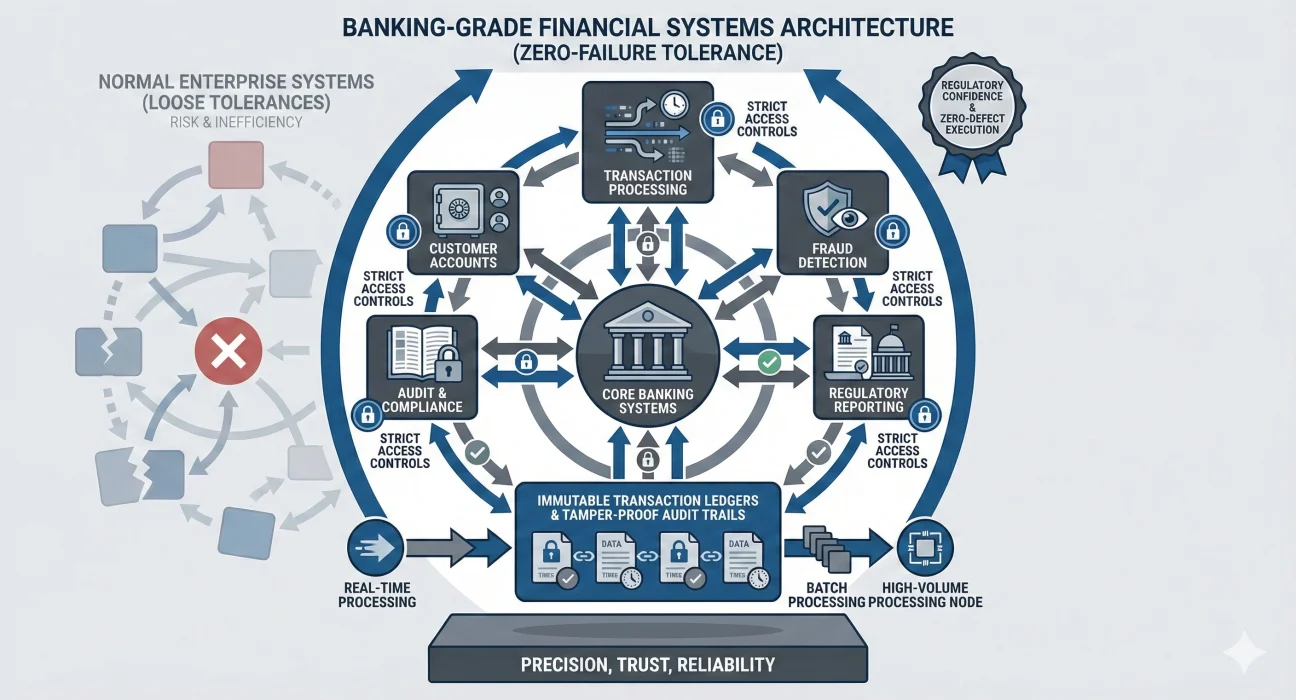
Financial institutions run on applications that need to work together with perfect accuracy. Your transaction processing systems. Your customer account systems. Your regulatory reporting platforms. Your fraud detection tools. Your reconciliation processes. These aren’t independent applications. They’re interconnected systems where an error in one component propagates through the entire chain.
This integration complexity creates challenges that don’t exist in simpler environments. A transaction initiated through your mobile application might touch fifteen different systems before completing. Each handoff needs to preserve data accuracy. Each system needs to maintain consistency with every other system. If balances don’t match across systems or if audit trails don’t align perfectly, you have serious problems that require immediate attention and extensive investigation.
The temporal dimension makes this harder. Financial transactions happen in real time, but some processes run in batch. Your customers see their account balances immediately, but certain updates might process overnight. Maintaining consistency across real-time and batch processes requires careful design and rigorous testing. Get it wrong and you create discrepancies that take days to identify and resolve.
What Regulatory Requirements Actually Mean for Development
Financial services executives are familiar with regulatory requirements that affect their operations. What often gets underestimated is how deeply these requirements need to be embedded in application architecture. Compliance isn’t something you add at the end. It’s fundamental to how the application works.
Audit requirements affect everything from database design to user interface behavior. Every transaction needs a complete trail showing who initiated it, who approved it, what systems processed it, and what the outcome was. This audit information needs to be tamper-proof, searchable, and retained for years. Building this into an application after the fact is nearly impossible. It needs to be part of the core design.
Data sovereignty and privacy requirements create architectural constraints that influence where systems run and how data moves between regions. A global financial institution can’t simply deploy applications in a single cloud region and serve customers worldwide. Different jurisdictions have different requirements about where customer data can be stored and processed. Your application architecture needs to support these constraints while maintaining the integration and consistency requirements your business operations depend on.
Change management in regulated environments adds another layer of complexity. You can’t just deploy new code when it’s ready. Changes need documentation, testing evidence, risk assessment, and often regulatory notification or approval. This governance process affects your entire development cycle. Teams that don’t understand these requirements waste enormous time building things that can’t actually be deployed.
The Testing Standards That Financial Systems Require
Most enterprise applications go through testing before production deployment. Financial applications require testing that’s an order of magnitude more comprehensive. Functional testing validates that features work. But you also need testing that validates accuracy to the penny across millions of transactions. Testing that confirms audit trails are complete and correct. Testing that verifies the application behaves correctly under load and when dependent systems fail.
The test data requirements alone create significant challenges. You need test scenarios that cover not just typical transactions but edge cases and error conditions. Your testing needs to verify behavior when systems are unavailable, when data is malformed, when timing creates race conditions. You need to test rollback and recovery procedures because in financial systems, you can’t just restart a failed transaction. You need to ensure that partial failures don’t create financial discrepancies.
Performance testing in financial contexts means more than checking response times. You need to verify that the system maintains accuracy under load. That concurrent transactions don’t create race conditions or data inconsistencies. That batch processes complete within required windows even when volumes spike. That the system can handle sustained peak load without degrading. These tests take time to design and execute properly, but skipping them creates production risks that financial institutions cannot accept.
How Ozrit Approaches Financial Services Application Development
Ozrit works with financial institutions that need applications built to the exacting standards required in banking and financial services. Our approach recognizes that financial applications can’t be developed the same way as typical enterprise software. The requirements for accuracy, auditability, and reliability are fundamentally different.
The team structure reflects these requirements. Financial services engagements typically include twenty-five to thirty people with specific experience in financial systems. This isn’t a team learning about financial services requirements while building your application. These are engineers who understand transaction processing, regulatory requirements, and the integration patterns that large financial institutions depend on.
Senior architects with financial services backgrounds remain involved throughout delivery. They review every significant design decision to ensure it meets the accuracy and auditability requirements your regulators will examine. They validate that testing approaches actually verify the behaviors that matter in financial contexts. This sustained senior involvement prevents the drift that happens when experienced architects hand off to implementation teams that don’t fully understand the constraints.
Our onboarding process for financial services programs runs five to six weeks. This extended onboarding is necessary because we need to understand not just your functional requirements but your regulatory obligations, your existing system landscape, your change management processes, and your audit requirements. We work with your compliance, risk, and operations teams to document requirements that often aren’t written down but are critical to regulatory acceptance.
Development timelines for substantial financial applications typically run eighteen to twenty-four months. This includes comprehensive testing that goes beyond functional validation to verify accuracy, auditability, and reliability under all operating conditions. It includes security assessments that meet financial services standards. It includes the documentation and evidence that your regulators expect to see before major system changes go live.
After deployment, financial applications require support that understands both the technology and the financial context. Our 24/7 support model ensures that transaction processing never stops because of application issues. When problems occur, you reach engineers who understand your system and can resolve issues correctly rather than applying quick fixes that might create financial discrepancies or compliance violations.
Technology and Architecture for Financial Reliability
Financial applications need architectures that support the accuracy and reliability requirements we’ve discussed. This means making different technology choices than you might make for typical enterprise applications. Transactional integrity needs to be guaranteed, not just likely. Audit logging needs to be comprehensive and tamper-proof. Security needs to meet the standards that financial regulators expect.
We build financial systems on technology stacks that have proven themselves in banking environments over years of operation. Your financial applications will run for a decade or more. The underlying technology needs to be stable, well-supported, and understood by the broader financial services technology community. Experimenting with emerging technologies in core financial systems creates risks that serve no business purpose.
Database architecture receives particular attention because financial data requirements differ from typical enterprise data. Transaction records need to be immutable. Balances need to be provably accurate and reconcilable. Historical data needs to remain accessible for regulatory retention periods. These requirements influence everything from how we structure tables to how we handle backups and disaster recovery.
AI and automation get incorporated where they improve accuracy, reduce operational risk, or enhance fraud detection. Machine learning models that identify suspicious transaction patterns. Automated reconciliation that flags discrepancies immediately rather than days later. Intelligent monitoring that predicts system issues before they affect transaction processing. These capabilities add value by making financial systems more reliable and easier to operate safely.
The Economics of Getting It Right
Financial institutions often view high-quality application development as expensive. The accurate assessment is that it’s expensive compared to development approaches that can’t meet financial services requirements. When you account for the full cost of getting things wrong, the economics shift significantly.
Applications built without proper financial services discipline create ongoing costs that compound over time. Operational costs for investigating and correcting errors. Compliance costs for explaining problems to regulators. Reputation costs when customers lose trust. Business costs when limitations in your systems prevent you from launching new products or entering new markets. These costs often dwarf the incremental investment in building applications correctly from the start.
The strategic value matters more than the cost comparison. Financial institutions compete on trust, reliability, and the ability to offer sophisticated services at scale. Applications built to banking-grade standards enable that competition. They let you launch products confidently. They let you operate in regulated markets where others can’t meet the requirements. They reduce the operational overhead and regulatory risk that consume management attention and limit growth.
Building Systems That Earn Trust
Financial services exists on trust. Customers trust you with their money. Regulators trust you to operate within the law. Partners trust you to settle transactions accurately. Every application you deploy either reinforces that trust or puts it at risk. The discipline that goes into banking-grade development isn’t about perfectionism or excessive caution. It’s about building systems that consistently earn the trust your business depends on. That foundation makes everything else possible.