

Introduction
Late rent payments are one of the most common headaches for PG and hostel owners. A single missed payment might seem minor, but when it happens across multiple tenants every month, it disrupts cash flow, delays maintenance, and adds unnecessary stress to daily operations. Effective PG rent collection isn’t just about chasing payments it’s about building a system that makes on-time payment the easiest option for tenants.
In this article, you’ll learn ten practical, field-tested strategies to improve rent collection, reduce follow-ups, and bring more predictability to your PG business. Many of these strategies become significantly easier to implement with PG and hostel management software that centralises rent tracking and reminders.
Why On-Time PG Rent Collection Matters
Consistent rent collection is the financial backbone of any PG or hostel business. When payments are delayed or inconsistent, owners often struggle to cover recurring expenses like staff salaries, utility bills, and maintenance costs on schedule.
Beyond cash flow, inconsistent collection also creates an administrative burden. Owners and managers end up spending hours each month manually tracking who has paid, sending reminders, and reconciling cash or UPI transactions. This time could otherwise go toward improving tenant experience or growing the business.
A structured PG rent collection process helps you:
- Maintain predictable monthly cash flow
- Reduce time spent on manual follow-ups
- Build clearer financial records for tax and accounting purposes
- Improve tenant accountability and trust
- Identify payment issues early, before they become larger disputes
1. Set a Clear, Written Rent Policy From Day One
Ambiguity is one of the biggest causes of late payments. If tenants aren’t entirely sure when rent is due, how to pay, or what happens if they’re late, delays become more likely.
A clear rent policy should specify:
- The exact due date each month (e.g., the 5th of every month)
- Accepted payment methods
- Late payment charges, if applicable
- Grace period, if any
- Security deposit terms
Share this policy in writing during move-in, and keep a copy in the tenant’s file or digital record. When expectations are documented rather than verbal, disputes are far less common.
2. Standardise a Fixed Due Date for All Tenants
Some PG owners allow tenants to pay rent based on their individual move-in date, which creates a scattered, hard-to-track collection cycle throughout the month. Standardising rent collection to a single date – such as the 1st or 5th of every month — makes tracking simpler for both the owner and the tenant.
A fixed due date also allows you to plan reminders, follow-ups, and reconciliation on a predictable schedule rather than reacting to different deadlines throughout the month.
3. Offer Multiple Convenient Payment Methods
Tenants are more likely to pay on time when the payment process is quick and convenient. Relying on a single payment method, such as cash only, can create unnecessary delays, especially for tenants who prefer digital payments.
Common PG rent payment methods include:
| Payment Method | Convenience | Tracking Ease | Common Use Case |
|---|---|---|---|
| Cash | Immediate | Manual, prone to errors | Tenants without digital payment habits |
| UPI | Very fast | Easier to track digitally | Most common among students and young professionals |
| Bank Transfer | Moderate | Trackable via bank statements | Larger PGs, formal record-keeping |
| Online Payment Gateway | Very fast | Automatically logged | PGs using management software |
Offering both cash and UPI, at minimum, removes a common excuse for delayed payment. If you use PG management software, digital payments can also be automatically logged against each tenant’s record, reducing manual reconciliation work.
4. Send Rent Reminders Before the Due Date
Waiting until rent is overdue to follow up is a reactive approach. A more effective strategy is sending reminders a few days before the due date, giving tenants time to plan their payment.
A simple reminder cadence might look like:
- A friendly reminder 3–5 days before the due date
- A reminder on the due date itself
- A follow-up message 1–2 days after, if payment hasn’t been received
Manually sending these reminders to every tenant each month is time-consuming. This is where PG rent collection becomes significantly easier with software that can send automated rent reminders, reducing the manual workload for owners and managers.
5. Maintain Digital Tenant and Rent Records
Paper registers and scattered spreadsheets make it difficult to know, at a glance, who has paid and who hasn’t. Digital tenant records solve this by keeping rent status, payment history, and tenant details in one place.
With centralised rent tracking, owners can:
- Instantly see which tenants have paid for the current month
- Access historical payment records for reference or disputes
- Avoid duplicate or missed entries
- Generate reports for accounting purposes
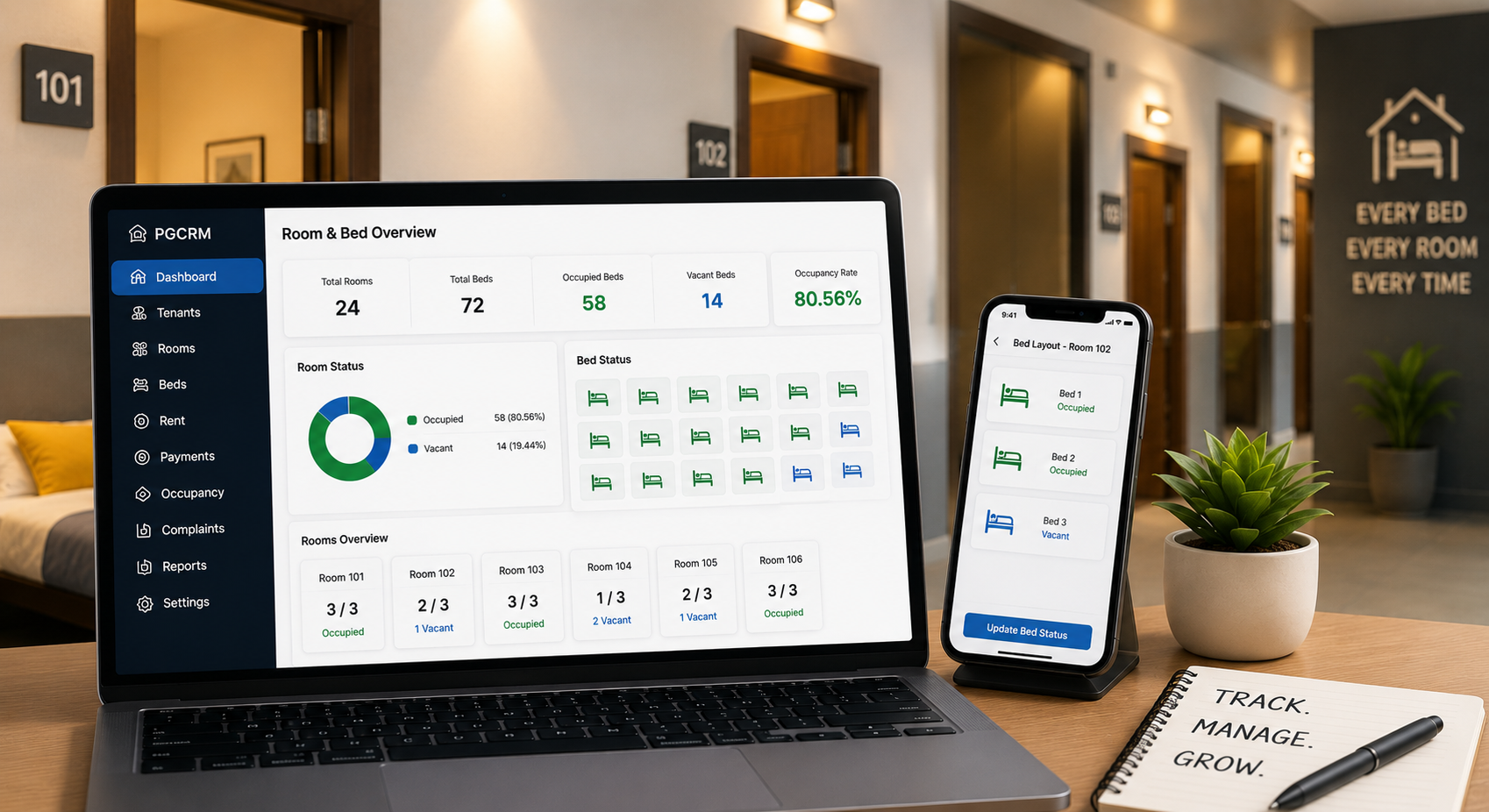
Platforms like PGCRM are built specifically for PG and hostel management, allowing owners to track rent, tenant records, and occupancy from a single system rather than juggling multiple tools.
6. Introduce a Reasonable Late Payment Policy
A late payment policy shouldn’t be punitive, but it should create a mild incentive for tenants to pay on time. This could be a small late fee applied after a defined grace period, clearly communicated in advance.
Key principles for a fair late payment policy:
- Keep the grace period reasonable (commonly 2–3 days)
- Apply the policy consistently to all tenants
- Communicate the exact charge upfront, not after the fact
- Avoid steep penalties that could strain tenant relationships unnecessarily
Consistency matters more than the size of the penalty. Tenants are more likely to respect a policy that is applied fairly across the board.
7. Use Rent Receipts to Build Trust and Accountability
Issuing a receipt — digital or physical — for every rent payment builds transparency between the owner and tenant. It also protects both parties in case of disputes about whether a payment was made.
Digital receipts, generated automatically through management software, save time and eliminate the risk of lost paper records. They also give tenants a clear, timestamped confirmation, which can reduce follow-up questions about payment status.
8. Simplify KYC and Onboarding to Avoid Payment Confusion
Payment issues sometimes stem from incomplete or unclear tenant onboarding. If KYC details, agreed rent amount, or payment terms aren’t properly documented at move-in, confusion can arise later about how much is owed or when.
A thorough onboarding process should include:
- Verified tenant identification and contact details
- Agreed rent amount and due date, documented clearly
- Security deposit terms
- Room and bed assignment details
Centralising KYC management alongside rent tracking, as PGCRM allows, ensures that tenant and payment information stay linked and easy to reference whenever a question comes up.
9. Track Occupancy and Rent Status Together
Occupancy and rent collection are closely connected. If a bed is marked occupied but no rent has been logged against it, that’s a red flag worth investigating early rather than at the end of the month.
Reviewing occupancy and rent status together helps owners:
- Spot unpaid or partially paid tenants quickly
- Avoid confusion between vacant and occupied beds
- Reconcile actual occupancy against expected monthly revenue
This kind of cross-checking is far easier with a system that links room, bed, and rent data, rather than managing occupancy in one register and payments in another.
10. Review Rent Collection Reports Monthly
Reviewing your rent collection performance every month helps identify patterns, such as tenants who consistently pay late or months where collection rates dip. This insight allows you to address issues proactively rather than repeatedly reacting to the same problems.
A basic monthly review should look at:
- Total rent expected vs. rent collected
- Number of late payments and by how many days
- Tenants with repeated late payment history
- Any outstanding dues carried over from previous months
Reports and analytics tools, available in most PG management platforms, can generate this data automatically instead of requiring manual calculation from spreadsheets or registers.
Manual vs Software-Based Rent Collection
| Aspect | Manual Process | Software-Based Process |
|---|---|---|
| Tracking payments | Registers or spreadsheets | Centralised digital records |
| Sending reminders | Manual calls or messages | Automated reminders |
| Payment methods | Often cash-only | Cash and UPI both supported |
| Receipts | Handwritten or none | Digital, instant |
| Reporting | Manual calculation | Automated reports |
| Error risk | Higher, due to manual entry | Lower, with digital logs |
As the table shows, the core difference isn’t just convenience — it’s the reduction in manual effort and error that comes with a structured, digital approach to PG rent collection.
Bringing It All Together
None of these strategies works in isolation. A clear policy means little without consistent reminders. Digital records are only useful if they’re actually kept up to date. The real improvement in PG rent collection comes from combining these practices into a consistent, repeatable system rather than treating them as one-off fixes.
This is why many PG and hostel owners eventually move from manual tracking to dedicated management software — not because manual methods can’t work, but because they become harder to sustain as the number of tenants grows.
Frequently Asked Questions
What is the best way to collect PG rent on time? The most effective approach combines a clear rent policy, a fixed due date, multiple payment options, and timely reminders before the due date. Using PG management software to automate reminders and track payments further reduces the chances of delays and manual tracking errors.
How can I remind tenants about rent without being pushy? Send a friendly reminder a few days before the due date rather than waiting until rent is overdue. Automated reminders through management software feel more neutral and consistent than personal phone calls, reducing awkwardness for both owners and tenants.
Should PG owners charge a late fee for delayed rent? A reasonable late fee, applied consistently after a short grace period, can encourage timely payment. It should be communicated clearly at the time of tenant onboarding so there’s no confusion or disagreement when it’s applied.
What payment methods should PG owners accept? At minimum, owners should accept cash and UPI, since these are the most commonly used methods among PG tenants. Offering multiple options reduces excuses for delayed payment and makes it easier for tenants to pay promptly.
How does PG management software help with rent collection? PG management software centralises tenant records, rent tracking, and payment reminders in one system. This reduces manual follow-up, minimises errors from spreadsheets or registers, and gives owners a clear, real-time view of who has paid and who hasn’t.
How can I track which tenants have paid and which haven’t? Maintaining a centralised digital record of rent status, updated as payments come in, is the most reliable method. This avoids the errors common with paper registers and lets owners check payment status instantly instead of cross-referencing multiple sources.
Is it necessary to issue rent receipts to tenants? Yes. Rent receipts, whether digital or physical, create a clear record of payment for both the owner and tenant. They help prevent disputes about whether or when a payment was made and add a layer of transparency to the rent collection process.
Conclusion
Consistent PG rent collection comes down to clarity, convenience, and consistency — a clear policy, convenient payment options, and a consistent system for reminders and tracking. Applying even a few of these ten strategies can noticeably reduce late payments and the time spent chasing them down. As your PG or hostel grows, managing this manually becomes harder to sustain. Explore PGCRM to simplify your PG and hostel management, from rent tracking and reminders to tenant records and occupancy, all in one place.