
Introduction
Knowing how much rent came in last month is useful, but it doesn’t tell you what to expect next month or how to plan for a slow season before it hits. PG income forecasting fills that gap, giving you a realistic projection based on your actual occupancy patterns, rent levels, and seasonal trends rather than assuming next month will simply look like the last one. PG and hostel management software that keeps accurate rent and occupancy records makes forecasting far more reliable, since projections are only as good as the historical data behind them.
This guide walks through how to forecast monthly income for a PG business, what factors to account for, and how to use the forecast to plan.
What PG Income Forecasting Actually Involves
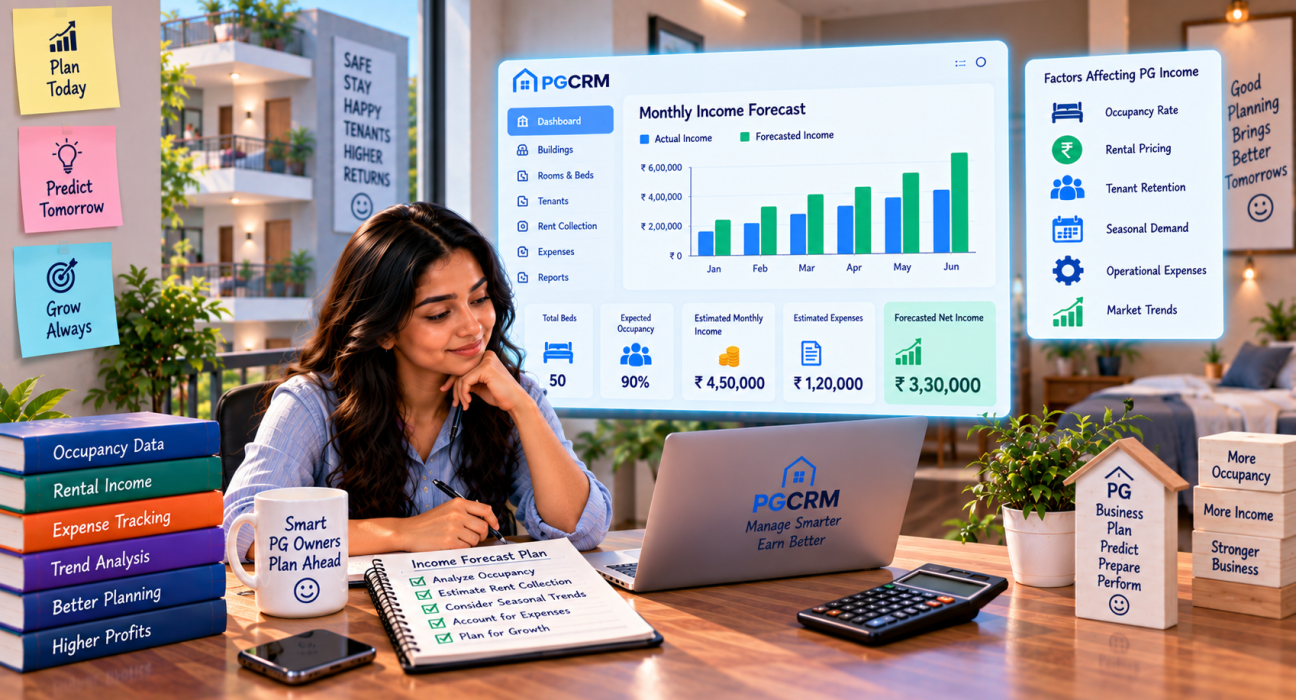
Direct answer: PG income forecasting is the process of estimating your expected rental income for an upcoming period, based on current occupancy, expected move-ins and move-outs, seasonal patterns, and historical collection trends — rather than simply assuming full rent collection at full occupancy.
A forecast isn’t a guarantee. It’s a realistic estimate that helps you plan cash flow, staffing, and expenses with more confidence than guessing.
Why Forecasting Matters for a PG Business
- Cash flow planning: Knowing roughly what’s coming in helps you plan for expenses like maintenance, staff salaries, or loan payments.
- Early warning for slow periods: Forecasting ahead of academic breaks or off-peak seasons helps you prepare rather than react.
- Better decision-making on expansion: A reliable forecast for your current property supports more grounded projections when evaluating a new one.
- Clearer budgeting: Comparing forecasted income against fixed and variable costs shows whether you’re on track to stay profitable.
Without forecasting, many owners only discover a cash flow gap after it has already become a problem.
Step 1: Gather Your Historical Data
Direct answer: Accurate forecasting starts with reviewing at least the past three to six months of actual rent collection, occupancy levels, and any seasonal patterns, since this history forms the basis for realistic projections rather than guesses.
Look specifically for:
- Actual rent collected each month, not just listed rent rates.
- Occupancy trends, including any recurring dips or spikes.
- Payment timing patterns, such as how many tenants typically pay late.
- Tenant turnover patterns, particularly around academic or seasonal cycles.
Step 2: Account for Current and Expected Occupancy
Start with your current occupancy as a baseline, then adjust for known changes.
- Confirm current occupied beds and their rent amounts.
- Factor in any known move-outs, including notice periods already given.
- Estimate likely move-ins, based on current enquiries or historical turnaround time for vacant beds.
- Adjust for beds likely to remain vacant, rather than assuming every empty bed fills immediately.
Step 3: Factor in Seasonal and Cyclical Patterns
PGs near educational institutions or job hubs often see predictable occupancy shifts.
- Academic breaks: Expect potential dips if a large share of tenants are students.
- Job relocation seasons: Some cities see turnover spikes tied to hiring cycles.
- Local events or demand shifts: Nearby developments, new colleges, or business openings can shift demand in either direction.
Reviewing your own historical data for these patterns is more reliable than assuming a generic seasonal trend applies to your specific property.
Step 4: Adjust for Collection Reliability
Direct answer: Forecasted income should reflect realistic collection rates, not just listed rent multiplied by occupied beds, since late payments, partial payments, and occasional missed rent are common even in well-managed PGs.
Review your historical collection rate and the percentage of billed rent actually collected on time and apply that percentage to your forecast rather than assuming 100% collection every month.
Step 5: Build the Forecast
Illustrative Example (Hypothetical Numbers)
To demonstrate the process, consider a simplified example using illustrative figures:
- Currently occupied beds: 18, generating ₹5,000 each = ₹90,000
- Expected new move-ins next month: 2 beds at ₹5,000 = ₹10,000
- Known move-outs next month: 1 bed, reducing income by ₹5,000
- Historical collection rate: 95%
Raw projected income = ₹90,000 + ₹10,000 − ₹5,000 = ₹95,000
Adjusted forecast = ₹95,000 × 0.95 = ₹90,250
This hypothetical scenario results in a forecasted income of approximately ₹90,250 for the month, factoring in expected occupancy changes and a realistic collection rate rather than assuming perfect payment.
This example uses made-up figures purely to illustrate the process. Apply your own occupancy, rent, and collection data to build a forecast relevant to your property.
Forecasting Components at a Glance
| Component | What to Include | Why It Matters |
|---|---|---|
| Current occupied beds | Existing tenants and their rent amounts | Establishes your income baseline |
| Expected move-ins | Confirmed or likely new tenants | Adds anticipated income |
| Known move-outs | Tenants who’ve given notice | Subtracts expected income loss |
| Seasonal adjustments | Historical patterns for the period | Accounts for predictable demand shifts |
| Collection rate | Percentage of billed rent typically collected | Prevents overstating the forecast |
How to Use Your Forecast Once It’s Built
1. Compare Against Fixed and Variable Costs
Once you have a forecasted income figure, compare it against your expected costs for the same period to see whether you’re projected to stay profitable.
2. Plan for Shortfalls in Advance
If your forecast shows a likely gap during a slow season, you can plan by adjusting marketing efforts, reviewing discretionary expenses, or setting aside a buffer from stronger months.
3. Revisit and Refine Monthly
Forecasts improve with practice. Comparing your forecasted figure against actual results each month helps you identify where your estimates were off and refine your approach going forward.
Common Mistakes in PG Income Forecasting
- Assuming 100% collection, without accounting for historical late or missed payments.
- Ignoring seasonal patterns, treating every month as identical to the last.
- Forecasting only once a year, rather than updating monthly as occupancy and conditions change.
- Overlooking known move-outs, resulting in an overly optimistic projection.
- Relying on listed rent instead of actual historical collections, which tends to overstate expected income.
How PG Management Software Supports Accurate Forecasting
Reliable forecasting depends on having accurate historical data readily available. Using PG management software such as PGCRM can help owners centralise tenant records, rent tracking, occupancy information, and daily operations, making it easier to pull the collection rates, occupancy trends, and rent figures needed to build a realistic forecast.
Specifically, this kind of tracking supports:
- Rent tracking, giving accurate historical collection data rather than relying on memory or scattered records.
- Occupancy tracking, showing move-in and move-out patterns over time.
- Reports, helping identify seasonal trends across multiple months or years.
Without organised historical records, forecasts often rely on rough guesses, which reduces their usefulness for planning ahead with confidence.
Frequently Asked Questions
How far ahead should I forecast income for my PG? A one-month forecast is common for short-term cash flow planning, while a three- to six-month forecast helps with broader budgeting and seasonal preparation. Longer-term forecasts become less reliable the further out they extend, since occupancy and market conditions can shift.
What data do I need to start forecasting PG income? At minimum, you need historical rent collection figures, current occupancy details, known upcoming move-ins or move-outs, and your typical collection rate. Reviewing at least three to six months of history gives a more reliable starting point than a single month’s data.
How do I account for late or missed rent payments in my forecast? Apply your historical collection rate the percentage of billed rent typically collected- to your raw projected income instead of assuming full collection. This adjustment prevents your forecast from overstating expected income.
Should I forecast income for each room type separately? If your PG has significantly different rent rates or occupancy patterns across room types, forecasting separately for each can improve accuracy compared to a single property-wide estimate.
How often should I update my income forecast? Updating your forecast monthly, using the most recent occupancy and collection data, keeps projections realistic as conditions change, rather than relying on an outdated estimate built several months earlier.
Can income forecasting help with PG expansion decisions? Yes, a reliable forecast for your current property provides a realistic reference point when estimating potential income for a new property, helping you set more grounded expectations before committing to expansion.
Conclusion
PG income forecasting turns guesswork into a realistic projection by combining current occupancy, expected changes, seasonal patterns, and historical collection rates. Building this habit monthly helps you plan cash flow and catch potential shortfalls before they become urgent problems. Explore PGCRM to simplify your PG and hostel management, and keep the rent and occupancy data you need for accurate forecasting organised in one place.