
Introduction
Rent collection gets most of a PG owner’s attention, but expenses are just as important to track – and often far less organised. Electricity bills, staff salaries, maintenance costs, and grocery purchases can pile up across different receipts, apps, and notebooks, making it hard to know where the money actually goes each month.
This guide breaks down PG business expenses into clear categories, explains how to track them without losing receipts or details, and shows how PG and hostel management software can help owners keep expense records alongside rent and occupancy data instead of managing them separately.
Why Tracking PG Business Expenses Matters
Rent collection tells you how much money comes in. Expense tracking tells you how much of that actually stays as profit. Without a clear view of costs, it’s easy to assume a PG is doing well simply because rent collection looks steady, while rising expenses quietly eat into margins.
This gap between “rent collected” and “actual profit” is where many PG owners get an inaccurate picture of their business. A property can show full occupancy and on-time rent every month while still losing money if utility bills, food costs, or maintenance expenses have crept up unnoticed. Expense tracking closes that gap by making the real cost of running the property visible, not just assumed.
Accurate expense tracking helps owners:
- Understand true monthly profitability, not just rent collected
- Spot unusual spikes in costs (like a sudden jump in electricity bills)
- Plan for recurring and seasonal expenses in advance
- Make informed decisions about rent pricing or cost-cutting
- Keep organised records for tax filing and financial planning
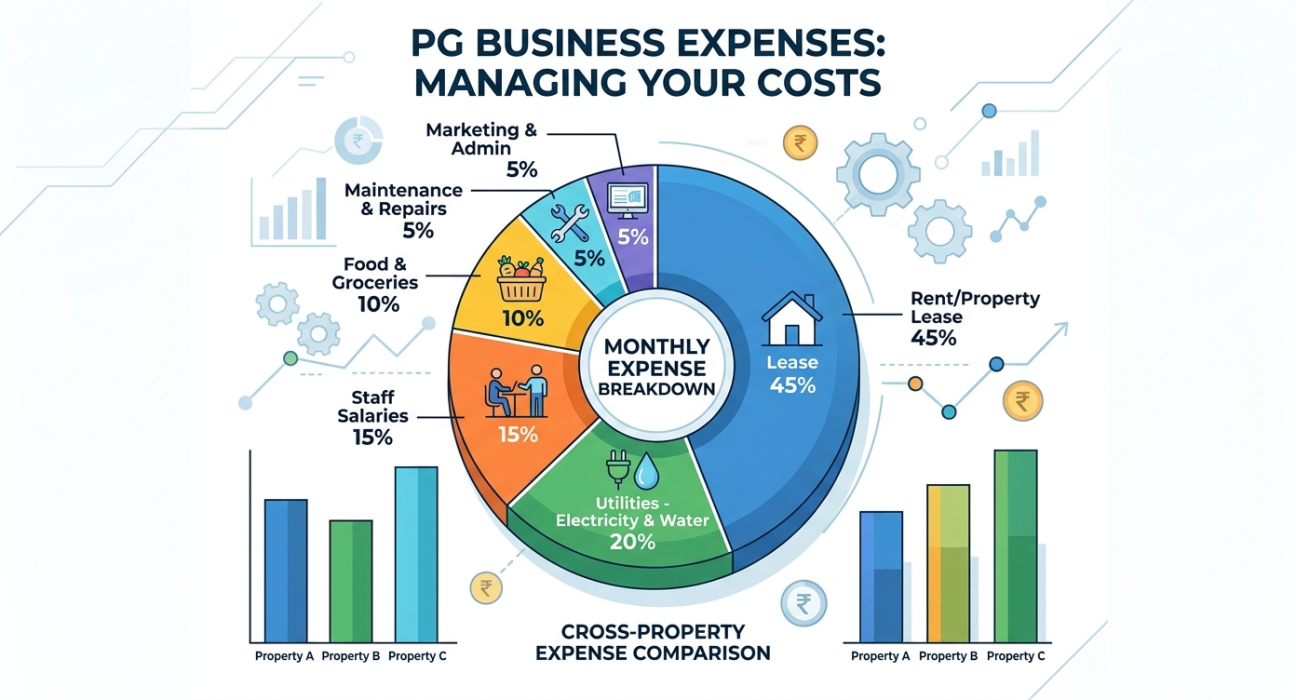
Common Categories of PG Business Expenses
Understanding where money typically goes makes it easier to build a tracking system that covers everything, rather than missing categories along the way.
1. Fixed Monthly Costs
These recur every month regardless of occupancy:
- Property rent or loan EMI (if the property is leased or financed)
- Staff salaries (wardens, cooks, cleaning staff, security)
- Internet and cable/DTH subscriptions
- Software or tool subscriptions used to run the business
2. Utility Expenses
Utility costs often fluctuate with occupancy and season:
- Electricity
- Water supply or tanker charges
- Cooking gas (LPG)
- Waste management or municipal charges
3. Food and Kitchen Costs
For PGs offering meals, food is usually one of the largest expense categories:
- Groceries and raw materials
- Kitchen staff wages (if tracked separately from general staff)
- Kitchen equipment and utensils
4. Maintenance and Repairs
- Plumbing and electrical repairs
- Furniture and appliance repairs or replacement
- Pest control
- General housekeeping supplies
5. Administrative and Miscellaneous Costs
- Stationery and printing (for KYC forms, receipts, notices)
- Bank charges or payment gateway fees
- Marketing costs (listing fees, local advertising)
- Legal or compliance-related costs
PG Expense Categories at a Glance
| Category | Examples | Typical Frequency |
|---|---|---|
| Fixed costs | Rent/EMI, salaries, subscriptions | Monthly |
| Utilities | Electricity, water, gas | Monthly, occupancy-linked |
| Food and kitchen | Groceries, kitchen wages | Daily/weekly purchases |
| Maintenance | Repairs, pest control | As needed |
| Administrative | Printing, bank fees, marketing | Occasional |
How to Track PG Business Expenses Effectively
Tracking expenses well comes down to recording costs consistently, categorising them clearly, and reviewing them regularly rather than only at tax time.
Step 1: Record Expenses as They Happen
The most common reason expense tracking falls apart is delayed entry. A grocery bill paid in cash on Tuesday but noted “sometime this week” often gets forgotten, misremembered, or lost. Recording each expense on the day it happens, even briefly, keeps the data accurate.
Step 2: Categorise Every Expense
Group expenses into consistent categories (like the ones above) rather than lumping everything into a single “expenses” total. Categorised data makes it possible to see, for example, that utility costs jumped 20% in a particular month, instead of just seeing a higher total with no explanation.
Step 3: Separate Property Expenses from Personal Spending
Mixing personal and business expenses is a common issue for PG owners running the business themselves. Keeping a dedicated account or clearly separated records for the PG makes profitability calculations far more accurate and simplifies tax filing.
Step 4: Reconcile Expenses Against Rent Collection Monthly
At the end of each month, compare total expenses against total rent collected. This single comparison gives a quick, honest picture of whether the property is actually profitable that month, not just whether rent came in on time.
Step 5: Review Trends, Not Just Totals
A single month’s expense total doesn’t tell you much on its own. Reviewing expenses over three to six months reveals patterns — seasonal utility spikes, rising food costs, or maintenance issues that keep recurring in the same area. For example, electricity costs often climb during summer months due to fan and cooler usage, and spotting that pattern in advance helps an owner budget for it rather than being caught off guard when the bill arrives.
Common Mistakes in Managing PG Business Expenses
- Tracking rent closely but expenses loosely. Many owners have a clear rent register but only a rough idea of monthly costs.
- Not separating fixed costs from variable ones. This makes it harder to know which costs will stay the same regardless of occupancy and which will change.
- Losing receipts or relying on memory. Cash expenses in particular tend to go unrecorded without a consistent habit of logging them immediately.
- Reviewing expenses only during tax season. By then, it’s too late to catch and correct issues that happened months earlier.
How PGCRM Supports Expense Management
PGCRM includes expense tracking alongside rent collection, occupancy, and tenant management, so owners can see costs and income from the same dashboard instead of maintaining a separate spreadsheet for expenses. Using PG management software such as PGCRM can help owners record expenses as they happen, categorise them consistently, and compare them against rent collection without manually pulling data from multiple sources.
FAQ
What are the main categories of PG business expenses?
The main categories include fixed monthly costs (rent, salaries, subscriptions), utilities (electricity, water, gas), food and kitchen costs, maintenance and repairs, and administrative expenses like printing or bank charges. Grouping expenses this way makes it easier to spot which costs are rising and why.
How can I track PG business expenses without losing receipts?
Record each expense the same day it happens, even briefly, instead of relying on memory or a pile of receipts. Using a centralised system to log expenses digitally as they occur – rather than collecting paper receipts to sort later – significantly reduces the chances of losing or forgetting entries.
What’s the biggest expense in most PG businesses?
This varies by property, but food and kitchen costs are often among the largest for PGs offering meals, followed by staff salaries and utility bills. Fixed costs like rent or loan EMI can also be significant, especially for leased properties.
How often should I review my PG business expenses?
Reviewing expenses monthly helps catch unusual spikes early, while a broader review every three to six months reveals longer-term patterns like seasonal utility increases or recurring maintenance issues. Waiting until tax season to review expenses often means missing problems that owners could have caught and addressed months earlier.
Should I separate personal and business expenses for my PG?
Yes. Mixing personal and PG-related spending makes it difficult to calculate true profitability and complicates tax filing. Keeping a dedicated account or clearly separated records for the property gives a more accurate picture of how the business is actually performing.
Can expense tracking help me set better rent prices?
Yes. Understanding your actual monthly costs, not just rent collected, shows whether current rent pricing covers expenses with a reasonable margin. Without this visibility, it’s easy to underprice rent relative to rising utility, food, or maintenance costs.
Conclusion
PG business expenses rarely get the same attention as rent collection, but they determine whether a property is actually profitable. Recording costs consistently, organising them into clear categories, and reviewing them regularly turns a vague sense of “spending too much” into a clear picture of where money goes each month. If expense tracking has become scattered across receipts and spreadsheets, explore PGCRM to see how a PG and hostel management platform can bring expenses, rent, and occupancy data together in one place.