
If you’ve ever launched a Google Ads or Facebook Ads campaign only to watch your budget disappear with little to show for it, you already understand why so many businesses turn to PPC management services. Pay-per-click advertising looks simple on the surface – set a budget, pick some keywords, write an ad, and wait for clicks. In practice, running a profitable campaign requires constant testing, bid adjustments, audience research, and data analysis that most in-house teams simply don’t have time for.
PPC management services solve this problem by putting your advertising in the hands of specialists who plan, execute, and continuously optimize your paid campaigns. Whether you’re a startup trying to generate your first leads or an established company looking to scale ad spend without wasting money, understanding what these services actually include – and how to choose the right provider – can make the difference between a campaign that burns cash and one that consistently delivers customers.
This guide breaks down what PPC management services are, what’s typically included, how much they cost, and how to decide whether outsourcing your PPC makes sense for your business.
What Are PPC Management Services?
PPC management services refer to the professional planning, execution, and ongoing optimization of pay-per-click advertising campaigns on behalf of a business. This typically covers platforms like Google Ads, Microsoft Advertising (Bing Ads), Meta Ads (Facebook and Instagram), LinkedIn Ads, and Amazon Ads.
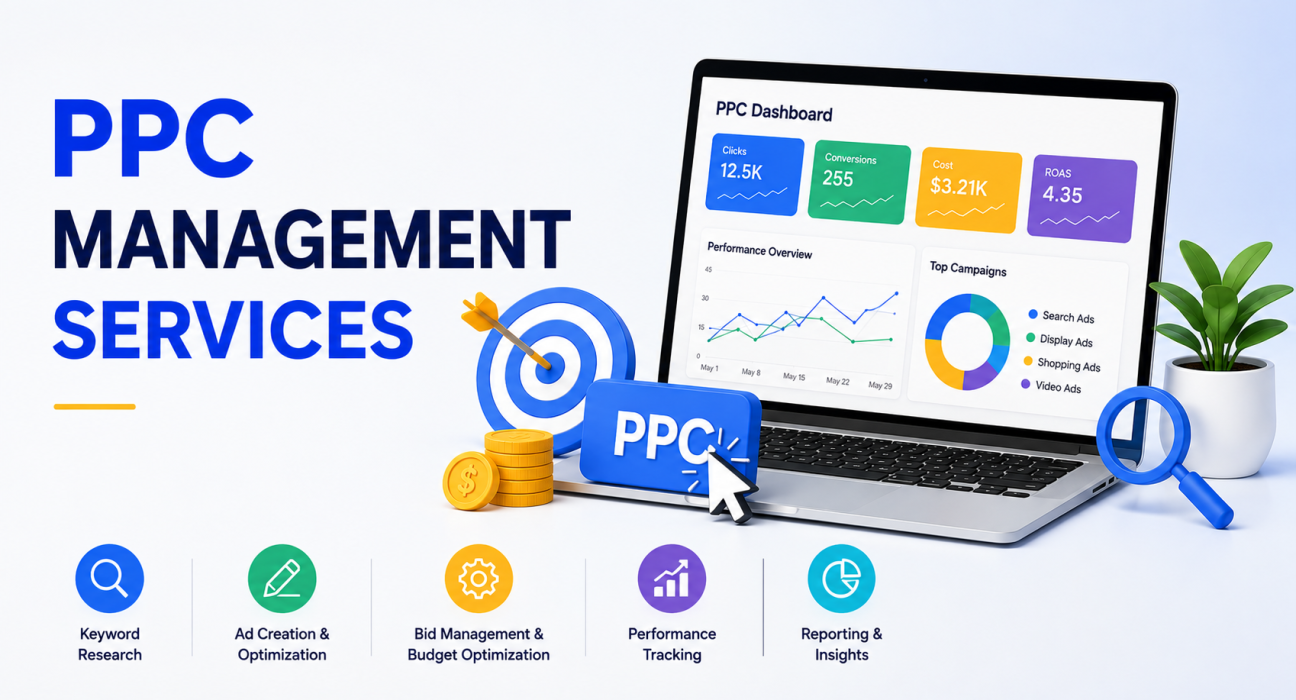
Rather than handling campaigns internally, businesses hire a PPC agency, freelance specialist, or in-house consultant to manage keyword research, ad creation, bid strategy, budget allocation, landing page alignment, and performance reporting. The goal is straightforward: get the best possible return on ad spend (ROAS) while minimizing wasted budget.
PPC management is different from simply “running ads.” It’s an ongoing, data-driven process that involves regular adjustments based on performance data, market changes, and competitor activity.
What’s Included in PPC Management Services?
Most professional PPC management services follow a similar core structure, even if the specific tactics vary by platform or industry.
1. Account Audit and Strategy Development
Before any campaign launches, a PPC manager typically audits existing accounts (if any) and builds a strategy based on business goals, target audience, budget, and competitive landscape.
2. Keyword Research and Targeting
This involves identifying the search terms, audiences, or placements most likely to convert. It includes:
- Identifying high-intent keywords
- Filtering out irrelevant or low-quality search terms
- Building negative keyword lists to avoid wasted spend
- Researching audience demographics and interests for platforms like Meta and LinkedIn
3. Ad Copywriting and Creative Development
PPC managers write and test ad copy, headlines, and calls to action. For visual platforms, this may also include designing banner ads, video ads, or product feed optimization for shopping campaigns.
4. Campaign Setup and Structuring
Proper campaign structure affects performance significantly. This includes organizing campaigns and ad groups logically, setting appropriate match types, and configuring conversion tracking correctly from day one.
5. Bid Management and Budget Optimization
PPC managers monitor and adjust bids to control cost-per-click and cost-per-acquisition, reallocating budget toward what’s working and away from underperforming keywords or placements.
6. Landing Page Recommendations
Since ad performance is closely tied to the page a visitor lands on, many PPC services also review or recommend improvements to landing pages to improve conversion rates.
7. A/B Testing
Continuous testing of headlines, images, ad formats, and calls to action helps identify what resonates best with the target audience.
8. Performance Tracking and Reporting
Regular reports typically cover metrics like click-through rate (CTR), cost per click (CPC), conversion rate, cost per acquisition (CPA), and return on ad spend (ROAS), along with recommendations for the next optimization cycle.
How PPC Management Services Improve Your Advertising
They Reduce Wasted Ad Spend
One of the most common problems with self-managed PPC campaigns is budget waste on irrelevant clicks. Professional PPC managers actively monitor search term reports and audience data to eliminate spend on traffic that’s unlikely to convert.
They Bring Platform Expertise
Google Ads, Meta Ads, and other platforms update their algorithms, bidding options, and ad formats frequently. PPC specialists stay current with these changes and know how to use new features – like automated bidding strategies or performance max campaigns – effectively.
They Save Internal Time and Resources
Running PPC well requires daily or weekly attention. Outsourcing this work frees up internal marketing teams to focus on strategy, content, and other priorities instead of manually monitoring bids and reports.
They Improve Campaign Structure
Poorly structured campaigns are one of the biggest reasons PPC underperforms. Experienced PPC managers build account structures that make optimization easier and more accurate over time.
They Provide Data-Driven Decision Making
Instead of guessing which keywords or audiences work best, PPC management services rely on continuous testing and performance data to guide budget decisions.
They Scale Campaigns More Effectively
As a business grows, PPC campaigns need to scale without losing efficiency. Experienced managers know how to increase budgets while maintaining or improving cost-per-acquisition.
Common Types of PPC Campaigns Managed
| Campaign Type | Common Platform | Best For |
|---|---|---|
| Search Ads | Google Ads, Microsoft Ads | Capturing high-intent search traffic |
| Shopping Ads | Google Shopping, Meta | E-commerce product sales |
| Display Ads | Google Display Network | Brand awareness, retargeting |
| Social Media Ads | Meta, LinkedIn, TikTok | Audience targeting, lead generation |
| Video Ads | YouTube, Meta | Brand storytelling, product demos |
| Remarketing/Retargeting | Google, Meta | Re-engaging past website visitors |
How Much Do PPC Management Services Cost?
PPC management pricing varies significantly based on the provider, ad spend, and scope of work. Common pricing models include:
- Percentage of ad spend – Often a percentage of the monthly budget managed
- Flat monthly retainer – A fixed fee regardless of ad spend
- Performance-based pricing – Fees tied to specific results, such as leads generated
- Hourly consulting rates – Common for smaller, project-based engagements
Because pricing structures and rates vary widely between providers and depend on your specific goals and industry, it’s best to request custom quotes from a few providers and compare what’s included before making a decision. Businesses researching options can use a platform like GoFirms to compare digital marketing agencies and PPC specialists based on their services, focus areas, and client reviews.
How to Choose the Right PPC Management Service
1. Look for Platform-Specific Certifications
Google Ads and Meta Blueprint certifications indicate that a provider has demonstrated platform knowledge, though certification alone doesn’t guarantee results.
2. Ask About Reporting and Transparency
A good PPC partner should provide clear, regular reporting on key metrics and be willing to explain strategy decisions rather than treating campaign management as a “black box.”
3. Evaluate Industry Experience
Providers with experience in your specific industry often understand buyer behavior, seasonal trends, and competitive dynamics more quickly.
4. Understand Their Optimization Process
Ask how often campaigns are reviewed and optimized. Weekly or biweekly optimization is generally more effective than campaigns left untouched for months.
5. Check Communication and Account Access
Make sure you retain ownership and access to your ad accounts, and clarify how often you’ll be able to communicate with the team managing your campaigns.
6. Compare Multiple Providers
Rather than choosing the first agency you find, it’s worth comparing a few options. Platforms like GoFirms allow businesses to research digital marketing and PPC agencies side by side, making it easier to evaluate providers based on services offered, specialties, and client feedback before reaching out.
In-House vs. Outsourced PPC Management
| Factor | In-House Management | Outsourced PPC Management |
|---|---|---|
| Cost | Salary + tools | Agency fee or retainer |
| Expertise | Limited to team’s knowledge | Access to specialized experience |
| Time investment | High, ongoing | Lower internal time investment |
| Scalability | Requires hiring to scale | Easier to scale with agency resources |
| Tools & platforms | Must be purchased separately | Often included in service |
Neither approach is universally “better” – the right choice depends on your budget, internal expertise, and how central PPC is to your overall growth strategy.
Frequently Asked Questions
What do PPC management services typically include? PPC management services typically include keyword research, ad creation, campaign setup, bid and budget management, A/B testing, landing page recommendations, and ongoing performance reporting across platforms like Google Ads and Meta Ads.
How much do PPC management services cost? Costs vary by provider and pricing model, commonly ranging from a percentage of monthly ad spend to flat monthly retainers. It’s best to request quotes from multiple providers to compare pricing against the scope of services offered.
Is it worth hiring a PPC management agency? For businesses without dedicated in-house PPC expertise or time to manage campaigns daily, hiring an agency can reduce wasted spend and improve results. Businesses with strong internal marketing teams may manage PPC effectively in-house instead.
How long does it take to see results from PPC management? Search campaigns can generate traffic almost immediately, but meaningful optimization and stable performance data typically take several weeks to a few months as the account gathers enough data for informed decisions.
What’s the difference between PPC management and SEO? PPC management involves paid advertising with immediate but ongoing costs, while SEO focuses on improving organic search rankings over time without paying per click. Many businesses use both strategies together.
Can small businesses benefit from PPC management services? Yes. Small businesses can benefit from professional PPC management, especially when budgets are limited and every dollar of ad spend needs to be used efficiently rather than spent on trial and error.
How do I know if my current PPC campaigns are underperforming? Signs of underperformance include high cost-per-click without conversions, low click-through rates, budget spent on irrelevant search terms, and a lack of clear reporting from whoever is currently managing the account.
Final Thoughts
PPC management services exist to take the guesswork out of paid advertising. Instead of manually adjusting bids and hoping for the best, businesses gain access to structured strategy, ongoing optimization, and data-driven decision-making that’s difficult to replicate without dedicated expertise.
Whether you manage PPC in-house or choose to outsource it, the key is treating it as an ongoing process rather than a one-time setup. If you’re exploring options for a digital marketing or PPC agency, researching and comparing providers through a platform like GoFirms can help you find a partner whose experience and service offerings align with your specific advertising goals.