
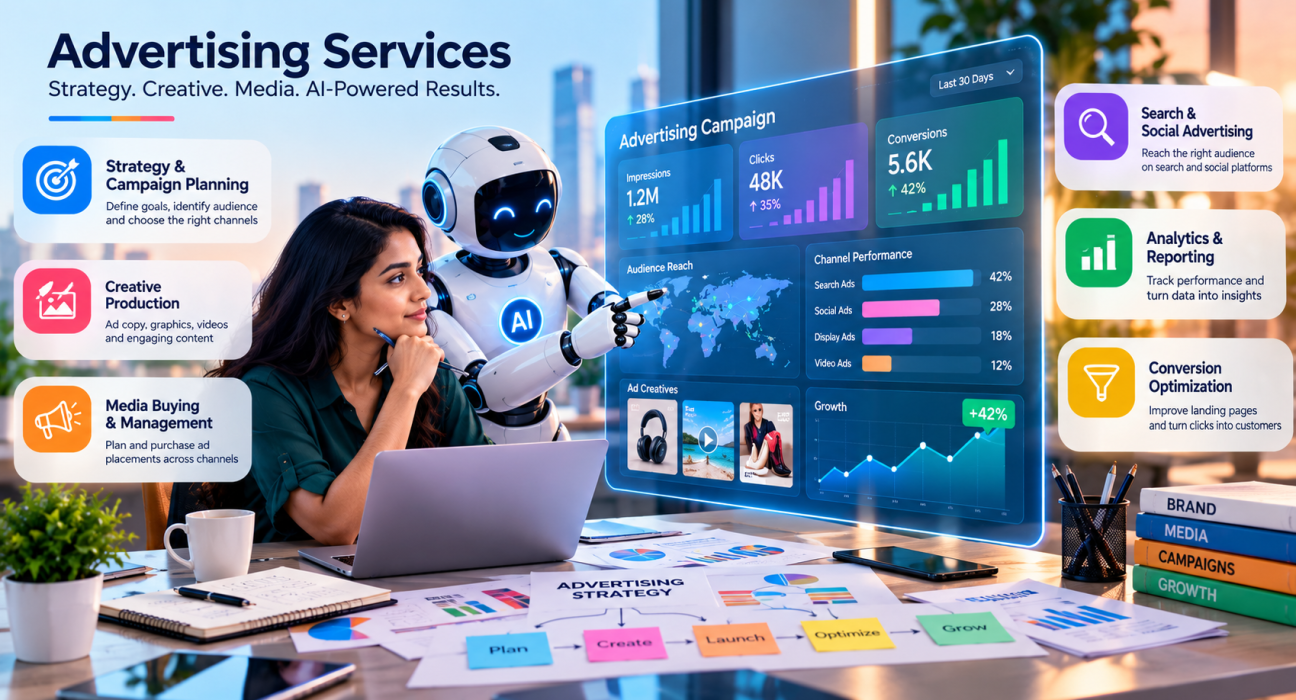
Advertising agencies plan, create, and manage paid and promotional campaigns on behalf of businesses. In short, they research your audience, develop the message and creative, place the media, and measure results so your marketing spend turns into customers.
If you’ve wondered whether you need an agency or whether your in-house team can handle the work, this guide can help. First, it explains what advertising agencies actually do. Then it covers the main types, how they work with clients, and how to choose one. It’s written for founders, marketing managers, and business owners who want a clear picture before spending budget.
What Are Advertising Agencies?
An advertising agency is an external company that helps businesses promote products or services. It combines strategists, creatives, media specialists, and analysts under one roof. As a result, you get skills that would be expensive to hire individually.
However, agencies are not just “ad makers.” Today they often manage the entire path from the first impression to the sale. This can include search, social media, video, display, email, and sometimes offline channels.
What Do Advertising Agencies Do? Core Services
Services vary from one agency to another. Even so, most advertising agencies cover the areas below.
1. Market and audience research
Before spending anything, a good agency studies your market, competitors, and customers. This usually includes:
- Identifying who your best customers are and what they care about
- Reviewing competitor messaging and channels
- Finding gaps your brand can own
2. Advertising strategy and planning
Next, strategy turns research into a plan. The agency defines campaign goals such as awareness, leads, sales, or app installs. It also picks channels, splits the budget, and decides how success will be measured.
3. Creative development
This is the part most people picture. For example, the creative team produces:
- Ad copy and headlines
- Graphics, banners, and social creatives
- Video ads and short-form content
- Landing page concepts
- Brand messaging and taglines
4. Media planning and buying
Meanwhile, media specialists decide where ads appear and negotiate or purchase placements. Depending on your goals, this can include search ads, social platforms, programmatic display, connected TV, and influencer partnerships. Some campaigns also use print, radio, or outdoor placements.
5. Campaign management and optimization
Launching is only the start. After launch, the agency monitors performance, tests creative variations, and adjusts bids and targeting. It then shifts budget toward what works.
6. Analytics and reporting
Agencies track metrics such as click-through rate, cost per lead, cost per acquisition, and return on ad spend. Good ones translate those numbers into decisions rather than sending a data dump.
7. Brand and digital support
In addition, many agencies offer branding, website and landing page work, SEO, content marketing, and social media management. Some are specialists, while others are full-service.
Types of Advertising Agencies
Choosing the right type matters as much as choosing a good agency. The table below compares the most common options.
| Agency type | What it focuses on | Best for |
|---|---|---|
| Full-service agency | Strategy, creative, media, and production under one roof | Larger brands running multi-channel campaigns |
| Creative agency | Concepts, branding, and campaign ideas | Brands needing a strong identity or big idea |
| Digital advertising agency | Paid search, social, display, and online performance | Businesses focused on measurable online results |
| Media buying agency | Planning and purchasing ad placements | Companies with large media budgets |
| Performance marketing agency | Leads, sales, and ROI-driven campaigns | E-commerce, SaaS, and lead-generation businesses |
| Social media agency | Platform-specific content and paid social | Brands building community and engagement |
| Niche or specialist agency | One industry or channel (healthcare, B2B tech, video) | Businesses with specialized compliance or audience needs |
How Do Advertising Agencies Work With Clients?
Most engagements follow a similar rhythm.
- Discovery and briefing. First, you share goals, budget, audience, and past results. The agency then asks questions to fill any gaps.
- Strategy and proposal. Next, the agency presents its approach, channels, timeline, and pricing.
- Creative and setup. After approval, ads, landing pages, tracking, and audiences are built.
- Launch. Campaigns then go live, often starting with small tests.
- Optimization. Afterward, the team refines targeting, creative, and budget based on data.
- Reporting and review. Finally, you get regular updates, plus strategic reviews to plan the next phase.
Typically, you’ll have an account manager as your day-to-day contact. Behind them sit strategists, designers, copywriters, and media buyers.
How Do Advertising Agencies Charge?
Pricing models differ widely, so you should always confirm the details in writing. Common structures include:
- Monthly retainer: A fixed fee for an ongoing scope of work.
- Project-based fee: A set price for a defined campaign or deliverable.
- Percentage of ad spend: The fee scales with your media budget.
- Performance-based fee: Compensation tied partly to results such as leads or sales.
- Hourly rate: Less common, and usually used for consulting or small tasks.
Also ask whether ad spend is billed separately from agency fees. Similarly, check for setup, creative production, or tool charges. Because typical rates change by market and agency size, verify any figures with the agencies you’re considering.
Do You Need an Advertising Agency?
Not every business does. Instead of guessing, use the practical checks below.
When an agency is likely a good fit
An agency usually makes sense if:
- You lack in-house creative or media expertise
- You want to scale campaigns faster than you can hire
- You need an outside perspective on messaging or strategy
- Your campaigns span several channels
- You prefer predictable access to specialists over building a full team
When you may not need one yet
On the other hand, you may want to wait if:
- Your budget is very small and your offer is still unproven
- Your product-market fit is unclear
- You have a capable in-house team with time to run campaigns
- You only need one narrow task, where a freelancer may be enough
A common middle path is to keep strategy and brand decisions in-house. You can then outsource execution, such as paid media or video production.
Benefits and Drawbacks of Hiring Advertising Agencies
Benefits
- Access to specialists across strategy, design, copy, and media
- Faster launches than building a team from scratch
- Experience from working across industries and platforms
- Scalability, since you can increase or reduce effort as needs change
- Familiarity with ad platforms, tools, and benchmarks
Drawbacks
- Retainers and fees add to your total marketing cost
- An agency may not know your product as deeply as your own team
- Quality varies widely between agencies
- Poor communication or unclear goals can waste budget
- You can become dependent on the agency for knowledge and accounts
How to Choose the Right Advertising Agency
Step 1: Define your goals and budget
Start by deciding what success looks like. “More brand awareness” and “50 qualified leads per month” lead to very different agency choices. In addition, set a realistic budget range for both agency fees and media spend.
Step 2: Shortlist agencies with relevant experience
Next, look for experience in your industry, audience type, or channel mix. For instance, a B2B software company has different needs than a local restaurant chain. Directories such as GoFirms can help you browse and compare service providers, including digital marketing and advertising-focused companies, before you start conversations.
Step 3: Review case studies and portfolios
Then look for specifics: the goal, the approach, and the measurable outcome. Be cautious about vague claims without context. Above all, ask for references you can contact.
Step 4: Ask the right questions
During intro calls, ask questions such as:
- Who will work on my account day to day?
- How do you set goals and report results?
- What does your onboarding look like?
- How are fees structured, and what’s excluded?
- How often will we meet?
- Who owns the ad accounts, creative assets, and data?
Step 5: Evaluate fit and communication
Even the best agency on paper can be a poor match if it communicates badly. Therefore, notice how responsive and transparent the team is during the sales process. This often predicts the working relationship.
Step 6: Start with a clear scope
Finally, consider a pilot project or a short initial contract. This lets you test the working relationship and results before committing to a long engagement.
Red Flags to Watch For
Some warning signs appear early. Watch for:
- Guaranteed results (rankings, sales, or ROI) with no caveats
- Unwillingness to share past work or references
- Vague reporting or reluctance to give you account access
- Pressure to sign long contracts immediately
- Hidden fees or unclear pricing
- Generic proposals that ignore your business
Practical Checklist Before You Sign
Before signing, confirm that:
- Goals and KPIs are written down and agreed on
- Scope, deliverables, and timelines are clear
- Fee structure and billing terms are documented
- You own your ad accounts, creative files, and data
- Reporting frequency and format are defined
- There is a clear exit or notice period
Example: How an Agency Might Support a Small Business
Imagine a regional online furniture store with an owner and one marketing assistant. Sales are steady, but growth has stalled. In this case, an agency might:
- Audit the existing ads and website
- Identify the best-performing products and audience segments
- Create new product video ads and seasonal promotions
- Run search and social campaigns with tracked conversions
- Test creative variations and refine targeting
- Report monthly on cost per sale and recommend where to scale
As a result, the business keeps control of its product and pricing while gaining campaign expertise it couldn’t build quickly alone. Note that this is an illustrative scenario, not a guaranteed outcome.
Frequently Asked Questions About Advertising Agencies
What do advertising agencies do?
Advertising agencies plan, create, and manage promotional campaigns for businesses. Their work includes market research, strategy, creative development, media buying, campaign optimization, and performance reporting. Ultimately, the goal is to reach the right audience with the right message and to measure the results.
What is the difference between an advertising agency and a marketing agency?
An advertising agency focuses mainly on paid promotion and campaign creative, such as ads and media placement. A marketing agency, however, usually covers a wider scope, including SEO, content, email, branding, and overall strategy. Because some agencies do both, always check the actual services offered.
How much do advertising agencies cost?
Costs depend on agency size, location, scope, and pricing model, such as retainers, project fees, or a percentage of ad spend. In addition, ad spend is often billed separately from agency fees. Therefore, request detailed proposals from several agencies and compare what each includes.
How long does it take to see results from an advertising agency?
Timelines vary by channel and goal. For example, paid search and social campaigns can generate data within weeks, while brand awareness or content-driven efforts usually take longer. Most agencies also need a testing period to optimize. For that reason, ask for realistic milestones instead of accepting promises of instant results.
Should a small business hire an advertising agency?
It depends on budget, goals, and in-house skills. Small businesses with limited expertise and a proven offer may benefit from specialist support. If your budget is tight or your offer is unproven, however, you might start with freelancers or focused projects before committing to a long retainer.
How do I find advertising agencies near me or in my industry?
Start with referrals, industry networks, and online directories. Platforms like GoFirms let you research and compare digital marketing and related service providers. Then shortlist a few, review their case studies, and hold intro calls to check experience, communication style, and fit.
What should I ask an advertising agency before hiring them?
Ask about relevant experience, who will manage your account, how success is measured, how fees work, and what reporting you’ll receive. Also confirm who owns ad accounts, creative assets, and data. Finally, review the contract terms and exit options.
Conclusion
Advertising agencies bring strategy, creative, media, and analytics together so businesses can promote themselves more effectively than they might alone. Because the right agency depends on your goals, budget, and industry, define what you need first. Then compare specialists carefully, and insist on clear scope, transparent pricing, and measurable reporting.
If you’re ready to shortlist partners, you can use GoFirms to research and compare digital marketing and other service providers. After that, speak with a few before choosing the one that fits your goals.