
Introduction
Food is the one PG expense that touches every tenant, every day. It’s also the one most likely to leak money quietly. A few extra kilos of rice here, a vegetable vendor who rounds up there, a cook who over-orders “just in case,” and by month-end your margin has shrunk without any single bill looking wrong.
Good PG grocery expense management is not about serving smaller portions or cheaper food. It’s about knowing what you spend, buying smarter, cutting waste and checking the numbers every month. This guide covers each step, with simple formulas you can use right away. If you already use PG and hostel management software, you can keep these expense records next to your rent and occupancy data.
Why PG Food Costs Slip Out of Control
Most owners don’t overspend on purpose. Costs creep up because food buying is spread across many small purchases, often made by someone other than the owner.
Common reasons:
- Buying without a menu plan, so quantities are guesses
- Cooks or helpers ordering informally, with no record
- Spoilage from over-buying vegetables, milk and bread
- Leftover food that gets thrown away
- Paying different prices for the same item at different shops
- Cash purchases with no bill or note
- Meals cooked for the full building when half the tenants are away
- No one checking cost per tenant
If three or four of these sound familiar, there’s room to save before you change a single dish.
Step 1: Know Your Real Food Cost Per Tenant
You can’t control a number you’ve never calculated. Start here.
Food cost per tenant per month = total monthly food and grocery spend ÷ number of tenants eating meals
Count only tenants who actually take meals. If some are “room only”, leave them out.
Here’s an example with assumed figures:
| Amount | |
|---|---|
| Monthly grocery, vegetable, milk and gas spend | ₹1,20,000 |
| Tenants eating meals | 40 |
| Food cost per tenant per month | ₹3,000 |
Once you have this number, compare it with what you charge for meals. If you charge ₹3,500 and spend ₹3,000 on groceries, you haven’t counted cook salary, gas, water, utensils or wastage. Track those too, so you know your true margin.
Break the Cost Into Categories
A single total hides the problem. Split spending into groups such as:
- Grains and pulses (rice, atta, dal)
- Vegetables and fruits
- Milk, curd and dairy
- Oil, spices and condiments
- Eggs, meat or fish (if you serve them)
- Cooking gas
- Cleaning and kitchen supplies
When one category jumps, you’ll see it. Vegetable costs rising is a different problem from a gas cylinder running out faster than usual.
Step 2: Plan a Menu You Can Actually Cost
A menu is a budget in disguise. A good one controls spending and keeps tenants happy.
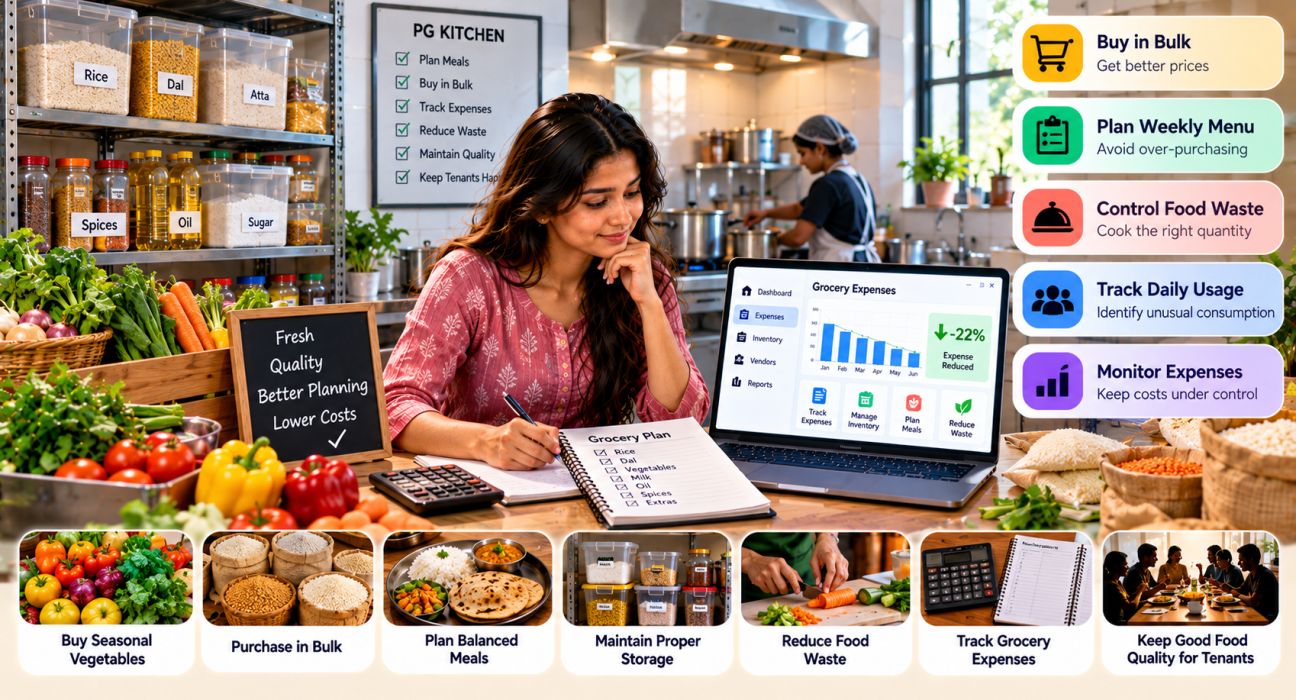
- Make a weekly or fortnightly menu. Repeating cycles make buying predictable.
- Work out the cost of each meal. Estimate the ingredients per serving. You’ll see which dishes are expensive and which are cheap.
- Balance the week. Put costly dishes (paneer, chicken, special sweets) on fewer days and mix them with low-cost, filling meals.
- Use seasonal vegetables. Prices usually fall when something is in season. Plan around what’s cheap.
- Ask your tenants. A short feedback chat tells you which dishes are loved and which are left on the plate.
A menu people like also reduces wastage, which is often where the money goes.
Step 3: Buy Smarter
Where and how you buy matters as much as what you buy.
Compare suppliers.
Don’t depend on one shop forever. Ask for rates from two or three wholesalers or vendors for your main items. You might find that dal, rice and oil are cheaper in bulk, while vegetables are better bought fresh from a local market.
Buy in bulk, but only for non-perishables.
Grains, pulses and oil last long, so bulk buying often makes sense if you have dry, clean storage. Vegetables, milk and bread do not. Overbuying these is how spoilage starts.
Fix a buying schedule.
- Weekly: vegetables and fruits
- Daily: milk, curd, bread (if you have no good storage)
- Monthly: rice, atta, dal, oil, spices
A schedule stops random trips and reduces impulse purchases.
Ask for bills, even from small vendors.
For every purchase, ask for a bill or write down the item, quantity and price in a daily book. This is how you catch price jumps and quantity gaps later.
Step 4: Cut Wastage Where It Starts
Wastage is a cost you pay twice: once to buy the food and again to throw it away.
- Track daily headcount. Cook for the number of people actually eating, not the full building. Ask tenants to inform you when they’re away for a day or two.
- Use first-in, first-out storage. Place new stock behind old stock so older items get used first.
- Store properly. Keep grains in sealed containers, refrigerate perishables and check for pests regularly.
- Note what’s left over. If the same dish keeps coming back unfinished, change the quantity or the recipe.
- Repurpose safely. Use leftover rice or chapati for another meal only if they’ve been stored well and are still safe to eat.
- Reduce plate waste. Smaller, refillable servings often work better than big portions that end up in the bin.
Keep a simple wastage note. Even a few lines a day (what was thrown away and why) shows where the pattern is.
Step 5: Control Who Buys and Who Approves
A lot of grocery leakage is about process, not prices. A few rules help.
- Decide who is allowed to buy. Ideally, one or two people.
- Set a limit. Purchases above a certain amount need your approval.
- Use a stock register. Note what comes in and what is used.
- Check against the menu. If the kitchen buys far more than the menu needs, ask why.
- Do surprise checks. A quick look at stock and bills now and then keeps everyone careful.
This isn’t about distrust. It’s about making sure the numbers always make sense, so small gaps don’t become habits.
Step 6: Review Your Costs Every Month
A monthly review keeps small problems from growing. Here is a simple way to do it.
What to check
- Total food and grocery spend
- Spend by category (grains, vegetables, dairy, gas and so on)
- Food cost per tenant
- Change from last month, and the reason
- Wastage notes
- Meal charges collected against food costs
Manual vs. software-based tracking
| Notebook or loose bills | Tracked in software | |
|---|---|---|
| Finding last month’s spend | Flip through pages and bills. | Look up by date or category. |
| Comparing buildings | Hard to do | It’s easier when expenses are tagged by building. |
| Spotting a sudden jump | Often noticed late | Visible in monthly expense records |
| Sharing with a partner or manager | Photos and messages | One shared record |
If you use PG management software such as PGCRM, you can record expenses by category and building and view expense and income reports. That makes it easier to compare grocery spend against the money you earn from the PG. PGCRM also supports a mess-only admission option, which can help if you run meals for tenants outside your rooms. It doesn’t plan menus or track kitchen stock, so you’ll still need a stock register for that, but it keeps your overall spending clear.
Common Mistakes in PG Grocery Expense Management
- Never calculating cost per tenant. Without it, you can’t tell if you’re profitable on meals.
- Cooking for everyone every day. Absent tenants mean wasted food.
- Buying perishables in bulk. Savings on price vanish when food spoils.
- Relying on one vendor with no comparison. You may be overpaying and not know it.
- Paying cash with no record. Without a note or bill, you can’t check anything later.
- Cutting quality to save money. Tenants notice quickly, and a few move-outs cost more than you saved.
- Skipping the monthly review. Problems stay hidden until they’re big.
FAQ
How can I reduce grocery costs in a PG?
Start by calculating your food cost per tenant. Then plan a repeating menu, compare suppliers, buy non-perishables in bulk, track the daily headcount to cut wastage and keep purchase records. Review the numbers every month so you can catch problems early.
How do I calculate food cost per tenant in a PG?
Add up your monthly spending on groceries, vegetables, dairy and cooking gas, then divide it by the number of tenants who take meals. Leave out room-only tenants. For a fuller picture, also add the cook’s salary and other kitchen costs.
How much should a PG charge for food?
There’s no fixed number, because it depends on your city, menu and tenants. Work out your full food cost per tenant, including salary, gas and wastage, then add a margin. Compare it with nearby PGs offering similar meals before you decide.
How do I reduce food wastage in a hostel or PG?
Cook according to the actual daily headcount, store ingredients properly, use older stock first and note what comes back unfinished. If a dish is often left on the plate, change the recipe or the portion. Even loose tracking of wastage helps you spot patterns.
Should I run my own mess or use a caterer?
Both can work. Your own mess gives control over quality and cost but needs staff and daily management. A caterer saves effort but may cost more and gives you less control. Compare the full monthly cost of each, including salary, gas and wastage, before choosing.
How often should I review PG food expenses?
Review them every month at minimum. Compare spend by category, cost per tenant and any wastage notes. If you’ve just changed suppliers or the menu, check weekly for the first month so you can see the effect quickly.
Conclusion
Strong PG grocery expense management comes down to a few steady habits. Know your cost per tenant, plan a menu you can cost, buy smarter, cut wastage, control who buys and review the numbers monthly. Small changes here protect your margin without touching meal quality.
Clear records make all of this easier. If you’d like rent, occupancy and expense tracking in one place, explore PGCRM to simplify your PG and hostel management.