
Introduction
Ask three people on your staff how to handle a tenant who moves out without notice, and you’ll probably get three different answers. That’s the problem a PG SOP solves.
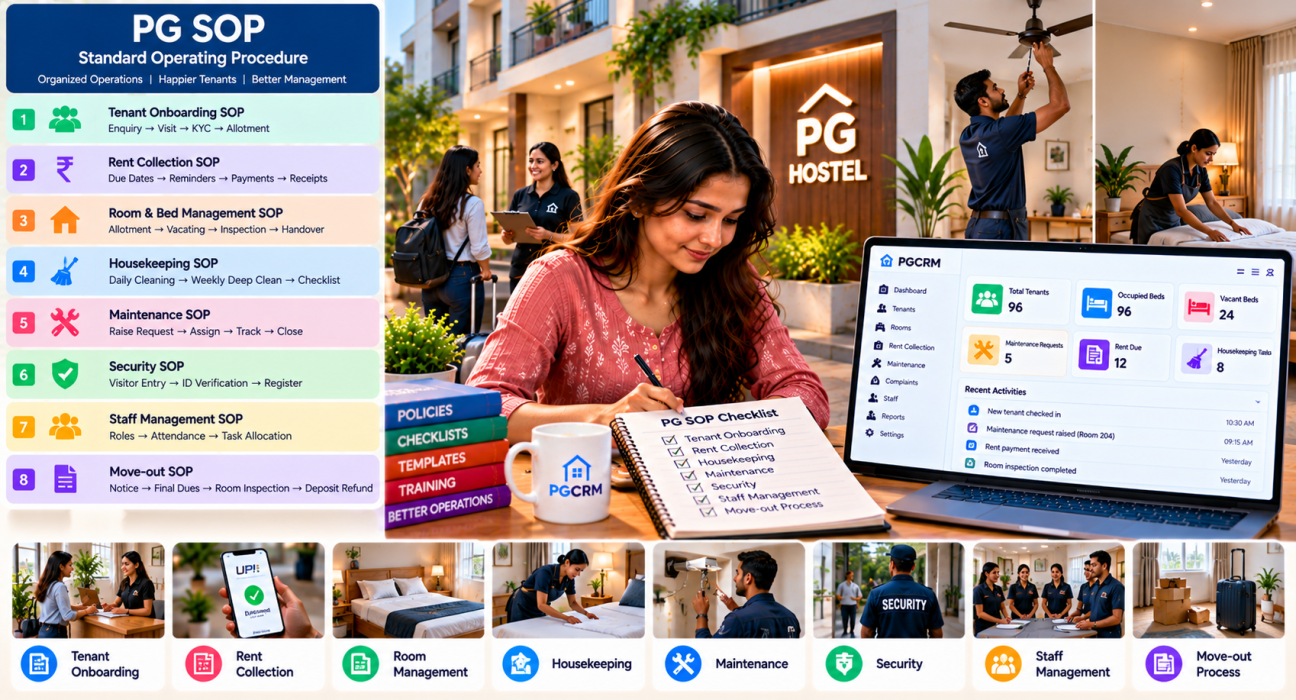
A PG SOP (standard operating procedure) is a written set of steps for the jobs that repeat in your PG, such as move-ins, rent collection, complaints and move-outs. It means the work gets done the same way whether you’re there or not. This guide shows you what to put in one, how to write it in six steps, and how to keep it alive after the first week. You can start in a notebook, and PG and hostel management software can later back it up with records.
What Is a PG SOP?
A PG SOP is a written, step-by-step procedure for a recurring task in your PG, such as onboarding a tenant, collecting rent or closing a complaint. It states who does what, in what order, and what “done” looks like. A good SOP lets any trained staff member do the job correctly without asking the owner.
Think of it as a recipe card. The cook may know the dish well, but when someone new steps in, the card keeps the result the same.
Why Your PG Needs Written SOPs
Most PGs run on memory and habit. That works until it doesn’t. Someone is on leave, a new caretaker joins, or you add a second building. Then small gaps show up fast.
Written procedures help you:
- Train new staff in days instead of months
- Treat every tenant the same way, which cuts arguments
- Stop depending on one person who “knows how it works”
- Catch mistakes early, because you know what the right steps were
- Run more than one building without being everywhere at once
- Handle disputes with something written, not just opinions
Which PG Processes Need an SOP?
You don’t need a hundred documents. Start with the tasks that repeat often or cause the most trouble.
- Tenant move-in and onboarding
- Rent collection and follow-up
- Complaint and maintenance handling
- Housekeeping and cleaning
- Visitor and security rules
- Room shifts
- Tenant move-out and deposit settlement
- Emergency response
- Staff roles and daily routine
- Monthly reporting and review
If you can only do three this month, pick move-in, rent collection and move-out. Money and disputes tend to cluster around those.
How to Build a PG SOP, Step by Step
Step 1: List Every Task and Pick the Priorities
Spend 20 minutes writing down everything that happens in your PG in a normal week. Include the boring jobs. Then mark the ones that:
- Happen often
- Cost money when done wrong
- Cause tenant complaints
- Depend on one specific person
Those become your first SOPs.
Step 2: Watch How the Work Actually Gets Done
Don’t write what you think happens. Write what really happens. Sit with your caretaker for a day, or ask the manager to walk you through a move-in.
You’ll often find extra steps nobody told you about, like a verbal promise to a tenant or a shortcut that causes problems later. Better to learn that now.
Step 3: Write Each Procedure in Plain Steps
Keep the structure the same for every SOP. A simple format works well:
- Purpose: why this procedure exists, in one line
- Who is responsible: one named role
- When it happens: the trigger, such as “when a new tenant arrives”
- Steps: numbered, short, one action each
- Records to update: where the details get written
- Done when: a clear finish line
Use short sentences. Write for the newest person on your team, not the oldest.
Step 4: Assign One Owner Per Process
Every SOP needs a single person responsible. Shared responsibility usually means nobody checks. Decide who does the task, who reviews it and who approves exceptions, and write those roles in the document.
Step 5: Test It With Someone New
Give the draft to a person who hasn’t done the job and ask them to follow it. Where they get stuck, the SOP is unclear. Fix those spots, then try again. This one step improves most procedures a lot.
Step 6: Train, Display and Review
An SOP in a drawer does nothing. Walk your staff through each one, keep a printed copy where they work, and ask them for feedback. Then set a review date, say every quarter, so the document keeps up with how your PG changes.
Sample SOP: Tenant Move-In
Here’s an example you can adapt. It’s illustrative, so change the details to suit your PG.
Purpose: Welcome a new tenant and record everything correctly on day one.
Owner: PG manager
Trigger: A tenant confirms joining.
- Confirm the room, bed and joining date with the tenant.
- Collect the tenant’s ID and KYC documents, and check them against the originals.
- Note the rent, security deposit and billing cycle in writing.
- Collect the first payment and record whether it was cash or UPI.
- Share the house rules, including visitor timings and notice period.
- Do a short room walk-through and note any existing damage.
- Hand over keys and record the handover.
- Add the tenant to your records the same day.
Done when: All documents are saved, payment is recorded and the tenant has acknowledged the house rules.
For verification requirements, such as police or local-authority rules for tenants, check what applies in your city. They vary, so confirm with the relevant local office.
Sample SOP: Rent Collection and Follow-Up
Purpose: Collect rent on time without awkward chasing.
Owner: PG manager, reviewed by owner
Trigger: Start of each billing cycle.
- Send a reminder a few days before the due date.
- On the due date, record each payment as received, with mode (cash or UPI).
- Give a receipt or confirmation for every payment.
- Prepare a pending list the day after the due date.
- Contact each pending tenant personally, not through the group chat.
- Record the promised payment date.
- If dues continue past your grace period, apply the late fee stated in the house rules.
- Escalate long overdue cases to the owner.
Done when: Every payment is recorded, and every pending account has a note and a next step.
Sample SOP: Complaint Handling
Purpose: Fix issues quickly and keep tenants informed.
Owner: Caretaker, reviewed by manager
| Step | Action |
|---|---|
| 1 | Log the complaint: date, room, issue and who reported it |
| 2 | Set a priority: high (safety, no water or power), medium, or low |
| 3 | Assign it to a person with a target date |
| 4 | Tell the tenant who is handling it and when |
| 5 | Update the status as work progresses |
| 6 | Confirm with the tenant that it’s fixed, then close it |
If you want to go deeper on this one, a simple maintenance log makes the process easier to track.
Sample SOP: Tenant Move-Out and Deposit Settlement
Move-outs are where most disputes start, so this SOP matters.
- Confirm the notice was given in writing and note the last day.
- Share the move-out checklist with the tenant early.
- Do a room inspection with the tenant present.
- Compare it against the notes made at move-in.
- Calculate any dues, damage charges or fines, and write out the breakdown.
- Get the tenant’s acknowledgement of the settlement.
- Refund the balance deposit, and record the mode and date.
- Collect keys, mark the bed as vacant and start cleaning.
The more you document at move-in, the easier this becomes.
Do’s and Don’ts When Writing a PG SOP
| Do | Don’t |
|---|---|
| Use numbered, short steps | Write long paragraphs |
| Name one owner per task | Say “the staff will handle it” |
| Use the same format every time | Reinvent the layout for each SOP |
| Include what to record | Leave records to memory |
| Review and update regularly | Treat it as a one-time document |
| Ask staff for input | Write it alone in an office |
| Keep it practical | Add rules nobody will follow |
Where PG Management Software Fits In
An SOP says what should happen. Software helps make sure it actually did. When your records sit in one place, the steps in your procedures become easier to follow and check.
For example, PGCRM lets you add tenants with their KYC and joining date, collect rent by cash or UPI, and take deposits, fines and refunds. It sends automatic rent reminders, handles room shifts, vacates and settlements, and lets you log complaints with priority and a clear status trail. You can also give managers their own logins with limited access, so each person sees only what their role needs. Details are on the PGCRM features page.
That doesn’t replace the SOP. You still decide the process. The software just gives your team one consistent place to do it.
Keeping Your PG SOPs Alive
Many owners write SOPs once and forget them. A few habits keep them useful:
- Hold a short review every quarter. Ask what’s confusing or outdated.
- Update after every mistake. If something went wrong, find the gap in the procedure.
- Keep one master copy. Old versions floating around cause confusion.
- Add new SOPs only when needed. Quality beats quantity.
- Brief new staff on day one. Make SOP training part of joining.
Frequently Asked Questions
What is a PG SOP?
A PG SOP is a written set of steps for a recurring task in your PG, such as move-in, rent collection, complaints or move-out. It names who does what and in what order. It helps different staff members do the same job the same way, so quality doesn’t depend on one person.
What should a PG SOP include?
Include the purpose, the responsible person, the trigger, numbered steps, the records to update and a clear “done” condition. Keep each step short and specific. Add templates or checklists where useful, such as a move-in form. A good SOP is something a new staff member can follow without asking you.
Which PG processes should have an SOP first?
Start with tenant move-in, rent collection and move-out, since they involve money and can lead to disputes. Then add complaint handling, housekeeping, visitor rules and emergency response. Pick the tasks that happen often, cost money when done wrong or depend on one person. You can build the rest over time.
How long should a PG SOP be?
As short as possible while still being clear. Most SOPs fit on one page, with 6 to 10 numbered steps. If a procedure runs longer, split it into smaller ones. Staff are far more likely to follow a short, clear page than a long document that nobody reads.
How often should I update my PG SOPs?
Review them every quarter, and update them whenever something changes, such as a new rule, a new building or a recurring mistake. Ask your staff what’s working and what isn’t. An outdated SOP is worse than none, because people stop trusting it.
Can I manage PG SOPs without software?
Yes. Printed pages and a simple register are enough for a small PG. But as you add tenants, staff or buildings, keeping records consistent gets harder. PG management software helps your team follow the same steps and keeps tenant, rent and complaint records in one place.
Conclusion
A PG SOP doesn’t need to be a thick manual. It needs to be clear, short and used. Start with move-in, rent collection and move-out, write each one in simple numbered steps, test it with someone new and review it every quarter. Within a few months, your PG will run more smoothly and depend less on any single person.
The procedures work best when your records are tidy and in one place. PG management software such as PGCRM can support that, from tenant KYC and rent records to complaints and settlements. Explore PGCRM to simplify your PG and hostel management.