
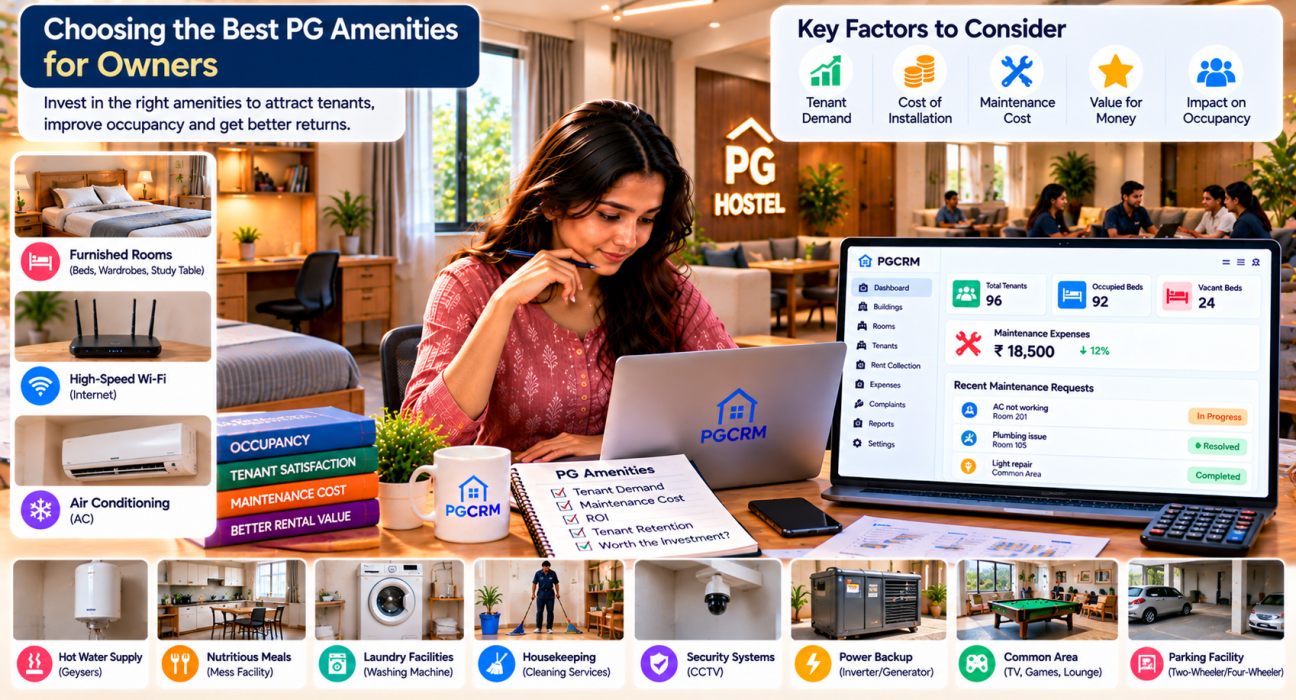
Every PG owner has been tempted. A competitor puts in an AC, a tenant asks for a washing machine, a broker says “everyone has Wi-Fi and a gym now.” Each amenity sounds reasonable. Each also costs money to buy, run and repair, and not every one earns that money back.
The best PG amenities for owners aren’t the longest list on a brochure. They’re the ones that fill beds faster, justify higher rent, or keep tenants from leaving, at a measurable cost. This guide gives you a simple way to judge any amenity before you pay for it, with a worked payback example and a rough ranking of what usually earns its keep. A notebook is enough to run the numbers, and PG and hostel management software helps you check afterwards whether the spending worked.
What Makes a PG Amenity Worth Paying For?
An amenity is worth paying for when the extra rent, extra occupancy or longer stays it creates are greater than its total cost. That total includes the purchase price, running costs such as electricity and water, maintenance, and the cost of replacing it later. If you can’t show a gain bigger than that cost, it’s a luxury, not an investment.
Three questions sort most decisions:
- Will tenants pay more for it, or will it help me fill beds faster?
- Will it keep tenants longer, so I lose fewer rent days between move-outs?
- What does it cost per bed per month, including running and repair costs?
If the answer to the first two is “not sure,” pause before buying.
Start With Your Tenants, Not the Competition
Copying the PG down the road is the most common way to waste money. Their tenants, location and rent may differ from yours.
Before you pick any amenity, find out what your own tenants want. A few simple ways:
- Ask departing tenants why they’re leaving and what they’d have liked
- Ask new tenants what made them choose you, and what almost made them go elsewhere
- Note the questions prospects ask during visits
- Look at your complaints. Repeated complaints show which basics are failing
- Check nearby PGs for what they offer and what rent they charge
Students, working professionals and shift workers all care about different things. A PG near a tech office may value fast Wi-Fi and laundry. One near a college may value study-friendly spaces and affordable food. Your own data beats guesses.
The Four-Tier Amenity Ranking
This is general guidance, not a statistic. Your market may differ, so use it as a starting point.
| Tier | What it covers | Examples |
|---|---|---|
| Must-haves | Tenants expect them. Missing them costs you tenants. | Clean water, reliable power, safe locks, clean bathrooms, a decent bed, mattress and cupboard, basic lighting |
| Strong earners | Often justify higher rent or faster filling | Reliable Wi-Fi, hot water (geyser), clean common areas, laundry access, good food if you offer meals |
| Depends on your market | Pay off only with the right tenants | AC rooms, power backup, attached bathrooms, study tables, parking |
| Usually hard to justify | High cost, low return in most PGs | Gym, indoor games room, large TV lounge, decorative extras |
Notice that the must-haves cost the least and protect you the most. Fix those before spending on anything in the lower tiers.
How to Decide: A Five-Step Method
Step 1: List the Amenities You’re Considering
Write each one down with a purchase or setup cost. Include everything: installation, wiring, furniture, permits.
Step 2: Work Out the Monthly Cost Per Bed
Add up the monthly cost of owning the amenity:
Monthly cost = (upfront cost ÷ useful life in months) + running cost + maintenance
Then divide by the number of beds that benefit. This gives you the cost per bed per month, which is the number to compare against rent.
Step 3: Estimate the Gain Honestly
There are three ways an amenity can pay you back:
- Higher rent per bed
- Higher occupancy, meaning beds fill faster or stay full
- Better retention, meaning fewer move-outs and fewer empty days
Be careful here. Owners often overestimate how much extra rent tenants will pay. Use a cautious number, not the best case.
Step 4: Calculate the Payback Period
Payback (months) = upfront cost ÷ net monthly gain
Net monthly gain is the extra income minus the running and maintenance cost. If payback is longer than the amenity’s useful life, skip it.
Step 5: Test Small Before Spending Big
You don’t have to commit across the whole building. Try the amenity in one room or on one floor first. See whether those beds fill faster or tenants stay longer. If they do, expand. If they don’t, you’ve lost much less.
A Worked Example: Adding AC to Double Rooms
These numbers are made up to show the method. Use your own.
You’re thinking of putting an AC in 6 double-sharing rooms, which is 12 beds.
| Item | Amount |
|---|---|
| Cost per AC with installation | ₹35,000 |
| Total upfront cost (6 ACs) | ₹2,10,000 |
| Useful life | 8 years (96 months) |
| Spread of upfront cost | about ₹2,200 per month |
| Extra electricity (₹1,500 per room) | ₹9,000 per month |
| Servicing (₹250 per room) | ₹1,500 per month |
Now see how the result swings with the rent uplift.
| Scenario | Extra rent per bed | Extra monthly income (12 beds) | Net monthly gain after running and service | Payback |
|---|---|---|---|---|
| Optimistic | ₹2,000 | ₹24,000 | ₹13,500 | about 16 months |
| Cautious | ₹1,000 | ₹12,000 | ₹1,500 | about 140 months |
The same AC is a good investment in one case and a bad one in the other. The only thing that changed is how much more tenants will actually pay. That’s why the test in Step 5 matters, and why you should check what nearby PGs with AC really charge before you buy.
A Smaller Example: Better Wi-Fi
Say a stronger internet connection costs ₹1,500 more per month. If that upgrade stops one tenant from leaving, and a vacant bed would otherwise sit empty for a month at ₹7,000, one saved vacancy covers more than four months of the extra cost. For working-professional PGs, where tenants rely on the internet daily, this kind of amenity often pays for itself through retention rather than higher rent. (Again, the figures are illustrative.)
Amenities That Quietly Cost More Than They Seem
Some features look cheap and aren’t. Watch for:
- High electricity use: ACs, geysers and heavy appliances add to the bill every month
- Constant repairs: cheap fittings that break often
- Staff time: a laundry or gym that needs someone to run it
- Space: a room used for a lounge is a room not earning rent
- Replacement cost: an appliance that dies in three years never really paid back
When in doubt, count the running cost, not just the purchase price.
Safety and Compliance Come First
Some amenities aren’t optional extras. Basic fire safety, working locks, clean drinking water and safe wiring protect your tenants and your property. Requirements vary by city and building type, so check what applies to you with your local authority or a professional.
If you add CCTV, keep cameras to common areas such as entrances and corridors, never inside rooms or bathrooms, and tell tenants about it. Check local rules on recording and privacy.
How to Check Whether an Amenity Worked
After you add something, measure. Compare the numbers for a few months before and after:
- Occupancy: are beds filling faster?
- Rent: did you actually charge more?
- Move-outs: are tenants staying longer?
- Complaints: did they go up or down?
- Running cost: is the real cost close to your estimate?
This is where record-keeping pays off. A tool like PGCRM shows occupancy, income and expense reports, records expenses by category and building so you can see what an amenity really costs to run, and logs complaints with a priority and status trail, so you can see whether an amenity is solving problems or creating them. It also shows which beds are full, free or under repair. You can see the details on the PGCRM features page.
The software doesn’t choose your amenities for you. It gives you the before-and-after numbers to judge them.
Common Mistakes When Choosing PG Amenities
- Copying competitors without checking your own tenants
- Spending on luxuries before fixing basics
- Ignoring running costs and looking only at the purchase price
- Assuming tenants will pay more without testing
- Buying everything at once instead of piloting
- Never measuring whether it worked
Frequently Asked Questions
What are the best PG amenities for owners to invest in?
Start with the basics tenants expect: clean water, reliable power, safe locks, clean bathrooms and comfortable beds. Then consider reliable Wi-Fi, hot water and tidy common areas, which often help fill beds and keep tenants. Add costlier items like AC only after checking that tenants in your area will pay more for them.
How do I know if an amenity is worth the cost?
Compare its monthly cost per bed against the extra rent, occupancy or retention it brings. Include the purchase price, running costs and maintenance. Then calculate the payback period by dividing the upfront cost by the net monthly gain. If payback is longer than the amenity’s useful life, it’s probably not worth it.
Does adding AC always increase PG rent?
Not always. It depends on your location, climate and tenant type, and on whether competing PGs charge extra for it. AC also raises your electricity and servicing costs. Check what nearby PGs charge, try it in one or two rooms first and calculate the payback before installing it everywhere.
Is Wi-Fi a must-have amenity in a PG?
For most PGs, especially those housing working professionals and students, reliable internet is close to a must-have. Slow or unreliable connections are a common reason tenants complain or leave. Paying for a stronger connection often costs less than the rent lost from a single early move-out.
Which PG amenities are usually not worth the money?
Gyms, game rooms and large entertainment lounges often cost a lot to set up and use space that could earn rent, while only some tenants use them. They can make sense in certain premium or co-living setups, but check demand and calculate payback first.
How can I test a new amenity before investing fully?
Pilot it in a small area, such as one floor or a few rooms. Track whether those beds fill faster, whether tenants pay the extra rent and whether they stay longer. Compare the actual running cost against your estimate. If the numbers work, roll it out further. If not, you’ve limited the loss.
Conclusion
The best PG amenities for owners are the ones that pay for themselves. Cover the basics first, because they protect your occupancy at low cost. Then judge each upgrade by its cost per bed, the rent or retention it realistically brings and its payback period. Test small, measure the results and let your own numbers guide the next decision.
Good records make that last step much easier. PG management software such as PGCRM keeps occupancy, income, expenses and complaints in one place, so you can see what an amenity really did for your PG. Explore PGCRM to simplify your PG and hostel management.