

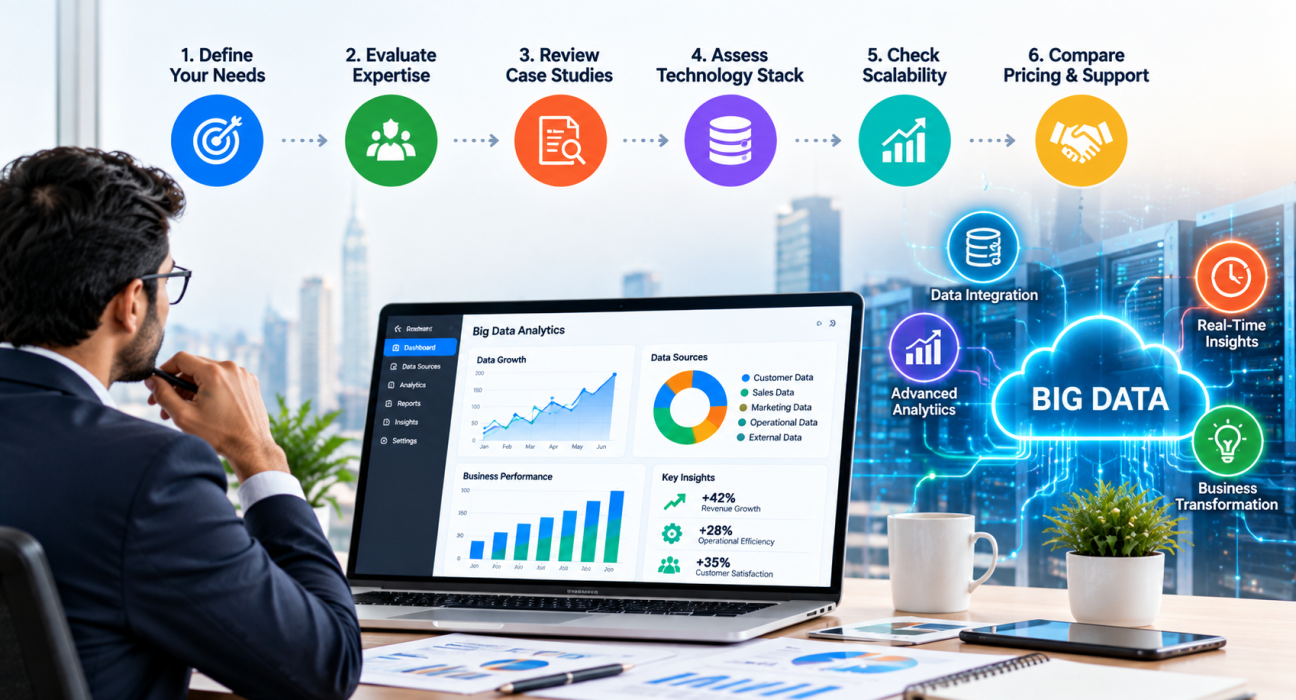
Choosing among big data consulting firms is harder than it looks. Most of them claim expertise in analytics, AI, cloud platforms, and data engineering, and their websites sound alike. The real differences show up in how they work, what they have delivered, and whether they understand your business problem.
The short answer: The right big data consulting firm has proven experience in your industry, strength in the specific technologies you need, a clear delivery process, transparent pricing, and references you can verify. Start by defining your business goal, build a shortlist, and evaluate each firm against the same criteria.
This guide walks through that process step by step, so you can compare big data consulting firms with confidence instead of guesswork.
What Do Big Data Consulting Firms Actually Do?
Big data consulting firms help organizations collect, store, process, and analyze large volumes of data so it can support better decisions. Their work usually falls into a few areas:
- Data strategy: Defining what data you need, how it should be governed, and how it supports business goals.
- Data engineering: Building pipelines, data lakes, and warehouses that move and organize data reliably.
- Analytics and BI: Creating dashboards, reports, and models that turn raw data into insight.
- Machine learning and AI: Building predictive models, recommendation engines, or forecasting tools.
- Cloud migration and architecture: Moving data workloads to platforms such as AWS, Azure, or Google Cloud.
- Data governance and security: Setting up access controls, quality checks, and compliance processes.
Knowing which of these you need is the first step. A company that needs a cleaner reporting setup has very different requirements from one building a real-time fraud detection system.
Step 1: Define Your Business Problem Before You Search
The most common mistake is starting with a vendor search instead of a problem statement. Before contacting anyone, write down:
- The business outcome you want. For example, reducing customer churn, forecasting demand, or consolidating reporting across departments.
- Your current data situation. Where does your data live, how clean is it, and who uses it?
- Your constraints. Budget range, timeline, internal team capacity, and compliance requirements.
- How you will measure success. Pick two or three measurable outcomes, such as report turnaround time or forecast accuracy.
A clear brief helps you compare proposals fairly and stops consultants from selling you a solution that doesn’t fit.
How Do You Evaluate Big Data Consulting Firms? (Key Criteria)
When you compare big data consulting firms, judge them on the same set of factors. Here are the ones that matter most.
Relevant industry and domain experience
A firm that has worked with healthcare, retail, finance, or logistics data will understand your data types, regulations, and common pitfalls faster. Ask for case studies from similar businesses and ask what went wrong, not just what went well.
Technical depth in your stack
Check whether the firm has hands-on experience with the tools you use or plan to use. Depending on your needs, that may include:
- Data platforms such as Snowflake, Databricks, or BigQuery
- Processing frameworks such as Apache Spark or Kafka
- BI tools such as Power BI or Tableau
- Cloud services across AWS, Azure, or Google Cloud
- ML and MLOps tooling
Ask who on the team holds the relevant skills, and whether certifications are current.
Delivery approach and communication
Ask how projects are run. Do they work in sprints? How often will you see progress? Who is your day-to-day contact? A firm with a clear delivery process is easier to manage and less likely to drift off scope.
Data security and compliance
Big data projects often involve sensitive customer or financial information. Ask how the firm handles access control, encryption, and data residency. If you operate under regulations such as GDPR or HIPAA, confirm they have worked within those frameworks before.
Scalability and long-term support
Your data volume will probably grow. Ask whether the architecture they propose can scale and what ongoing support or maintenance looks like after launch.
Pricing transparency
Look for clear pricing models, whether fixed-price, time-and-materials, or a dedicated team. Be cautious of vague estimates that skip discovery. Pricing varies widely by scope, location, and team seniority, so get at least three quotes to compare.
Comparison Checklist: What to Ask Every Firm
Use this table to score each firm on the same criteria.
| Evaluation Area | What to Ask | What Good Looks Like |
|---|---|---|
| Industry experience | Can you share similar case studies? | Specific, relevant projects with clear outcomes |
| Technical expertise | Which tools and platforms does your team use daily? | Hands-on experience that matches your stack |
| Team structure | Who will work on my project? | Named roles with relevant experience |
| Process | How do you manage scope, timelines, and reporting? | Defined methodology and regular check-ins |
| Security | How do you protect and govern client data? | Documented policies and compliance experience |
| References | Can I speak with past clients? | Willing to connect you with real references |
| Pricing | What is included, and what costs extra? | Clear breakdown with no hidden fees |
| Post-launch support | What happens after delivery? | Defined support or handover plan |
Where Can You Find and Compare Big Data Consulting Firms?
Once you know your requirements, build a shortlist of three to six companies. Useful sources include:
- Peer recommendations from other business leaders or technical contacts.
- Directories and review platforms where you can filter service providers by category, location, and focus area. GoFirms, for example, lets businesses research and compare technology and IT service providers in one place.
- Industry events and communities where consultants share their work.
- Direct research into each firm’s website, case studies, and published content.
Whichever source you use, treat listings as a starting point. Always verify claims through direct conversations and references.
[Internal Link Suggestion: GoFirms Big Data / Data Analytics Companies Category Page]
Step-by-Step: How to Choose a Big Data Consulting Partner
Follow this process to move from a long list to a confident decision.
- Write your project brief. Include goals, current systems, data sources, constraints, and success metrics.
- Build a shortlist. Aim for three to six firms that match your industry and technical needs.
- Send the same brief to each firm. This makes proposals easier to compare.
- Review proposals critically. Look for firms that ask smart questions about your business, not just those that send polished decks.
- Run discovery calls. Pay attention to how well they listen and whether they challenge your assumptions constructively.
- Check references and case studies. Ask about communication, quality, deadlines, and how the firm handled problems.
- Consider a pilot project. A small, paid proof of concept shows how the team actually works before you commit to a larger engagement.
- Review the contract carefully. Confirm data ownership, intellectual property, confidentiality, exit terms, and support obligations.
Red Flags to Watch For
Some warning signs are easy to spot if you know what to look for:
- Technology-first pitches. If a firm recommends a platform before understanding your problem, be cautious.
- Vague case studies. Results with no context, metrics, or client details are hard to trust.
- No discovery phase. Quoting a large project without understanding your data is a risk for both sides.
- Overpromising. Guaranteed outcomes from AI or analytics projects are unrealistic, since results depend on data quality.
- Unclear team. If you can’t find out who will actually do the work, ask until you can.
- Locked-in ownership. Make sure you own your data, pipelines, and documentation.
In-House Team vs. Big Data Consulting Firm: Which Is Better?
It depends on your situation. Here is a simple way to think about it.
A consulting firm may suit you if:
- You need specialized skills for a defined project.
- You want to move faster than hiring would allow.
- You don’t yet know what a full-time data team should look like.
An in-house team may suit you if:
- Data is core to your product or competitive advantage.
- You have continuous, long-term data work.
- You can attract and retain skilled data engineers and analysts.
Many companies use a hybrid approach: a consulting firm designs and builds the foundation, then trains an internal team to run it.
Practical Examples
A mid-size retailer wants to combine online and in-store sales data to forecast demand. It needs a firm strong in data engineering and forecasting, with retail experience. A pilot on one product category would be a sensible first step.
A healthcare startup wants to analyze patient engagement data. Compliance and security matter most here, so it should prioritize firms with proven experience in regulated environments.
An enterprise wants to migrate legacy data warehouses to the cloud. It should favor firms with strong cloud architecture credentials, migration case studies, and a clear plan for minimizing downtime.
Frequently Asked Questions
What are big data consulting firms?
Big data consulting firms are service providers that help organizations plan, build, and manage systems for collecting and analyzing large datasets. Their services typically include data strategy, engineering, analytics, cloud architecture, and machine learning, helping businesses turn raw data into practical decisions.
How do I choose the best big data consulting firm for my business?
Start by defining your business goal and data needs. Then shortlist firms with relevant industry experience and matching technical skills. Compare proposals using the same criteria, check references, review security practices, and consider a pilot project before signing a larger contract.
How much do big data consulting services cost?
Costs vary widely depending on project scope, team size, technology, and provider location. Common pricing models include fixed-price, time-and-materials, and dedicated teams. Request detailed quotes from several firms and confirm what is included. Verify any specific figures directly with providers.
What questions should I ask a big data consulting firm?
Ask about similar past projects, the team who will work on your project, the tools they use, how they handle data security, how they manage scope and communication, what support follows delivery, and whether you can speak with former clients.
How long does a big data project take?
Timelines depend on complexity. A focused analytics dashboard may take weeks, while a full data platform or cloud migration can take several months or longer. A good firm will propose phases with milestones rather than a single open-ended timeline.
Should I hire a big data consulting firm or build an in-house team?
Choose a consulting firm for specialized, time-bound projects or when you need speed. Build in-house when data is central to your business and the work is ongoing. A hybrid model, where consultants build and your team takes over, is also common.
Where can I compare big data consulting firms?
You can use business directories and review platforms, peer referrals, and industry communities. Platforms like GoFirms let you research and compare technology service providers by category, so you can build a shortlist before reaching out.
Conclusion
Choosing among big data consulting firms comes down to preparation and consistency. Define your business problem first, evaluate every firm against the same criteria, verify claims through references, and test the relationship with a pilot when possible. The best partner is the one that understands your goals, fits your technical environment, and communicates clearly.
When you’re ready to build your shortlist, you can research and compare relevant technology and IT service providers on GoFirms, then use the checklist above to evaluate each one.