

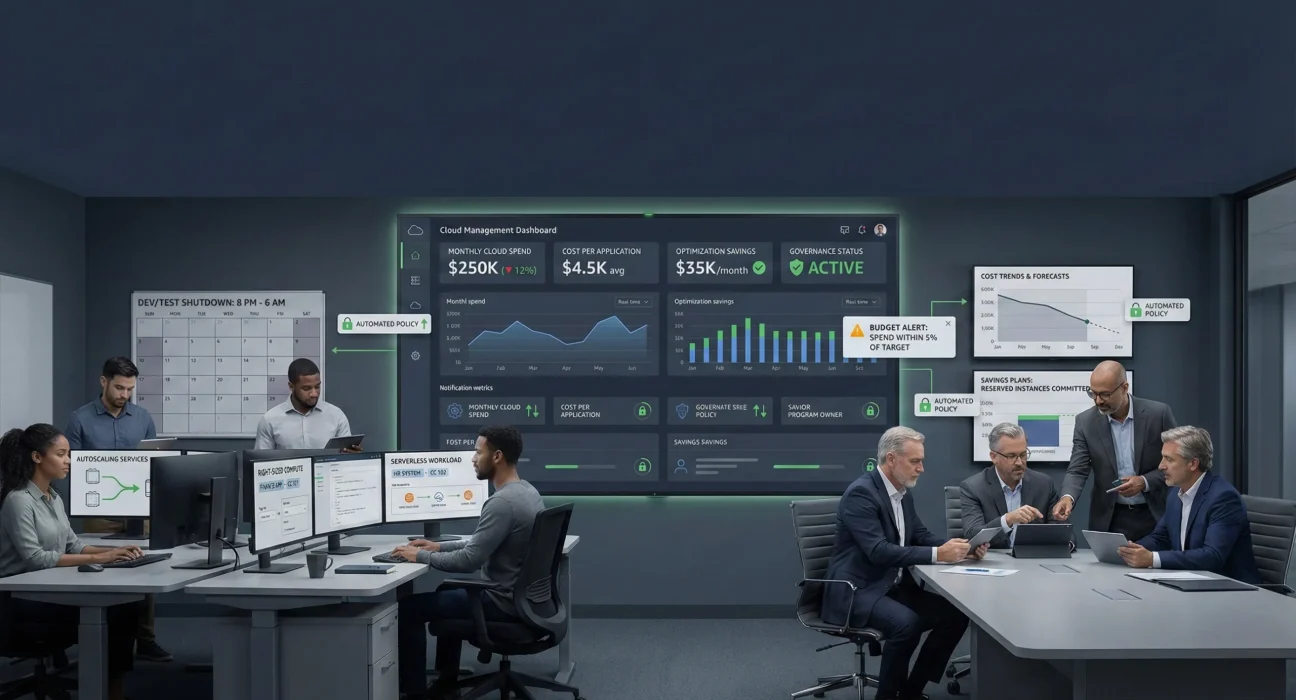
Every CFO I’ve spoken to in the last two years has asked the same question: “Why does our cloud bill keep growing when we’ve already migrated?”
It’s a fair question. Most enterprises approach cloud migration as a project with a finish line. Move the workloads, tick the box, celebrate the completion. But six months later, the finance team starts sending emails. The cloud spending is 40% higher than projected. Reserved instances are underutilized. Dev environments are running 24/7. No one quite knows who approved that new database cluster.
This isn’t a cloud problem. It’s an execution problem.
Why Cloud Costs Spiral in Large Enterprises
The promise of cloud computing has always been compelling. Pay for what you use. Scale on demand. Reduce capital expenditure. Move faster. But the reality in most mid-to-large enterprises, particularly those operating across India and globally, looks different.
Cloud costs don’t spiral because the technology is expensive. They spiral because organizations treat cloud adoption as a technology decision rather than a business transformation. The migration happens without proper governance. Teams spin up resources without accountability. No one owns the monthly bill until it becomes a problem.
I’ve seen this pattern repeatedly. A large manufacturing company migrates to the cloud to “save costs.” Eighteen months later, they’re spending more than they did on their on-premise infrastructure. Not because the cloud is more expensive, but because they migrated their problems along with their applications. Legacy architectures that weren’t optimized for cloud. Manual processes that should have been automated. Organizational silos where no single team takes ownership of the entire spend.
The uncomfortable truth is this: cloud migration doesn’t automatically deliver cost savings. It reveals every inefficiency in how you build, deploy, and manage technology.
The Real Drivers of Long-Term Cloud Costs
When you look at enterprise cloud bills that have run out of control, a few patterns emerge consistently.
Lack of architectural clarity. Many enterprises lift and shift applications to the cloud without rethinking how those applications should run. A monolithic application that worked fine on a dedicated server becomes expensive when you’re paying for compute, storage, and data transfer separately. The application wasn’t designed for cloud economics.
No ownership model. In traditional IT, infrastructure was centralized. Someone owned the data center. Someone managed capacity planning. In the cloud, every team can provision resources. Product teams, development teams, data teams. Without clear ownership and chargeback models, spending becomes diffuse and unmanageable.
Governance gaps. Cloud providers give you extraordinary control and flexibility. That same flexibility becomes a liability if you don’t have policies in place. Who can spin up which resources? What are the approval workflows? How do you ensure dev environments don’t consume production-level resources? These aren’t technology questions. They’re governance questions.
Vendor complexity. Most large enterprises don’t use one cloud. They use three or four, plus SaaS platforms, plus legacy systems that need to integrate with everything. Each vendor has different pricing models, different discounting structures, and different ways to optimize. Managing this effectively requires dedicated effort, and most organizations underestimate what that takes.
Skill gaps. Cloud optimization isn’t something most IT teams learned in traditional environments. Understanding reserved instances, spot pricing, right-sizing, autoscaling policies, these require specific expertise. Enterprises often realize this too late, after spending patterns are already established.
These aren’t problems you solve with better technology. You solve them with better execution.
What Actually Works: Governance Before Tools
The enterprises that manage cloud costs effectively do a few things differently.
First, they establish clear ownership. Someone senior owns the cloud program, not just the migration. That person has authority across teams and direct line of sight to finance. They’re accountable for both delivery and cost management. This isn’t a technical role. It’s a program leadership role.
Second, they build governance frameworks before scaling usage. Tagging standards for every resource. Approval workflows that make sense. Budget alerts that trigger action, not just reports. Policies that automatically shut down non-production resources outside business hours. These sound basic, but most organizations skip this step because they’re in a hurry to migrate.
Third, they treat cloud optimization as continuous work, not a one-time exercise. They review spending monthly. They benchmark against industry standards. They retire unused resources aggressively. They renegotiate contracts when usage patterns change. This requires discipline and dedicated resources.
Fourth, they invest in skills deliberately. They train existing teams. They hire specialists where needed. They partner with firms that understand enterprise delivery, not just cloud technology. This is where many organizations make a critical choice: do we build all this capability internally, or do we work with partners who’ve done this before?
The Partnership Question: Build vs. Collaborate
Most large enterprises face a decision point early in their cloud journey. Build internal cloud excellence or work with specialized partners.
The honest answer is: you need both.
You need internal ownership. You need people who understand your business, your constraints, your risk appetite. But you also need partners who bring experience from dozens of similar transformations. Partners who know what actually works at scale, not just in theory.
This is where companies like Ozrit become relevant. Not as outsourced IT, but as execution partners who understand what it takes to deliver large, complex programs in enterprise environments. The value isn’t just technical implementation. It’s understanding how governance actually works in a large organization. How to manage stakeholders across business units. How to build programs that survive leadership changes and budget cycles.
The best partnerships work when responsibilities are clear. The enterprise owns strategy, business outcomes, and long-term accountability. The partner owns delivery excellence, technical execution, and knowledge transfer. Both are accountable for cost management from day one.
Making Cloud Economics Work: Practical Approaches
Cost optimization in the cloud isn’t rocket science, but it does require method and consistency.
Start with visibility. You can’t optimize what you can’t see. Implement tagging standards that map spending to business units, applications, and cost centers. Use native cloud tools plus third-party platforms if needed. Make cost data accessible to the people who make spending decisions, not just finance teams.
Right-size continuously. Most cloud resources are over-provisioned. Development teams ask for more capacity than needed because they’re worried about performance. Monitor actual usage and adjust. This should happen monthly, not annually.
Automate the obvious. Non-production environments don’t need to run 24/7. Storage that hasn’t been accessed in six months can move to cheaper tiers. Failed resources that are still running can be terminated. Write policies that handle this automatically.
Commit strategically. Reserved instances and savings plans can reduce costs by 30-40%, but only if you understand your baseline usage. Don’t commit based on projected growth. Commit based on proven, stable workloads. Stay flexible for everything else.
Design for cloud economics. When you build new applications or refactor existing ones, design them to take advantage of cloud pricing models. Use serverless where appropriate. Implement auto-scaling properly. Choose the right storage tiers. These decisions have compounding effects over time.
Review vendor relationships regularly. Cloud providers offer different pricing for different commitment levels and use cases. What made sense at the start of your journey may not make sense two years in. Renegotiate when your usage changes.
None of this happens without organizational discipline. You need someone senior enough to make these things mandatory, not optional.
The CFO Conversation: Total Cost of Ownership
CFOs care about total cost of ownership, not just monthly cloud bills.
When you’re making the case for cloud investment or defending cloud spending, frame it in TCO terms. What are you saving on data center costs? What’s the cost of faster time to market? What’s the risk cost of running aging infrastructure?
But also be honest about where the cloud is more expensive. Egress charges can surprise you. Data transfer between regions adds up. Multiple cloud vendors mean multiple contracts to manage.
The CFO conversation should include these points:
Cloud spending is predictable when managed well, but requires active management. It won’t optimize itself.
Some costs are unavoidable table stakes for operating in modern technology environments. Others are waste that should be eliminated.
Cost optimization is a capability that improves over time. First year results won’t match third year results if you’re learning and improving.
Long-term value comes from speed, resilience, and ability to scale, not just infrastructure savings.
The best CFO relationships I’ve seen are built on transparency and realistic expectations. No one expects the cloud to be free. They expect it to be managed professionally.
Common Pitfalls That Derail Cloud Programs
Even well-run cloud programs hit predictable problems.
Underestimating change management. Cloud changes how teams work. Developers get more autonomy. Operations teams need new skills. Finance needs new reporting processes. Organizations that ignore the people’s side of this transformation struggle regardless of their technical choices.
Treating migration as a deadline, not a journey. Pressure to migrate by a certain date often leads to shortcuts. Proper architecture reviews get skipped. Security controls are implemented later. Cost optimization is postponed. These shortcuts create technical debt that becomes expensive to fix.
Ignoring application rationalization. Not every application should move to the cloud. Some should be retired. Some should be replaced with SaaS. Some should be rewritten. Making these decisions requires business involvement, not just IT.
Assuming one size fits all. Different workloads have different cloud optimization strategies. A data warehouse optimizes differently than a customer-facing application. Batch processing has different economics than real-time APIs. Treat them differently.
Letting security slow everything down. Security in the cloud requires different approaches than traditional perimeter-based security. Organizations that try to implement on-premise security models in the cloud create bottlenecks and frustrated teams. Security should enable cloud adoption, not prevent it.
These aren’t technology problems. They’re program management problems. They require leadership, communication, and organizational alignment.
Building for the Long Term
The enterprises that succeed with cloud over five and ten year horizons share certain characteristics.
They treat the cloud as a capability, not a destination. They keep learning. They adapt their operating models as cloud platforms evolve. They don’t assume that what worked in year one will work in year three.
They invest in their people. They create career paths for cloud specialists. They reward teams that find optimization opportunities. They make cost awareness part of engineering culture.
They maintain strong vendor relationships while avoiding lock-in. They understand the trade-offs between using proprietary services and maintaining portability. They make conscious choices, not default ones.
They measure what matters. Not just uptime and performance, but cost per transaction, cost per user, cost per business outcome. They connect technology spending to business value in concrete terms.
And critically, they work with partners who think long-term. Partners who care about knowledge transfer, not dependency. Partners who understand that enterprise programs succeed when internal teams grow stronger, not weaker.
This is the approach that firms like Ozrit bring to enterprise engagements. Not just delivering projects, but building delivery capability within the client organization. Not just implementing technology, but establishing the governance and processes that make that technology sustainable.
What This Means for Your Organization
If you’re leading or sponsoring a cloud program in your enterprise, a few priorities should be clear.
First, establish executive ownership and accountability. This cannot be delegated to mid-level IT management. Someone at CXO level needs to own outcomes.
Second, invest in governance and processes before you scale. It’s much harder to implement discipline after teams have established their own patterns.
Third, build cost management into your culture and workflows. Make it as important as security and performance. Measure it. Report on it. Reward teams that improve it.
Fourth, be realistic about what you can build internally versus where you need partnership. Most large enterprises benefit from working with experienced delivery partners, especially in the first few years of their cloud journey.
Fifth, think in years, not quarters. Cloud transformation takes time. Cost optimization takes time. Building internal capability takes time. Set expectations accordingly.
The prize for getting this right is significant. Lower total cost of ownership over time. Faster ability to respond to business needs. Better resilience and security. More satisfied technology teams.
But the prize goes to organizations that execute well, not just those that choose the right cloud platform.
Cloud is infrastructure. What you build on that infrastructure, how you manage it, how you optimize it over time, that’s what separates success from mediocrity. And that comes down to leadership, governance, and disciplined execution.
Everything else is just technology.