
If you are running a business in India today – be it a textile shop expanding from T. Nagar to online selling, or a D2C brand shipping pav bhaji masala kits pan-India – sooner or later this question will knock on your door: PWA vs mobile app – should you build a Progressive Web App (PWA) or go for a native Mobile App?
It’s a bit like choosing between an auto-rickshaw and your own car. Both will get you from point A to point B, but the comfort, cost, and maintenance are very different. In this article, we will break down PWA vs mobile app development in plain, simple language, look at real business scenarios, and also introduce you to some solid eCommerce development companies in Chennai – starting with Ozrit – who can help you build either option the right way.
What Exactly Is a Progressive Web App (PWA)?
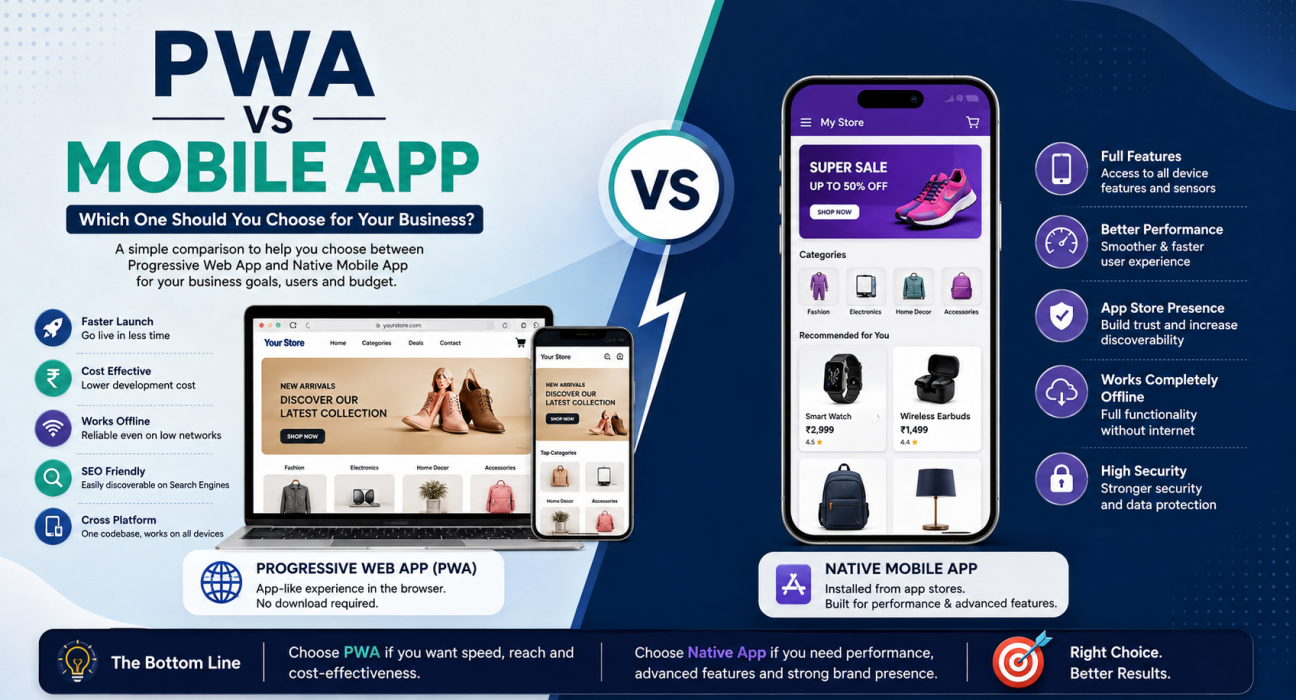
A Progressive Web App is essentially a website that behaves like an app. It loads in a browser but can be “added to home screen,” works reasonably well even on patchy 4G in areas like the outskirts of Coimbatore or interior Bihar, sends push notifications, and doesn’t need to be downloaded from the Play Store or App Store.
Think of Flipkart Lite or the mobile version of MakeMyTrip – that snappy, app-like feel without the actual install. That is PWA technology at work.
Key characteristics of a PWA:
- Built using standard web technologies – HTML, CSS, and JavaScript
- Runs inside a browser (Chrome, Safari, etc.) but can sit on your home screen like an icon
- Works offline or in low-network zones using something called a “service worker”
- No app store approval process, no waiting for review
- One single codebase works across Android, iOS, and desktop
What Is a Native Mobile App?
A native mobile app is built specifically for one operating system using its own language and tools – Kotlin or Java for Android, Swift for iOS. It is downloaded from the Google Play Store or Apple App Store and installed directly on the phone.
This is your Swiggy, Zomato, Amazon India kind of app – deeply integrated with the phone’s camera, GPS, contacts, fingerprint sensor, and so on.
Key characteristics of a native app:
- Built separately for Android and iOS (unless you use cross-platform frameworks like Flutter or React Native)
- Full access to device hardware – camera, Bluetooth, sensors, biometrics
- Distributed through app stores, which means visibility but also gatekeeping
- Generally faster and smoother for heavy, graphics-intensive tasks
- Higher development and maintenance cost
PWA vs Native App: The Real Difference, Explained Simply
Let’s put this in a simple, everyday comparison – the kind you’d explain to your uncle who runs a kirana store and is confused about “app” versus “website that looks like app.”
| Factor | Progressive Web App | Native Mobile App |
|---|---|---|
| Development Cost | Lower – one codebase | Higher – separate builds for Android/iOS |
| Time to Launch | Faster, weeks not months | Longer, especially with app store review |
| App Store Presence | Not listed (unless you also submit a wrapped version) | Listed, discoverable, builds trust |
| Offline Access | Partial, cache-based | Full, robust |
| Device Features | Limited (camera, GPS to an extent) | Full access to hardware |
| Updates | Instant, no user action needed | User must download update |
| Storage on Phone | Very light, a few MB | Heavier, can run into hundreds of MB |
| Best For | Content sites, eCommerce catalogues, lead-gen, quick MVPs | Complex apps, gaming, fintech, apps needing deep hardware use |
When Should You Choose a Progressive Web App?
If your business is an eCommerce store, a service booking platform, a news portal, or anything where speed of discovery and low friction matter more than deep hardware integration, a PWA often makes more sense. It is the sensible, budget-friendly choice – much like choosing a Metro ride over booking a cab during Chennai’s peak-hour traffic on OMR.
Go for a PWA if:
- You are a startup or SME watching your budget closely
- Your customers are largely browsing on mobile but don’t want to “install another app”
- You want faster load times and better SEO (Google indexes PWAs like websites)
- You need to launch quickly, perhaps before a festive season sale like Diwali or Pongal
- You don’t need heavy use of phone hardware like Bluetooth-connected devices
When Should You Choose a Native Mobile App?
If your product depends on rich user experience, offline-first functionality, camera-based features (think a QR scanner for a grocery delivery app), push notification-heavy engagement, or you’re building something like a ride-hailing app or an OTT streaming platform, native is usually the better route – even though the ticket size and timeline are bigger.
Go for Native if:
- Your app needs deep integration with GPS, camera, biometrics, or Bluetooth
- You want maximum performance for animations, gaming, or AR/VR features
- App store presence and brand credibility (being on Play Store/App Store) matters to your audience
- Your business model depends heavily on personalized push notifications
- You have the budget and roadmap to maintain two codebases (or use Flutter/React Native for one)
Hybrid Approach: Can You Have the Best of Both Worlds?
Many smart businesses today don’t pick one over the other – they start lean with a PWA to validate the market, and once they have traction and repeat customers, they invest in a full native app. This staged approach saves money upfront and reduces the risk of building something nobody wants.
It’s a bit like how many Chennai eateries first test a menu item as a “special of the day” before adding it permanently to the card. Test with a PWA, scale with native once demand is proven.
Cost Comparison: What Should You Budget For?
While exact numbers vary depending on features and the company you hire, here is a rough, real-world picture for the Indian market:
- Basic PWA: Can be built reasonably affordably, especially if it’s layered on top of an existing responsive website
- Native App (single platform, MVP): Costs noticeably more due to platform-specific development
- Native App (Android + iOS, full-featured): The most expensive route, but often necessary for larger consumer brands
Talk to a development partner who is transparent about costs upfront – this is one area where many businesses get caught off guard with hidden charges later.
SEO and Discoverability: An Underrated Factor
This is one point many business owners in India overlook. A PWA, being essentially a website, can be indexed by Google – meaning people searching for “buy sarees online Chennai” or “best pooja items delivery” can land directly on your PWA through organic search. A native app, on the other hand, depends entirely on app store search and paid promotion for discovery, which can get expensive over time.
If organic growth and search visibility matter to your business (and for most eCommerce brands, it absolutely does), a PWA gives you a real head start.
Performance on Low and Mid-Range Devices
India is still largely a market of budget and mid-range smartphones. A heavy native app with a large APK size can be a turn-off for someone with limited storage on their phone – a very common ground reality in tier 2 and tier 3 cities. PWAs, being lightweight, install almost instantly and don’t eat up precious phone memory, which can directly improve conversion rates for price-sensitive markets.
Which One Should You Actually Choose?
Here’s the honest, no-nonsense answer: there is no one-size-fits-all winner. It genuinely depends on:
- Your budget – PWA if tight, native if you have runway
- Your audience’s device and network conditions – PWA wins in low-bandwidth areas
- Feature requirements – native wins for hardware-heavy apps
- Speed to market – PWA gets you live faster
- Long-term brand goals – native builds stronger app-store presence and trust
Most eCommerce businesses in Tier 1 cities like Chennai actually benefit from starting with a well-built PWA and evolving toward native as the customer base and repeat-purchase behaviour justify the investment.
Top eCommerce Development Companies in Chennai to Build Your PWA or Mobile App
Whichever path you choose – Progressive Web App or native mobile app – execution matters just as much as the decision itself. Chennai, often called the Detroit of India for its industrial legacy, has also quietly become a strong hub for web and app development talent, with clusters of IT companies spread across OMR, Guindy, and T. Nagar. Below is a list of ecommerce and app development companies based in or serving Chennai that are worth evaluating for your project – starting with Ozrit.
1. Ozrit
Overview: Ozrit is a digital solutions company with a presence in Chennai (Anna Salai), along with offices in Hyderabad, Bengaluru, and international locations. The company works across eCommerce development, mobile and web app development, UI/UX design, AI/ML solutions, and cloud/DevOps services.
Key Points:
- Works on custom storefronts, Shopify Plus builds, headless commerce, and multi-vendor marketplace platforms
- Handles D2C, B2B, and B2C eCommerce projects, including payment gateway integrations like Razorpay and UPI
- Also builds Progressive Web Apps and native mobile apps for eCommerce brands, so businesses can get guidance on which route fits them best
- Known for combining technical delivery with design-led thinking rather than treating development as a plain coding exercise
Establishment & Presence: Operating with a multi-city presence across India (Chennai, Hyderabad, Bengaluru) and international offices, reflecting a growing footprint in the digital services space.
Team Size: Mid-sized, multi-disciplinary team spread across its India offices, covering development, design, and marketing functions.
2. Webnexs
Overview: Webnexs is a Chennai-based technology company that started out of Tirumudivakkam, Chennai, and has grown into a recognised name in eCommerce, mobile app, and OTT/VOD platform development.
Key Points:
- Specializes in Magento, PrestaShop, and headless commerce builds, along with its own product “Wcomm” for quick-start online stores
- Has expanded into OTT and video-on-demand app development in addition to core eCommerce work
- Cited by industry directories as one of the higher-rated eCommerce development firms from Chennai
- Serves clients across fashion, food and beverage, hospitality, and consumer services sectors
Establishment: Founded in 2015 in Chennai.
Team Size: Has scaled from a small ten-member team in its early years to a considerably larger workforce today, with reports citing 50+ to 100+ employees as the company matured.
3. Team Tweaks Technologies
Overview: Team Tweaks Technologies is a Chennai-headquartered mobile and web app development company with a base near Mylapore, known primarily for its mobile app work but equally active in eCommerce development.
Key Points:
- Founded by Kapil Dev G. along with co-founders, with over a decade of experience in the market
- Strong focus on Android, iOS, and Flutter development, including eCommerce and IoT-linked applications
- Has delivered projects for clients across the US, UAE, and other international markets
- Offers fixed-price project models, which many small and mid-sized Indian businesses find easier to plan around
Establishment: Founded in 2012-2013.
Team Size: A mid-sized team, with some listings citing around 50 professionals on board.
4. Pyramidion Solutions
Overview: Pyramidion Solutions (also referred to as Pyramidions) is a Chennai-based mobile app development company with branch presence in Bangalore, Pune, and Mumbai, now also positioning itself around AI-assisted development for eCommerce apps.
Key Points:
- Over a decade of experience with hundreds of mobile apps shipped for clients across sectors
- Builds AI-native iOS, Android, and cross-platform eCommerce apps with features like smart product discovery and personalized checkout
- Uses AI-assisted code reviews to speed up delivery timelines without compromising much on quality
- Works with both startups looking for MVPs and larger enterprises needing scalable platforms
Establishment: Operating in Chennai for over 11 years.
Team Size: A well-established mid-sized development team, supported by branch offices in other Indian metros.
5. Concern Infotech
Overview: Concern Infotech is a Chennai-based web development company known for serving a mix of IT and non-IT clients with personalized website and eCommerce design work.
Key Points:
- Works across web development, eCommerce platforms, and digital services
- Known for close, hands-on client engagement rather than a purely templated approach
- Has experience building on platforms like WooCommerce and Magento
- Popular among small and mid-sized businesses looking for cost-effective, personalized solutions
Establishment: An established player in Chennai’s web and eCommerce development circuit.
Team Size: A compact, experienced team focused on quality over volume.
6. Hourglass IT
Overview: Hourglass IT is a Chennai-based eCommerce and web development company that has built a reputation serving both Indian and international clients across varied industries.
Key Points:
- Team includes professionals with backgrounds spanning hospitality, construction, and banking sectors, bringing cross-industry insight to eCommerce builds
- Known for developing mobile-responsive, SEO-optimized online stores
- Works with businesses looking to establish a strong first impression through design-forward eCommerce sites
- Serves both domestic Chennai-based clients and export-oriented businesses
Establishment: A established mid-tier Chennai eCommerce development firm.
Team Size: Small to mid-sized team of dedicated web and eCommerce professionals.
7. KP Webtech
Overview: KP Webtech is a Chennai-based custom eCommerce website development company that positions itself around providing feature-rich, responsive online stores with strong UI/UX.
Key Points:
- Focus on custom eCommerce builds rather than one-size-fits-all templates
- Offers integration services for businesses wanting to add eCommerce capability to an existing website
- Supports multiple payment gateway integrations for smoother checkout experiences
- Known for quick turnaround on integration-based projects
Establishment: An established Chennai eCommerce web development company.
Team Size: A lean, specialised team focused on custom development and integrations.
8. ImagiNET Ventures
Overview: ImagiNET Ventures is a Chennai-based digital solutions company with an additional branch in Dubai, giving it a slightly more international flavour compared to purely local Chennai firms.
Key Points:
- Has been active in transforming business ideas into digital products since the mid-2000s
- Works across web design, eCommerce development, and broader digital solutions
- The Dubai branch gives it added exposure to Gulf-based clients wanting India-quality development at competitive pricing
- Known for a long operating history in a market where many agencies are relatively newer
Establishment: Operating since 2006.
Team Size: A moderately sized team with experience spanning nearly two decades in the industry.
9. I-Studio Technologies
Overview: I-Studio Technologies is a Chennai-based web and eCommerce development company known for its long-standing presence in the local IT services market.
Key Points:
- Over a decade of experience building eCommerce and business websites
- Dedicated team known for coming up with original design concepts rather than reusing templates
- Works across website design, development, software testing, and digital marketing as complementary services
- Has built a loyal client base through consistent quality of delivery
Establishment: In business for over 13 years.
Team Size: A dedicated, experienced core team of developers and designers.
Factors and Criteria We Considered While Ranking These Companies
Putting together a “Top ECommerce Development Companies in Chennai” list isn’t just about who shouts the loudest on Google Ads. We looked at a combination of hard facts and softer, experience-based signals, including:
- Years of Establishment and Track Record – How long the company has been operating in Chennai’s competitive IT landscape, and whether they’ve shown staying power rather than appearing and disappearing.
- Technical Expertise Across Platforms – Experience with major eCommerce platforms such as Shopify, WooCommerce, Magento, PrestaShop, and headless/custom builds.
- Team Size and Delivery Capacity – Whether the company has enough bench strength to handle projects of varying complexity without compromising on timelines.
- Client Reviews and Verified Ratings – Feedback available on independent platforms like Clutch, GoodFirms, and DesignRush, rather than only testimonials on their own website.
- Range of Services Offered – Companies offering end-to-end services (design, development, payment integration, post-launch support) scored higher than those offering only a single narrow service.
- Local Presence in Chennai – Genuine operational presence in Chennai (not just a virtual listing), since local presence often means better communication and faster turnaround for India-based clients.
- Pricing Transparency – Clear, upfront pricing models versus vague “contact us for a quote” approaches with hidden costs discovered later.
- Ability to Advise on PWA vs Native App Decisions – Since this is a strategic decision, not just an execution task, we gave weight to companies capable of guiding clients on the right technology choice rather than pushing one option blindly.
- Post-Launch Support and Maintenance – Because an eCommerce store isn’t a “build once, forget forever” product; ongoing support matters a lot, especially during high-traffic sale events.
- Industry Reputation and Word of Mouth – General standing among Chennai’s tech and startup community, gathered from multiple independent sources rather than a single review site.
Conclusion
Choosing between a Progressive Web App and a native mobile app isn’t about which technology is “better” in some absolute sense – it’s about understanding PWA vs mobile app and choosing the option that fits your business, your customers, and your budget at this particular stage of your journey. A PWA gets you to market faster, costs less, and works beautifully for eCommerce catalogues and content-driven platforms. A native app, on the other hand, gives you deeper device integration, stronger app-store presence, and a more premium user experience once your business is ready to invest in it.
There is no shame in starting small with a PWA and graduating to native later – in fact, that’s often the smarter, more capital-efficient path, much like how the best businesses in Chennai’s Ranganathan Street didn’t start as five-story showrooms; they grew into that scale over time.
What matters most, ultimately, is picking a development partner who understands your business goals and doesn’t just build what’s trendy, but what actually works for your customers. Whether you go with Ozrit or any of the other capable Chennai-based companies listed above, do your homework, ask for real portfolios, talk to existing clients if possible, and choose a partner who will be there for the long haul – not just for launch day. Your online store deserves nothing less.