If your business builds, buys, or maintains software, one question eventually becomes urgent: how do you know your application is actually secure? Data breaches, compliance failures, and customer trust issues rarely happen because a company ignored security altogether. They happen because security was assumed rather than tested.
That’s exactly what software security testing services are designed to solve. They give businesses a clear, evidence-based picture of where an application is vulnerable, so problems can be fixed before attackers, auditors, or customers find them first.
This guide breaks down what software security testing services actually involve, the different types available, how much they typically cost, and how to choose the right provider for your needs.
What Are Software Security Testing Services?
Software security testing services are specialized assessments that identify vulnerabilities, weaknesses, and security gaps in an application before or after it goes live. Unlike general QA testing, which checks whether software works as intended, security testing checks whether software can be misused, broken into, or manipulated by someone with malicious intent.
These services are typically delivered by dedicated security firms, cybersecurity consultants, or software development companies with in-house security teams. The output is usually a detailed report listing vulnerabilities, their severity, and clear steps for remediation.
Businesses use these services for web applications, mobile apps, APIs, cloud infrastructure, SaaS platforms, and internal enterprise systems.
Why Security Testing Matters More Than Ever
A few realities are pushing security testing from “nice to have” to “non-negotiable” for most software-driven businesses:
- Applications are more exposed. Cloud deployment, third-party integrations, and APIs all widen the attack surface.
- Compliance requirements are stricter. Regulations tied to data privacy, healthcare, and finance often require documented security testing.
- Customers and partners ask for proof. Enterprise clients frequently request security assessment reports before signing contracts.
- The cost of a breach is high. Beyond direct financial loss, breaches damage reputation, customer trust, and long-term growth.
For startups and SMBs especially, one serious security incident can be far more expensive than the cost of proactive testing.
Types of Software Security Testing Services
Not all security testing is the same. Different methods uncover different types of risk, and most mature security programs use a combination of them.
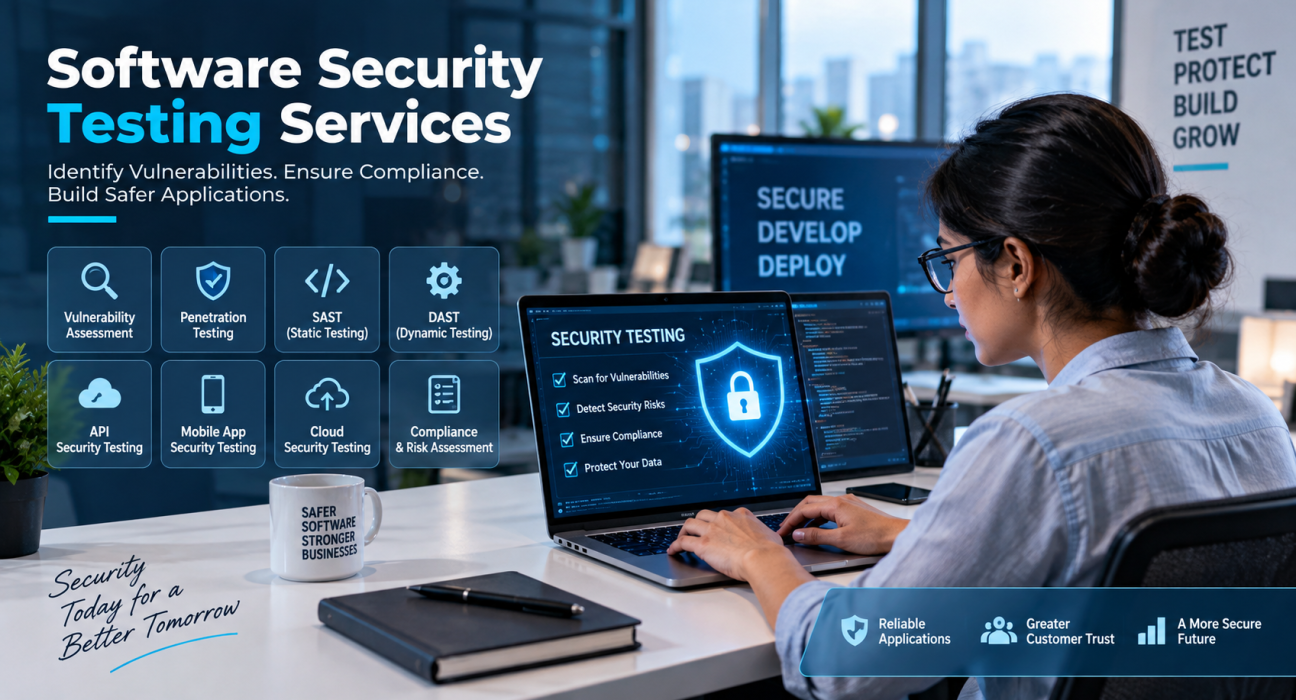
1. Vulnerability Assessment
A vulnerability assessment scans an application, network, or system to identify known weaknesses, such as outdated software components, misconfigurations, or missing patches. It’s typically automated and gives a broad, fast overview of potential risk areas.
Best for: Ongoing monitoring and identifying common, well-documented vulnerabilities quickly.
2. Penetration Testing (Pen Testing)
Penetration testing simulates a real-world attack. Skilled testers, sometimes called ethical hackers, attempt to actively exploit vulnerabilities to see how far an attacker could get and what damage could be done.
Best for: Understanding real-world exploitability, not just theoretical risk.
3. Static Application Security Testing (SAST)
SAST analyzes an application’s source code, byte code, or binaries without executing the program. It’s used early in development to catch security flaws such as insecure coding patterns before the software is deployed.
Best for: Catching issues early in the software development lifecycle.
4. Dynamic Application Security Testing (DAST)
DAST tests a running application from the outside, simulating how an attacker would interact with it in a live environment. It’s useful for identifying issues that only appear during runtime, such as authentication flaws or session handling problems.
Best for: Testing applications as they behave in production-like conditions.
5. API Security Testing
With most modern applications relying heavily on APIs, dedicated API security testing checks for issues like broken authentication, excessive data exposure, and improper access controls specific to API endpoints.
Best for: Businesses with API-driven products, mobile backends, or third-party integrations.
6. Mobile Application Security Testing
This focuses specifically on risks unique to mobile apps, including insecure local data storage, weak encryption, and platform-specific vulnerabilities on iOS and Android.
Best for: Companies with consumer or enterprise mobile apps handling sensitive data.
7. Cloud Security Testing
Cloud security testing evaluates cloud infrastructure configurations, access controls, and storage settings to catch issues such as publicly exposed storage buckets or overly permissive access roles.
Best for: Businesses running on AWS, Azure, Google Cloud, or hybrid cloud environments.
8. Compliance-Driven Security Testing
Some testing is designed specifically to meet standards like SOC 2, HIPAA, PCI DSS, ISO 27001, or GDPR-related requirements. These assessments are structured around specific compliance checklists.
Best for: Regulated industries such as healthcare, finance, and e-commerce.
Comparison Table: Security Testing Types at a Glance
| Testing Type | What It Checks | Typical Timing |
|---|---|---|
| Vulnerability Assessment | Known weaknesses, outdated components | Ongoing / periodic |
| Penetration Testing | Real-world exploitability | Before launch, annually |
| SAST | Source code security flaws | During development |
| DAST | Runtime behavior and live vulnerabilities | Pre-launch, staging |
| API Security Testing | API authentication, data exposure | Development and post-launch |
| Mobile App Security Testing | Mobile-specific risks | Before app store release |
| Cloud Security Testing | Cloud configuration and access | Ongoing |
| Compliance Testing | Regulatory requirement alignment | Before audits |
How Software Security Testing Actually Works
While the exact process varies by provider and testing type, most engagements follow a similar path:
- Scoping and planning. The provider defines what will be tested, including systems, environments, and objectives.
- Information gathering. Testers review architecture, technology stack, and existing documentation.
- Testing and analysis. Automated tools and manual techniques are used to identify vulnerabilities.
- Exploitation (for pen testing). Testers attempt to exploit discovered vulnerabilities to assess real impact.
- Reporting. A detailed report is delivered, listing vulnerabilities by severity, along with evidence and remediation guidance.
- Remediation support. Many providers offer guidance or re-testing after fixes are implemented.
A good report should be actionable, not just a list of technical findings. It should clearly explain business risk, not just technical severity.
How Much Do Software Security Testing Services Cost?
Costs vary widely depending on the scope, complexity, and type of testing. Factors that influence pricing typically include:
- The size and complexity of the application
- Whether testing is automated, manual, or a hybrid of both
- The depth of testing (basic scan vs. full penetration test)
- Compliance requirements involved
- Whether retesting after fixes is included
Because pricing depends heavily on these variables, it’s best to request a scoped quote from providers based on your specific application rather than relying on general estimates. Any specific pricing figures should be verified directly with vendors before being used for budgeting decisions.
How to Choose a Software Security Testing Provider
Choosing the right provider matters as much as choosing the right testing type. Here’s what to evaluate:
Technical Expertise
Look for certified professionals (such as those with recognized security certifications) and experience testing applications similar to yours in scale and industry.
Testing Methodology
Ask whether the provider uses manual testing, automated scanning, or both. Purely automated scans are faster but often miss business-logic vulnerabilities that only a human tester would catch.
Reporting Quality
Request a sample report if possible. A strong report should be clear, prioritized by risk, and include practical remediation steps, not just a raw vulnerability dump.
Industry Experience
If you operate in a regulated industry, look for providers experienced with your specific compliance requirements.
Post-Testing Support
Some providers only deliver a report. Others offer remediation guidance and free re-testing after fixes. This can significantly affect long-term value.
Checklist: Questions to Ask Before Hiring a Security Testing Provider
- What types of testing do you specialize in?
- Do you use manual testing, automated tools, or both?
- Can you share a sample (redacted) report?
- Do you offer retesting after vulnerabilities are fixed?
- Do you have experience with our industry’s compliance requirements?
- What is the typical turnaround time for a full assessment?
Finding the Right Security Testing Partner
Because security testing requires specialized expertise, many businesses prefer working with an established provider rather than building this capability in-house, especially for one-off assessments or periodic audits.
This is where a platform like GoFirms can help. GoFirms allows businesses to research and compare technology and IT service providers, including companies offering security-focused development and testing services, making it easier to shortlist providers based on relevant experience before reaching out for quotes.
Common Mistakes Businesses Make with Security Testing
- Treating it as a one-time event. Security testing should be recurring, especially after major updates or new feature releases.
- Only using automated scans. Automated tools are useful but often miss complex, logic-based vulnerabilities.
- Ignoring low and medium severity findings. Smaller issues can sometimes be chained together to create serious exploits.
- Skipping retesting. Fixes should always be verified to confirm the vulnerability is actually resolved.
- Choosing a provider based on price alone. The cheapest option isn’t always the most thorough, especially for compliance-driven testing.
Frequently Asked Questions
What is the difference between vulnerability assessment and penetration testing? A vulnerability assessment identifies known weaknesses using automated scanning, giving a broad overview of potential issues. Penetration testing goes further by actively attempting to exploit vulnerabilities to determine real-world impact. Most mature security programs use both, with vulnerability assessments run more frequently and penetration testing done periodically.
How often should software security testing be done? This depends on how frequently the application changes and the industry it operates in. Many businesses run vulnerability scans continuously or monthly, and conduct full penetration tests annually or after major releases. Regulated industries may require testing on a stricter compliance-driven schedule.
Is security testing only necessary for large enterprises? No. Startups and SMBs are frequent targets precisely because they often have fewer security resources in place. A single vulnerability in a customer-facing application can affect businesses of any size, making testing valuable regardless of company scale.
Can security testing slow down software development? When integrated properly, security testing shouldn’t significantly slow development. Practices like static code analysis (SAST) during development catch issues early, when they’re faster and cheaper to fix, rather than after launch when remediation becomes more disruptive.
Do software security testing services guarantee an application is 100% secure? No responsible provider can guarantee complete security, since new vulnerabilities and attack techniques emerge constantly. What testing does provide is a clear, evidence-based understanding of current risk, along with a path to significantly reduce it.
What industries need security testing the most? Industries handling sensitive data, such as finance, healthcare, e-commerce, and SaaS, typically have the highest need due to regulatory requirements and the sensitivity of the data they manage. That said, any business with a customer-facing application benefits from regular testing.
How do I know if my current provider’s testing is thorough enough? A strong indicator is the balance between automated and manual testing, along with report quality. If reports lack context, prioritization, or remediation guidance, or if testing relies entirely on automated scans, it may be worth evaluating other providers with more comprehensive methodologies.
Conclusion
Software security testing services exist to answer one essential question: is your application actually safe to use, or does it just appear that way? Between vulnerability assessments, penetration testing, and specialized testing for APIs, mobile apps, and cloud environments, businesses have more options than ever to get a clear, accurate picture of their security posture.
The right approach depends on your application’s complexity, industry, and compliance needs, but the underlying principle stays the same: test regularly, prioritize fixes by real-world risk, and choose a provider whose expertise matches your specific technology stack.
If you’re exploring providers for security testing or related software development services, GoFirms can help you research and compare relevant companies, making it easier to find a partner suited to your specific needs.