

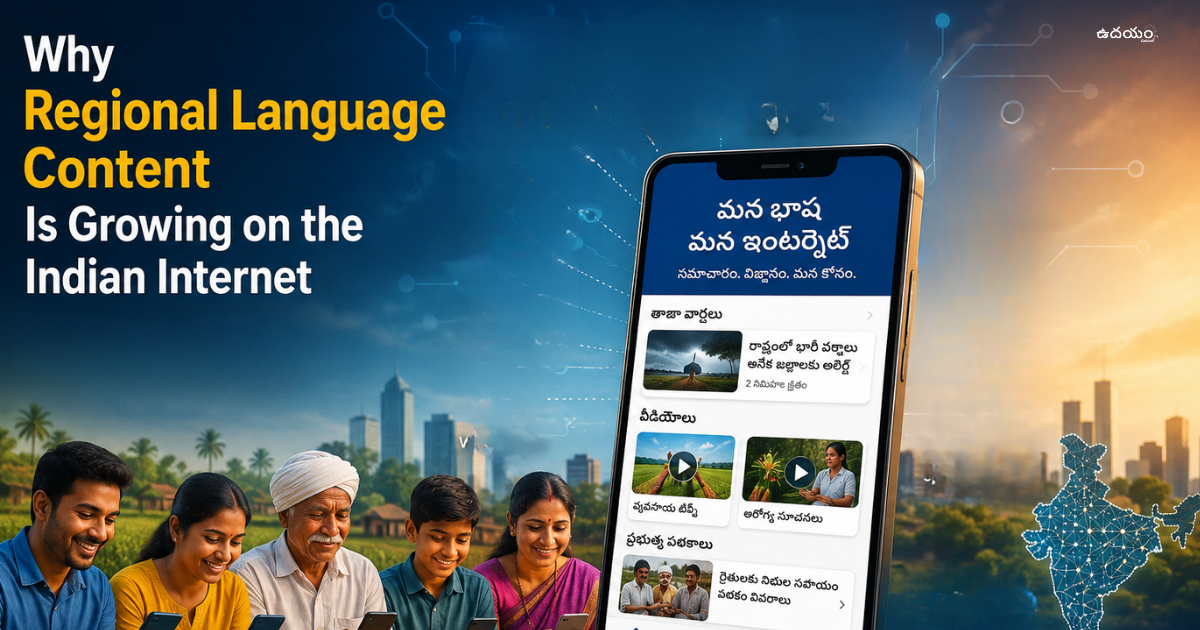
India’s digital landscape has transformed dramatically over the past decade. While English once dominated the internet, millions of users now prefer consuming content in their native languages. This shift has opened new opportunities for regional-language publishers, creators, educators, businesses, and technology companies.
Among India’s many languages, Telugu has emerged as one of the fastest-growing digital content ecosystems. From news websites and YouTube channels to educational platforms and social media creators, Telugu-language content is reaching audiences across cities, towns, and rural communities.
Understanding why regional language content is growing helps explain the future of India’s internet and the role technology plays in making digital information accessible to everyone.
The Internet Is Becoming More Inclusive
For many years, English-speaking users represented a significant share of internet activity in India. However, as internet access expanded across the country, millions of first-time users came online with little or no preference for English.
Today’s users want to read, watch, and interact in the language they use every day. This has led to tremendous growth in regional-language websites, apps, podcasts, videos, and news platforms.
Instead of adapting to English, technology is increasingly adapting to users’ native languages.
Smartphone Penetration Has Changed Everything
One of the biggest reasons behind regional-language growth is the widespread adoption of smartphones.
Affordable Android devices have enabled millions of Indians to access the internet for the first time. Smartphones are no longer limited to urban professionals. Students, farmers, small business owners, homemakers, senior citizens, and rural communities now rely on mobile devices for daily information.
Because smartphones are personal devices, users naturally prefer consuming content in the language they are most comfortable with.
For Telugu-speaking users, this means browsing websites, reading news, watching videos, and communicating in Telugu without needing advanced technical knowledge.
Affordable Internet Access Has Expanded Digital Reach
India has some of the world’s most affordable mobile data plans.
Lower internet costs have encouraged users to spend more time online, streaming videos, reading articles, attending online classes, and using social media platforms.
Cheap data has particularly benefited regional audiences because users no longer hesitate to watch longer videos or consume multimedia content in their preferred language.
The combination of affordable smartphones and inexpensive internet has created one of the largest digital audiences in the world.
Unicode Has Revolutionized Regional-Language Publishing
Earlier, publishing regional-language content online was difficult because different fonts often created compatibility problems.
The introduction of Unicode solved this challenge by creating a universal standard for displaying text across devices, browsers, and operating systems.
Today, Telugu text appears consistently on the following:
- Websites
- Mobile applications
- Search engines
- Social media platforms
- Email services
- Messaging apps
Unicode has made it easier for publishers to create reliable Telugu websites while improving user experience and search engine visibility.
Better Telugu Keyboard Support Has Increased Content Creation
Typing in Telugu used to require specialized software and technical expertise.
Modern smartphones now include built-in Telugu keyboards, predictive typing, transliteration, and autocorrect features.
Users can type Telugu directly or simply write Telugu words using English letters, which are automatically converted into Telugu script.
These improvements have encouraged more people to create content, participate in discussions, and publish articles in their native language.
The barriers to creating Telugu content have become significantly lower than they were a decade ago.
Voice Typing Makes Regional Languages Easier to Use
Voice typing has become one of the most influential technologies for regional-language adoption.
Instead of typing long messages, users can simply speak into their phones.
Speech recognition technology converts spoken Telugu into written text almost instantly.
This feature is especially useful for:
- Senior citizens
- First-time smartphone users
- People who type slowly
- Users with limited literacy in English
- Professionals working on the move
Voice input has made digital communication faster and more natural for millions of users.
Voice Search Is Changing How People Find Information
Search behavior has evolved rapidly with the rise of voice assistants.
Instead of typing keywords, users now ask complete questions like the following:
- What are today’s Telugu news headlines?
- How is the weather today?
- What are the latest government schemes?
- Where is the nearest hospital?
Search engines have become better at understanding conversational Telugu queries.
This shift encourages publishers to produce content that answers real user questions rather than focusing only on traditional keyword optimization.
Voice search is expected to become even more important as speech recognition technology continues improving.
Video Content Appeals to Regional Audiences
Video has become the preferred content format for many internet users.
Regional-language videos are particularly successful because they combine visual storytelling with familiar language and cultural context.
Popular formats include:
- News updates
- Educational tutorials
- Farming advice
- Health awareness
- Government scheme explanations
- Entertainment
- Product reviews
- Local event coverage
Short-form video platforms have also encouraged thousands of regional creators to reach large audiences without needing expensive production equipment.
For many users, watching information in Telugu is easier than reading lengthy articles.
Regional Creators and Publishers Are Driving Growth
The creator economy has expanded beyond English-speaking influencers.
Today, regional creators produce valuable content across countless categories, including education, finance, technology, agriculture, business, healthcare, travel, and local news.
Independent publishers have also launched digital-first regional news websites that provide timely updates tailored to local communities.
This growing ecosystem offers audiences more relevant content while creating new business opportunities for advertisers and publishers.
Telugu publishers and digital news platforms such as Udayam are part of this broader regional-language internet ecosystem, helping make local news and information more accessible to Telugu-speaking audiences.
Growing Demand for Local Information
People often search for information that directly affects their daily lives.
Examples include:
- Local news
- District-level developments
- Government announcements
- School admissions
- Employment opportunities
- Agricultural updates
- Weather reports
- Festivals
- Traffic information
- Public services
Regional-language platforms are uniquely positioned to provide this information because they understand local culture, geography, and audience preferences.
As digital literacy increases, demand for hyperlocal information is expected to continue growing.
Artificial Intelligence Is Accelerating Regional Content
Artificial intelligence is making regional-language publishing faster and more accessible.
Modern AI tools can help with:
- Language translation
- Speech recognition
- Text-to-speech conversion
- Automatic subtitles
- Voice assistants
- Content recommendations
- Grammar assistance
- Search optimization
These technologies allow publishers to create multilingual content more efficiently while reaching wider audiences.
Although human editors remain essential for maintaining quality and accuracy, AI significantly reduces the time required for many publishing tasks.
As AI models improve, regional-language experiences will become even more natural and personalized.
Businesses Are Investing More in Regional Languages
Companies increasingly recognize that customers prefer engaging with brands in their native language.
Businesses now invest in:
- Regional-language websites
- Mobile applications
- Customer support
- Product descriptions
- Marketing campaigns
- Educational content
- Social media communication
This trend creates new opportunities for regional publishers through advertising partnerships and branded content.
It also improves customer trust by making digital services more accessible.
The Future of Regional-Language Platforms
The future of India’s internet is expected to be multilingual.
Several trends are likely to shape the next phase of growth:
- Smarter AI-powered translation tools
- More accurate speech recognition
- Personalized regional-language recommendations
- Expansion of voice-based interfaces
- Increased digital literacy
- Growth of regional e-commerce
- Better accessibility technologies
- Stronger local creator communities
Regional-language platforms that focus on quality, trust, user experience, and technological innovation will be well positioned for long-term success.
Conclusion
Regional-language content is no longer a niche segment of the Indian internet—it is becoming its foundation. Advances in smartphones, affordable internet, Unicode, voice technologies, AI, and digital publishing have made it easier than ever for people to access information in the language they know best.
For Telugu audiences, this transformation has created a richer digital ecosystem where news, education, entertainment, and everyday information are available in a familiar language. As technology continues to evolve, regional-language platforms will play an increasingly important role in connecting millions of users with relevant, accessible, and meaningful online experiences.