

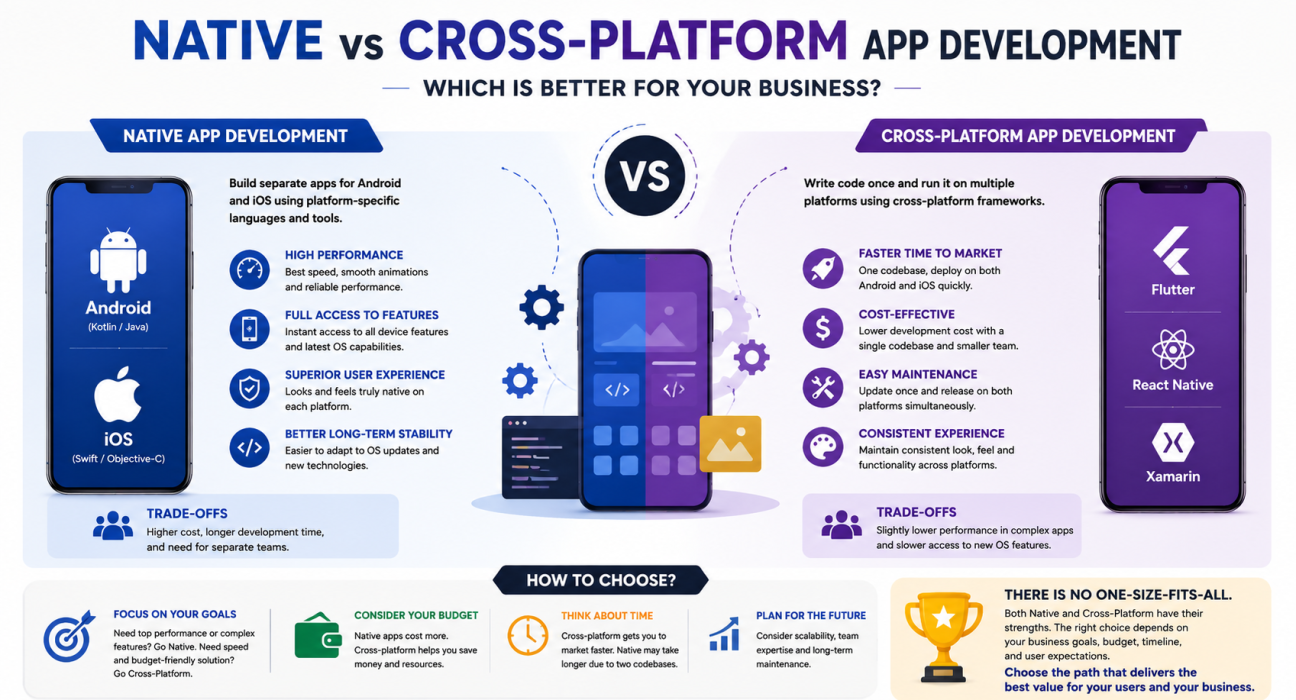
Native vs cross platform app development is an important decision for businesses planning a mobile app. If you have ever sat with a cup of filter coffee trying to decide how to build your business’s mobile app, you have probably faced this question: should you choose native or cross-platform development? This decision can affect your app’s performance, budget, launch timeline, and future maintenance.
This article breaks down native vs cross platform app development in plain, simple language – no unnecessary jargon, just a clear, practical comparison to help you decide which route suits your business best.
When choosing between native vs cross platform app development, consider factors such as your budget, project timeline, target audience, app complexity, performance requirements, and future scalability.
Ultimately, native vs cross platform app development should be treated as a business and product decision rather than simply a technical choice. Whichever path you choose, the real success of your app will come down to good planning, a development team that understands your business, and a genuine focus on what your users actually need.
Take a step back, weigh your priorities honestly, and choose the approach that allows your app to perform well, stay within budget, launch on time, and grow with your business. A well-planned decision between native vs cross platform app development can give your app a stronger foundation for long-term success.
What Do We Mean by Native and Cross-Platform Development?
Before comparing, let’s get the basics sorted.
Native app development means building a separate app for each operating system, using the language and tools that platform prefers. For Android, that typically means Kotlin or Java; for iOS, it means Swift or Objective-C. Each app is built specifically for its platform, almost like tailoring two different outfits – one for Android, one for iOS – instead of one outfit that tries to fit both.
Cross-platform app development, on the other hand, means writing the code once and deploying it across both Android and iOS, using frameworks like Flutter, React Native, or Xamarin. Think of it like a ready-made outfit that fits reasonably well on most people, saving you the cost and time of stitching two separate ones.
Both approaches are widely used across India and globally – from Chennai-based startups building their first delivery app, to large enterprises running apps used by lakhs of customers.
Native App Development: Strengths and Trade-Offs
Where Native Apps Shine
Native apps are built using the platform’s own toolkit, so they tend to perform exceptionally well. If your app needs to be lightning-fast – think gaming apps, apps with heavy camera or AR (augmented reality) usage, or apps handling large amounts of real-time data – native is usually the safer bet.
Key advantages of native app development:
- Best possible performance: Since the code runs directly on the platform without any extra translation layer, native apps are typically faster and smoother, especially for graphics-heavy or animation-heavy screens.
- Full access to device features: Camera, GPS, Bluetooth, fingerprint sensors, NFC for payments – native apps get first-class, immediate access to every new feature Android or iOS rolls out.
- Superior user experience: The app looks and feels exactly the way users expect on that platform, right down to the smallest scroll behaviour and button animation.
- Better long-term stability: Native apps tend to age well with new OS updates, since they are built using the platform vendor’s own recommended tools.
Where Native Apps Struggle
The catch is cost and time. Since you are essentially building two apps – one for Android, one for iOS – you need two separate development teams, or one team working double the hours. This naturally pushes up both the budget and the delivery timeline. For a small business or a bootstrapped startup, this can feel like trying to run two households on one salary.
Cross-Platform App Development: Strengths and Trade-Offs
Where Cross-Platform Apps Shine
Cross-platform development has matured a lot over the last few years. Frameworks like Flutter and React Native are now powering some genuinely large, well-known apps – proof that “cross-platform” no longer automatically means “compromise.”
Key advantages of cross-platform app development:
- Faster time to market: One codebase, two platforms – your app can go live on both Android and iOS almost simultaneously, which matters a lot if you are racing a competitor to launch.
- Lower development cost: Since you are not maintaining two separate codebases, you generally need a smaller team, which brings the overall project cost down – often a big relief for startups watching every rupee.
- Easier maintenance: Bug fixes and feature updates can usually be made once and pushed to both platforms together, instead of duplicating the work twice.
- Consistent branding: Since the same code drives both versions, your app’s look, feel, and behaviour stay consistent across Android and iOS.
Where Cross-Platform Apps Struggle
Cross-platform apps can sometimes lag slightly behind native apps in raw performance, particularly for apps that lean heavily on complex animations, 3D graphics, or brand-new OS features that haven’t yet been fully supported by the cross-platform framework. There can also be a short delay before a cross-platform framework catches up with the very latest Android or iOS release, since it depends on the framework’s own update cycle.
Popular Tools Used in Each Approach
It helps to know the actual tools behind these two approaches, since you will hear these names thrown around by any development team you talk to.
On the native side:
- Android Studio with Kotlin or Java – the official toolkit for building Android apps, backed directly by Google.
- Xcode with Swift or Objective-C – Apple’s own development environment for iOS, iPadOS, and watchOS apps.
On the cross-platform side:
- Flutter – built by Google, using the Dart programming language, known for smooth animations and a genuinely native-like feel.
- React Native – built by Meta (Facebook), using JavaScript, popular because so many web developers can pick it up quickly.
- Xamarin – Microsoft’s cross-platform framework using C#, often preferred by teams already working in the .NET ecosystem.
Each of these frameworks has its own community, its own strengths, and its own quirks – so the “best” cross-platform tool also depends on what your development team already knows well.
Cost, Timeline, and Team Structure: The Practical Side
Numbers matter, especially for a founder watching cash flow closely. While exact costs vary depending on app complexity, region, and the agency you hire, a few general patterns hold true across most projects:
- Native development usually needs two parallel teams (or double the developer-hours from one team), which naturally pushes the total cost up – sometimes by 40-60% compared to a cross-platform build of similar complexity.
- Cross-platform development typically needs one core team, which keeps both cost and coordination simpler – fewer stand-up meetings, fewer version-mismatch headaches between two codebases.
- Timeline-wise, a native app for both platforms can take noticeably longer to reach launch, since features are essentially built twice, tested twice, and polished twice.
- Team structure also differs – native projects often need platform specialists (an Android expert and an iOS expert), while cross-platform projects can often be handled by a smaller, more generalist team.
None of this means cross-platform is automatically “cheaper and better” – a native app that performs beautifully and drives higher user retention can easily justify its higher upfront cost over time. It is a business trade-off, not just a technical one.
Testing, Updates, and Long-Term Maintenance
This is a factor many businesses forget to weigh at the planning stage, but it matters enormously once the app is live and real users start reporting issues.
- With native apps, every bug fix, feature addition, or design tweak has to be built and tested separately on both Android and iOS – like maintaining two separate shops instead of one.
- With cross-platform apps, most updates can be written once and rolled out to both platforms together, though certain platform-specific bugs may still need individual attention.
- App store approvals apply to both approaches equally – Google Play and Apple’s App Store both have their own review processes, regardless of how the app was built underneath.
- Long-term framework support is worth checking before you commit – Flutter and React Native are both actively maintained and widely adopted, which reduces the risk of your app “ageing badly” a few years down the line.
Real-World Examples to Put This in Perspective
Some of the apps you use daily will surprise you once you know how they were built. Several very large, high-traffic apps – including well-known platforms in retail, social media, and food delivery – run on cross-platform frameworks like React Native or Flutter, proving that cross-platform is more than capable of handling serious scale when built well. At the same time, apps that depend on cutting-edge camera work, heavy gaming graphics, or deep hardware integration still lean towards native development for good reason – because that last 10% of performance polish genuinely matters for those use cases.
The takeaway here is simple: the “best” companies don’t pick native or cross-platform because it’s trendy – they pick it because it matches what their specific app actually needs to do well.
Quick Decision Checklist
Before you finalize your approach, it helps to sit down and honestly answer a few questions:
- Does my app need heavy graphics, gaming performance, or deep hardware access? → Lean native.
- Am I building an MVP (minimum viable product) to test a business idea quickly? → Lean cross-platform.
- Is my budget tight, with limited room for two separate builds? → Lean cross-platform.
- Do I have a longer runway and a need for top-tier, platform-perfect user experience? → Lean native.
- Will my app likely need frequent updates and fast iteration? → Cross-platform usually makes this easier.
- Is my in-house team already skilled in a particular native or cross-platform stack? → Build on what your team already knows well, where possible.
Answering these honestly, rather than following whatever is currently trending on LinkedIn or Twitter, will get you to the right decision faster than any amount of debate.
Native vs Cross-Platform: A Side-by-Side Look
| Factor | Native App Development | Cross-Platform App Development |
|---|---|---|
| Performance | Excellent, closest to hardware | Very good, occasionally slightly behind native |
| Development cost | Higher, two separate builds | Lower, one shared codebase |
| Time to market | Slower | Faster |
| Device feature access | Immediate, full access | Good, but sometimes slightly delayed |
| Maintenance effort | Two codebases to manage | One codebase to manage |
| Best suited for | Gaming, AR/VR, fintech, heavy-graphics apps | Startups, MVPs, ecommerce apps, content and utility apps |
So, Which One Should You Actually Choose?
Here is the honest answer: there is no single “better” option sitting on a pedestal – it genuinely depends on your app’s purpose, your budget, and your timeline. Choosing between them is a bit like deciding between a custom-tailored suit and a well-made ready-to-wear one – both can look sharp, but the right choice depends on the occasion and your budget.
Go with native app development if:
- Your app depends heavily on performance – gaming, camera-intensive, or AR/VR apps.
- You need the very latest platform features on day one of release.
- You have a comfortable budget and a longer runway to build and launch.
- User experience needs to feel exactly, precisely native to each platform.
Go with cross-platform app development if:
- You are a startup or small business validating an idea and need to move fast.
- Budget is tight and you need to control development costs.
- Your app is more content, ecommerce, booking, or utility-focused rather than performance-heavy.
- You want to launch on both Android and iOS at the same time without doubling your team.
A Practical Middle Path
Many growing businesses today don’t pick one approach and stick with it forever – they start with cross-platform development to launch fast and test the market, almost like a soft opening before the grand launch. Once the business proves itself and scales, some teams later migrate performance-critical parts of the app to native, or rebuild specific heavy-use screens natively while keeping the rest cross-platform. This hybrid, phased approach lets you balance speed-to-market in the early days with performance and polish once the business has found its footing.
It’s a strategy that suits the Indian startup environment particularly well, where speed and cost control often matter just as much as long-term technical perfection – especially in the early days when you are still figuring out product-market fit.
Conclusion
Native vs cross platform app development isn’t really a battle with a permanent winner – it’s a decision that should be led by your app’s goals, not by trends or what a competitor happens to be using. Native development gives you unmatched performance and the smoothest possible user experience, while cross-platform development gives you speed, cost efficiency, and easier maintenance.
Whichever path you choose, the real success of your app will come down to good planning, a development team that understands your business, and a genuine focus on what your users actually need – not just which framework sounds more impressive on paper. Take a step back, weigh your priorities honestly, and pick the approach that lets your app do its job well, without burning a hole in your pocket or your timeline.
Ultimately, native vs cross platform app development is both a technical and business decision. Choose the approach that supports your goals and delivers value to your users.
With proper planning, your team can build an app that performs well and stays within budget. A smart technology choice can give your app a strong foundation for long-term business growth.