
Choosing the wrong development partner can cost you months of delays, a broken budget, and an app that never quite works the way you imagined. That’s why app development comparison isn’t just a nice-to-have step in your hiring process – it’s the difference between a smooth build and a project that stalls out halfway through.
Most businesses searching for a mobile app development company run into the same problem: dozens of agencies claim to be “the best,” but their portfolios, pricing, and processes vary so much that it’s hard to compare them on equal footing. Without a clear framework, it’s easy to pick a vendor based on a polished website rather than actual capability.
This guide breaks down exactly how to compare mobile app development companies – what criteria matter, what questions to ask, and how to avoid the most common hiring mistakes. Whether you’re a startup founder building your first MVP or an enterprise buyer evaluating vendors for a long-term partnership, this framework will help you make a confident, informed decision.
Why App Development Comparison Matters
A mobile app is a significant investment of time, money, and internal resources. Two agencies can quote similar prices and still deliver wildly different results, depending on their technical expertise, communication style, and development process.
Proper app development comparison helps you:
- Avoid vendors who overpromise and underdeliver
- Identify agencies with real experience in your industry or app type
- Understand true costs, including what’s not included in a quote
- Reduce the risk of missed deadlines and scope creep
- Find a partner who can support your app after launch, not just build it
Skipping this comparison step is one of the most common reasons app projects go over budget or fail to launch on time.
Step 1: Define Your App Requirements Before You Start Comparing
Before you can compare companies fairly, you need clarity on what you’re building. This doesn’t mean you need a finished spec document, but you should be able to answer:
- What problem does the app solve, and for whom?
- Native (iOS/Android separately) or cross-platform (Flutter, React Native)?
- What’s your rough budget range and timeline?
- Do you need ongoing maintenance and support after launch?
- Will the app require complex features like payments, real-time data, or AI integration?
Having these answers ready lets you evaluate proposals on an apples-to-apples basis, instead of comparing vague estimates that are based on different assumptions.
Step 2: Key Criteria for Comparing Mobile App Development Companies
1. Relevant Portfolio and Case Studies
Look past the visual polish of a portfolio and dig into the substance:
- Have they built apps similar in complexity to yours?
- Do they have experience in your industry (healthcare, fintech, e-commerce, etc.)?
- Can they show measurable outcomes, not just screenshots?
- Are the case studies recent, or is the portfolio outdated?
A strong portfolio in an unrelated niche doesn’t guarantee success with your specific requirements.
2. Technical Expertise and Tech Stack
Ask which technologies the company specializes in and why they’d recommend a particular stack for your project. Watch for agencies that push a single technology regardless of project fit – that’s often a sign of limited technical range rather than genuine best-fit advice.
Key questions to ask:
- Do you build native apps, cross-platform apps, or both?
- What is your experience with backend architecture and API integrations?
- How do you handle app security and data protection?
- What is your approach to app performance and scalability?
3. Development Process and Methodology
A clear, structured process is a strong signal of a mature agency. Ask about:
- Whether they follow Agile, Scrum, or another methodology
- How often you’ll receive updates or demos
- How they handle change requests mid-project
- What their QA and testing process looks like before launch
Vague answers here are a red flag. Reliable agencies can walk you through their process step by step.
4. Communication and Project Management
Poor communication is one of the top reasons app projects fail. When comparing companies, evaluate:
- Response time during initial conversations
- Time zone overlap and language fluency
- Whether you’ll have a single point of contact or a shifting team
- What project management tools they use (Jira, Trello, Asana, etc.)
5. Pricing Model and Transparency
Mobile app development pricing varies widely based on region, complexity, and engagement model. Common pricing structures include:
| Pricing Model | Best For | Considerations |
|---|---|---|
| Fixed price | Well-defined, smaller projects | Less flexibility for changes |
| Time and materials | Evolving or complex projects | Requires trust and clear reporting |
| Dedicated team | Long-term, ongoing development | Higher commitment, more control |
Always ask what’s included in a quote and what could trigger additional costs – this is where many businesses get blindsided later in the project.
6. Post-Launch Support and Maintenance
Launching the app is not the finish line. Ask every company:
- Do you offer post-launch bug fixes and updates?
- What does ongoing maintenance cost?
- How do you handle app store updates and OS compatibility changes?
- Is there a warranty period after delivery?
An agency that disappears after launch can leave you unable to maintain or scale your own product.
7. Client Reviews and References
Look beyond testimonials on the agency’s own website. Check third-party review platforms and, where possible, ask to speak directly with a past client. Pay attention to how the agency handled challenges, not just their successes.
Step 3: Questions to Ask During the Evaluation Process
Use these questions as a checklist when speaking with potential vendors:
- Can you share examples of apps similar to what I’m building?
- Who exactly will be working on my project, and what are their roles?
- How do you estimate timelines, and what happens if we fall behind?
- What is your process for testing and quality assurance?
- How do you handle intellectual property and code ownership?
- What support do you offer after the app goes live?
- Can you provide references from recent clients?
Agencies that answer these clearly and specifically are generally more reliable than those who give generic or evasive responses.
Step 4: Red Flags to Watch For
- Prices that seem far lower than every other quote you’ve received
- No clear development process or documentation
- Reluctance to provide references or past client contacts
- Pressure to sign a contract quickly without a discovery phase
- Vague answers about who owns the source code after project completion
- No mention of testing, QA, or post-launch support
How to Use a Comparison Framework Effectively
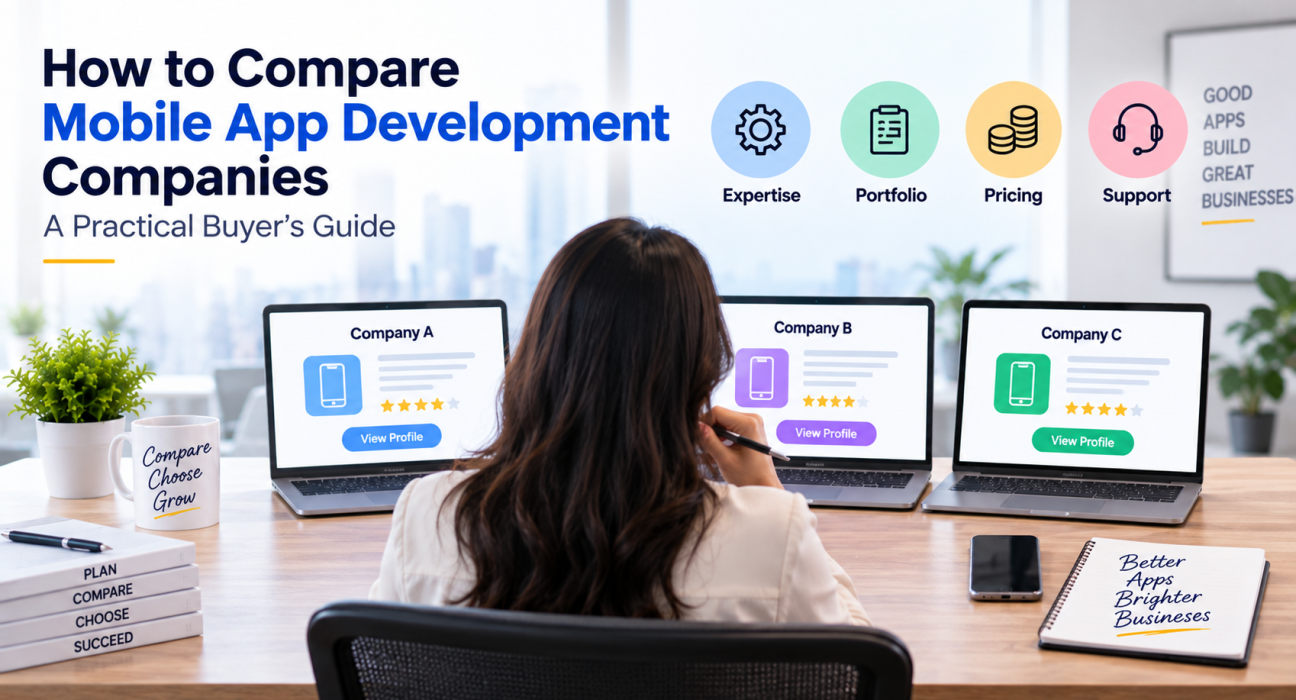
Once you’ve gathered proposals, create a simple scoring sheet across the criteria above – portfolio relevance, technical expertise, process, communication, pricing transparency, and post-launch support. Score each vendor out of 5 in every category. This turns a subjective decision into a structured one and makes it easier to defend your choice to stakeholders or investors.
Platforms like GoFirms can support this process by letting businesses research and compare mobile app development companies side by side, based on their profiles, service focus, and areas of expertise – making it easier to shortlist vendors before starting individual conversations.
Frequently Asked Questions
How do I compare mobile app development companies effectively? Compare companies based on relevant portfolio experience, technical expertise, development process, communication style, pricing transparency, and post-launch support. Use a consistent scoring framework across all vendors so you’re evaluating them on equal terms rather than relying on gut feeling alone.
What’s the difference between fixed-price and time-and-materials pricing? Fixed-price models work best for well-defined projects with clear scope, offering budget certainty but less flexibility. Time-and-materials pricing suits evolving projects where requirements may change, offering more flexibility but requiring closer budget monitoring throughout development.
Should I choose a local agency or an offshore development company? It depends on your priorities. Local agencies often offer easier real-time communication and cultural alignment, while offshore companies can provide cost efficiency and access to specialized talent. Evaluate based on communication needs, budget, and project complexity rather than location alone.
How important is industry-specific experience when hiring an app developer? Industry experience can speed up development and reduce costly mistakes, especially in regulated fields like healthcare or fintech. However, strong general technical expertise and a solid discovery process can often compensate for a lack of niche-specific experience.
What should be included in a mobile app development contract? A solid contract should cover project scope, timeline, payment milestones, intellectual property ownership, confidentiality terms, and post-launch support conditions. Clarifying code ownership and support terms upfront prevents disputes after the project is delivered.
How long does it typically take to build a mobile app? Timelines vary significantly based on complexity, ranging from a few weeks for a simple MVP to several months for a feature-rich app with backend integrations. Ask each vendor for a realistic timeline based on your specific requirements rather than relying on generic estimates.
Can I switch development companies mid-project if things aren’t working out? It’s possible, but it can be costly and disruptive, especially if code documentation is poor or IP ownership terms are unclear. This is why vetting a company thoroughly before starting – and confirming clear code ownership terms – is critical to avoiding this situation
Conclusion
Comparing mobile app development companies isn’t about finding the cheapest option – it’s about finding the right technical, communicative, and strategic fit for your specific project. By defining your requirements upfront, evaluating vendors against consistent criteria, and asking the right questions, you significantly reduce the risk of a failed or over-budget project.
Take your time during this comparison stage. The hours you invest now in properly vetting a development partner will save you far more time, money, and frustration once the project is underway. If you’re just starting your search, platforms like GoFirms can be a useful starting point for researching and shortlisting mobile app development companies that match your project needs.