
How to Reduce Lead Response Time and Increase Conversions
A prospect fills in your enquiry form at 11:05 AM. Your team sees it at 2:30 PM, and by then the prospect has already spoken to two of your competitors. This is the most common way sales teams lose leads. It is rarely because of price or product. It is usually because of a slow first call.
Reducing your lead response time does not need a bigger team. It needs a clear process for capturing, assigning and calling every lead quickly. Many teams do this with lead management software that assigns leads automatically and reminds agents to follow up. This guide explains what lead response time is, why it matters and how to improve it step by step.
What Is Lead Response Time?
Lead response time is the time between a lead showing interest (a form fill, missed call, portal enquiry or ad response) and your team’s first genuine attempt to contact them. It is usually measured in minutes for hot leads and hours for colder ones. A shorter response time gives you a better chance of reaching the prospect while their interest is still fresh.
Do not confuse it with resolution time or sales cycle length. Lead response time measures only the first touch.
Why Lead Response Time Matters for Conversions
Buyers who enquire online usually contact more than one business. The first company to call often gets the first real conversation, and that conversation shapes everything after it.
A well-known Harvard Business Review study, “The Short Life of Online Sales Leads” (2011), audited 2,241 US companies with test web leads. Only 37% responded within an hour, 24% took more than 24 hours, and 23% never responded at all, with a 42-hour average among those that did respond. The researchers also reported that firms contacting within an hour were nearly seven times more likely to qualify the lead, and over 60 times more likely than firms that waited 24 hours or more. WordPressAINORA
Two cautions are worth keeping in mind:
- The study covered US online leads, not Indian telecalling. Treat it as strong direction, not an exact prediction for your business.
- Some researchers have found that the best timing can vary by business type. Test what works for your own leads.
Even with these limits, the pattern is clear. Delays cost you opportunities, and most businesses are slower than they think.
Why Most Teams Respond Slowly
Before fixing the problem, find its cause. These are the most common ones:
- Leads sit in many places. Facebook ads, property portals, website forms, WhatsApp and Excel sheets are all checked at different times.
- Nobody owns the lead. If a lead is not assigned, everyone assumes someone else will call.
- No alerts. Agents find out about a new lead only when they open a sheet.
- Manual dialing. Copying numbers and dialing one by one wastes minutes on every lead.
- No visibility for managers. Nobody notices that a lead has been waiting for three hours.
- Coverage gaps. Leads that arrive after office hours or during lunch wait until the next slot.
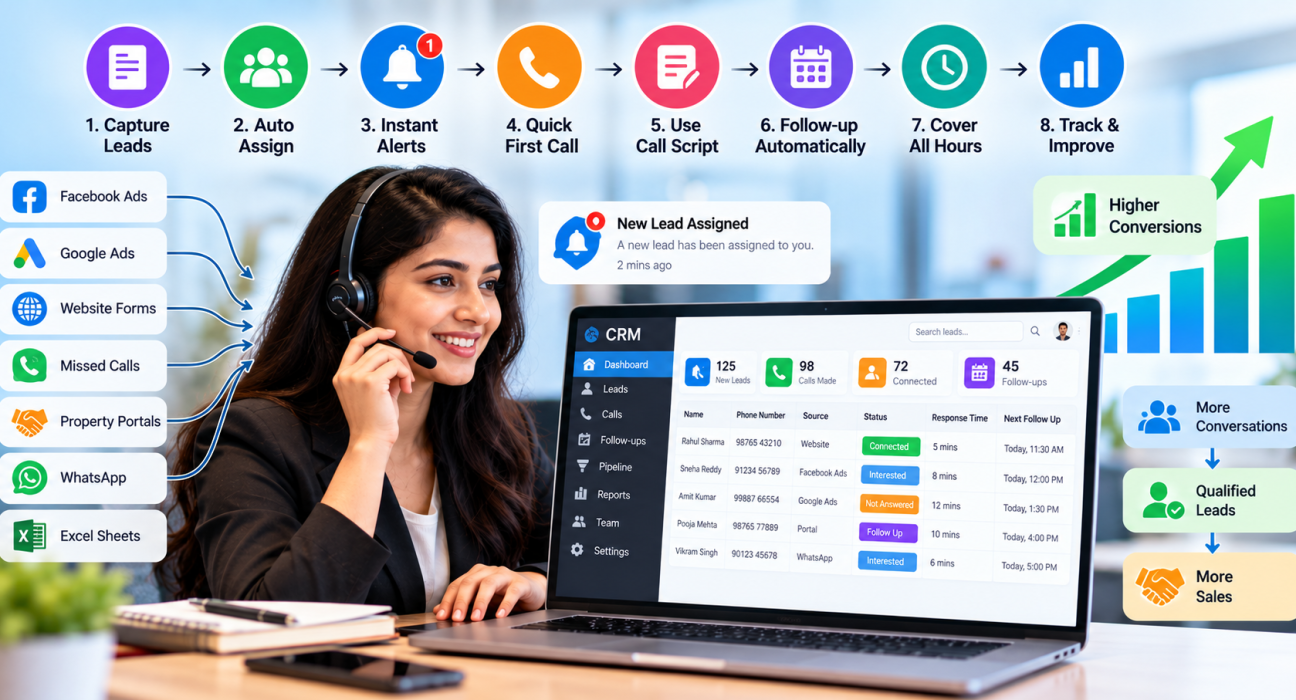
8 Steps to Reduce Lead Response Time
1. Bring All Leads into One Place
Start by capturing leads from every source in a single system. If your team has to open five tabs to find new enquiries, response time will always be slow. Connect your ad platforms, portals and website forms so that leads arrive automatically.
2. Assign Every Lead Instantly
An unassigned lead is an unanswered lead. Use rules to route leads automatically. You can assign by round-robin, by city, by product or by agent availability. Every lead should have one owner within seconds of arriving.
3. Send Alerts to the Right Person
The assigned agent should get a notification on their phone as soon as a lead arrives. Managers should also get an alert if a lead stays untouched beyond your set limit, for example 15 minutes.
4. Make the First Call a One-Click Action
Reduce the steps between seeing a lead and speaking to them. An auto dialer or click-to-call feature removes manual dialing. Agents can then spend their time talking rather than typing numbers.
5. Prepare a Short First-Call Script
Speed is useless if the call is weak. Give agents a simple opening: who you are, why you are calling, and one question to understand the enquiry. Keep a short WhatsApp message ready too, for leads who do not pick up.
6. Set a Follow-Up Rhythm for Unanswered Leads
Many leads do not answer the first call. Decide in advance what happens next. For example: call again after 30 minutes, send a WhatsApp message, and try once more the next morning. Log every attempt so nothing depends on memory.
7. Cover Peak Lead Hours and Off-Hours
Check when your leads arrive most often. If many come in the evening, arrange a shift or a callback plan. For after-hours leads, decide who calls first thing in the morning and make that a fixed routine.
8. Measure Response Time Every Week
You cannot improve what you do not track. Review response time by agent, by source and by hour of day. Share the numbers with the team openly, and use them to coach rather than to blame.
Suggested Response Targets by Lead Type
These are practical starting points, not research-backed rules. Adjust them to your industry and team size.
| Lead type | Suggested first-contact target |
|---|---|
| Callback request or demo request | Within 5 minutes |
| Portal enquiry (property, education, loans) | Within 5–15 minutes |
| Website or ad form lead | Within 15–30 minutes |
| Missed inbound call | Within 15 minutes |
| After-hours lead | First thing next working morning |
Real-World Examples (Hypothetical)
These examples are illustrations, not customer case studies.
Real estate. A builder’s team receives site-visit enquiries from property portals and Facebook ads. If leads are auto-assigned by project and agents get instant alerts, a buyer who enquires at lunchtime is called within minutes instead of the next day. That gives the team a better chance to book a site visit before the buyer contacts other developers. Teams in this space can look at how a real estate CRM handles portal leads.
Education. A coaching institute gets a surge of enquiries after an advertisement goes live. With one shared sheet, three counsellors may call the same student while others are never called. Automatic distribution avoids this duplication and the gaps. An education CRM is designed for this kind of admissions workflow.
Insurance and loans. Prospects often compare quotes the same day. A quick first call to understand their need, followed by a scheduled callback for documents, keeps the conversation alive.
Common Mistakes That Slow Down Response
- Speed without quality. A fast but poor call can lose a lead as easily as a slow one.
- Calling only once. One missed call is not a full attempt. Build a follow-up sequence.
- Ignoring duplicates. The same lead from two sources can waste an agent’s time and annoy the prospect.
- Skipping Do Not Call checks. Compliance matters. Screen numbers against DNC lists before calling.
- No accountability. Without a target and a report, response time drifts back to old habits.
- Blaming agents for a system problem. If leads arrive late or unassigned, agents cannot respond quickly.
Metrics to Track
Track a small set of numbers consistently:
- Average and median first-response time (median shows the typical case better)
- Percentage of leads contacted within your target time
- Contact rate, meaning how many leads actually answered
- Follow-up completion rate
- Lead-to-appointment or lead-to-sale conversion rate by response-time band
The last metric is the most useful. It shows you, with your own data, how much a faster response is worth to your business.
How a Telecalling CRM Can Help
Manual processes can work for a very small team, but they get harder as lead volume grows. Software helps by removing waiting time between each step.
TeleCalling CRM is built for outbound and telesales teams in India. Based on the information on its website, relevant capabilities include:
- Lead integrations with sources such as Facebook and Instagram Lead Ads, Google Ads, 99acres, Housing, MagicBricks, JustDial, Sulekha, TradeIndia, WordPress and Google Sheets
- Automatic lead distribution and assignment rules
- Automations that can trigger follow-ups, WhatsApp nudges and manager alerts when a lead is created
- A smart auto dialer and a mobile app for calling and logging outcomes
- Follow-up scheduling with reminders and overdue alerts
- De-duplication and DNC checks during lead import
- A live view of team activity and reports such as connection and answer rate
Whatever tool you choose, judge it on one question: does it reduce the gap between a lead arriving and a call being made? A tool alone will not fix a weak process, so define your targets and ownership rules first.
Frequently Asked Questions
What is a good lead response time?
For high-intent leads such as demo or callback requests, aim for within five minutes. For general web or ad enquiries, 15 to 30 minutes is a sensible starting target. The right number depends on your industry, so track your own conversion data to refine it.
Why is lead response time important?
Prospects often enquire with several businesses at once, and interest fades quickly. A faster first call gives you a better chance of reaching them and starting the conversation first. Research such as the 2011 HBR audit links faster response with higher lead qualification.
How do you calculate lead response time?
Subtract the time the lead was created from the time of your first contact attempt. For example, a lead created at 10:00 and called at 10:12 has a 12-minute response time. Report the average, and also the median and the percentage of leads within target.
How can small teams reduce lead response time without hiring more people?
Centralise leads, assign them automatically, send mobile alerts and remove manual dialing. Set fixed follow-up rules for missed calls. These changes usually save more time than adding one more agent to a disorganised process.
Should I call or send a WhatsApp message first?
For most sales enquiries, a call gives the fastest real conversation. If the lead does not answer, follow up with a short WhatsApp message and try again later. Respect the customer’s communication preferences and any consent requirements.
Does responding fast guarantee a sale?
No. Fast response improves your chances of a conversation, but conversion also depends on your offer, pricing, script and follow-up. Treat speed as one important part of the process.
How do I handle leads that arrive after office hours?
Note when they arrive, send an acknowledgement message if appropriate, and assign them for the first call the next morning. If after-hours leads are frequent, consider a small evening shift.
Conclusion
Lead response time is one of the few sales metrics you can improve quickly and measure clearly. Capture every lead in one place, assign it instantly, alert the owner, make calling easy and follow up in a fixed rhythm. Then track the numbers weekly and adjust.
If your team is still working from spreadsheets and scattered enquiries, it may help to see how a telecaller CRM fits your process. You can request a demo and check it against your own lead sources.