
Retail Execution Software: A Guide to Better In-Store Performance
A brand can plan the perfect planogram, negotiate prime shelf space and fund a promotion, and still lose sales because the right product wasn’t on the right shelf at the right time. The gap between the plan and what shoppers actually see is the problem retail execution software is built to close.
This guide explains what retail execution software is, which metrics it should track, which features matter, and how to choose a tool for your merchandisers, promoters and sales teams.
What Is Retail Execution Software?
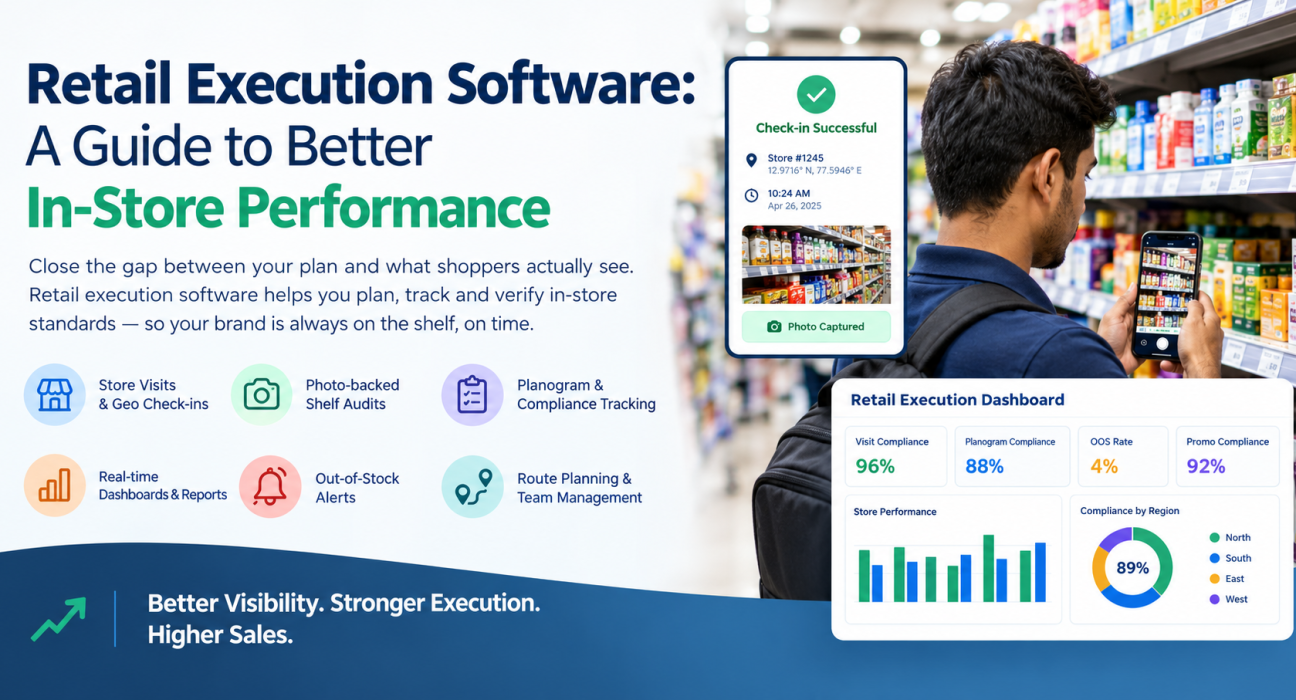
Retail execution software is a mobile and web platform that helps brands, distributors and merchandising agencies plan store visits, capture shelf and stock data, and verify that in-store standards are met.
Field staff use a mobile app to check in at each outlet, complete audit checklists and upload photos. Managers see the results on a dashboard, usually by store, region or team.
Retail execution is also broader than merchandising. It covers availability, pricing accuracy, promotional compliance, and the field team activity needed to keep all of that consistent across every store. Software is how you manage that activity without relying on phone calls, WhatsApp photos and month-end spreadsheets. customertimes
Why In-Store Execution Breaks Down
Most retail execution problems come from a lack of visibility, not a lack of effort. Common causes include:
- No proof of visits. A “visited” status in a report doesn’t show whether the merchandiser reached the store or how long they stayed.
- Delayed shelf data. Out-of-stocks and missing displays surface weeks later, when the sales opportunity has already passed.
- Inconsistent audits. Different agencies and supervisors use different formats, so results can’t be compared.
- Poor coverage planning. Visit frequency is often decided by habit instead of store priority.
- Manual reporting. Photos, notes and attendance sit in scattered chats and sheets.
When head office sets standards but cannot see compliance until someone walks into the store, execution depends on luck.
Retail Execution KPIs to Track
Retail execution typically covers five dimensions: numeric distribution, shelf placement, share of shelf, promotional compliance, and out-of-stock rate. Good software captures the data behind each one. roamler
| KPI | What It Measures | Why It Matters |
|---|---|---|
| Store visit compliance | Planned vs. completed visits | Confirms coverage |
| Planogram compliance | Shelf layout vs. the approved plan | Protects negotiated shelf space |
| Share of shelf | Your facings vs. total category facings | Shows visibility against competitors |
| Out-of-stock rate | Share of audited stores missing a SKU | Flags lost sales early |
| Promotion compliance | Whether displays and offers are live | Protects trade spend |
| Promoter attendance | Presence and hours at the outlet | Validates promoter cost |
| Visit duration | Time spent per store | Separates real audits from quick check-ins |
Key Features to Look For in Retail Execution Software
Geo-verified store check-in
Check-in should be tied to GPS and the store location, so every visit carries proof of presence. This ends disputes about whether a store was actually visited.
Photo-backed shelf audits
Look for configurable checklists with mandatory photos, so each response is evidence and not just a tick box. Photos should be geo-tagged and time-stamped.
Custom forms and audit templates
Every retailer and brand tracks different things: SKU availability, price tags, competitor activity, POSM, expiry checks. A drag-and-drop form builder lets you capture exactly what your process needs without developer help.
Planogram and share-of-shelf tracking
The tool should let you score shelf layout against a target and roll results up by store, region or team.
Out-of-stock and issue alerts
An alert reaches a supervisor when a merchandiser logs a gap. That turns a month-end finding into a same-day fix.
Route and store-order planning
Merchandisers cover more stores when visits follow an optimized sequence. Route and beat planning also keeps priority outlets from being missed.
Offline capture
Many stores, especially basement outlets and large malls, have weak connectivity. Audits should be completed offline and sync when the phone reconnects.
Live dashboards and reporting
Managers need live visibility of coverage, compliance scores and team activity, without waiting for end-of-week reports.
How Retail Execution Software Works Day to Day
- Assign stores. Managers give each merchandiser a store list, audit forms and targets.
- Check in at the outlet. The rep reaches the store and checks in with GPS.
- Audit the shelf. The rep completes the checklist, captures photos and logs stock gaps or competitor activity.
- Sync and flag. Data syncs to the dashboard, and exceptions trigger alerts.
- Review and coach. Managers compare stores, regions and reps, then act on the gaps.
The value comes from the loop. Standards are set, execution is captured as evidence, and the evidence drives the next action.
Retail Execution Software vs. Basic GPS Tracking
A GPS tracker tells you where a person is. Retail execution software tells you what they did there.
| Capability | Basic GPS Tracking App | Retail Execution Software |
|---|---|---|
| Location tracking | Yes | Yes |
| Store-level check-in | Limited | Yes |
| Photo-backed audits | No | Yes |
| Custom audit checklists | No | Yes |
| Compliance scoring | No | Yes |
| Out-of-stock reporting | No | Yes |
If you only need to know where people are, a tracker may be enough. If you need to prove shelf standards, you need audit capability.
How to Choose Retail Execution Software
Use this checklist when comparing options:
- Can you build your own audit forms without code?
- Are photos mandatory, geo-tagged and time-stamped?
- Does it work offline?
- Can you view compliance by store, region and team?
- Does it support route planning and visit scheduling?
- Can it track promoter attendance as well as merchandiser visits?
- Is it simple enough for field staff to adopt within days?
- Does it integrate with your CRM, ERP or HR systems?
- Is pricing clear as your team grows?
Run a pilot with one region or agency before a full rollout. Real store conditions will show you more than a demo.
Best Practices for Better In-Store Performance
- Define a small set of KPIs first. Start with visit compliance, planogram compliance and out-of-stocks.
- Standardize the audit form. One template across agencies makes results comparable.
- Keep checklists short. Long forms slow reps down and reduce data quality.
- Act on alerts quickly. Data only helps when someone responds to it.
- Review by exception. Focus managers on low-scoring stores instead of every report.
- Share results with field teams. Visible scorecards help coaching, not just policing.
How FieldExecutives Supports Retail Execution
Businesses looking to simplify these processes can use field force management software such as FieldExecutives. It offers a dedicated setup for retail and merchandising teams, built around store visits, shelf audits and promoter tracking.
According to the FieldExecutives retail page, teams can:
- Assign store lists, audit forms and planogram targets to each merchandiser
- Verify visits with geo-verified check-in at each outlet
- Capture shelf, planogram, stock and competitor audits against custom checklists with mandatory photos
- Log out-of-stock SKUs with a photo and alert a supervisor
- View share-of-shelf and compliance scores by store and region
- Track promoter attendance and store coverage on a live map
Because FieldExecutives is a broader field force platform, the same system also covers attendance, task management, route and beat planning, expenses and real-time reporting. Teams can use one tool for field operations instead of separate apps for tracking and audits.
You can start on the free plan with up to two users, or book a demo to map the setup to your workflow.
Conclusion
Retail execution fails when no one can see what happens in the store. The right retail execution software gives you proof of visits, photo-backed audits, live compliance data and fast alerts, so gaps are fixed while they still affect sales.