
When your engineering team spans three cities, two continents, and four vendor partners, the real challenge isn’t writing code. It’s making sure everyone is building the same thing.
Most C-level executives understand this instinctively. You’ve sat through enough status meetings where every team reports green, only to discover three months later that critical integration points were never discussed. You’ve watched projects slip not because of technical complexity, but because twenty brilliant engineers were solving twenty different problems.
The communication breakdown in large, distributed engineering programs isn’t a soft problem. It’s the hard problem. And it doesn’t get solved with another collaboration tool or a weekly all-hands call.
Why Communication Frameworks Matter More Than You Think
In a small, co-located team, communication happens naturally. People overhear conversations. They sketch on whiteboards. They course-correct in real time.
But when you’re running a digital transformation program with 150 engineers across Bangalore, Hyderabad, Pune, and offshore partners in Eastern Europe, that organic coordination disappears. What replaces it needs to be deliberate, structured, and consistently enforced.
Here’s what actually breaks down:
Context gets lost in translation. A product requirement written in Mumbai means one thing. By the time it reaches the development team in Bucharest, it means something else. By the time it comes back as working software, it solves a problem nobody actually has.
Decisions don’t propagate. Your architect in Bangalore makes a critical call about data residency on Tuesday. Your vendor team in Krakow doesn’t hear about it until the following Monday. They’ve already spent a week building something that won’t pass compliance.
Nobody owns the whole picture. Each team optimises locally. The payment team builds a robust service. The customer data team builds a robust service. When you try to connect them six months later, the integration is a nightmare because nobody was thinking about the seams.
Escalations come too late. In distributed teams, people hesitate to raise issues across time zones or organisational boundaries. By the time a problem surfaces to someone who can actually fix it, you’ve lost weeks.
This isn’t about blame. It’s about physics. When you distribute work, you fragment context. If you don’t have a framework to keep that context intact, execution suffers.
What Most Enterprises Get Wrong
The typical response to communication challenges is to add more meetings. Monday morning syncs. Thursday checkpoints. Friday retrospectives. Steering committees. Working groups. Tiger teams.
Within six months, your senior engineers are spending 25 hours a week in meetings and wondering when they’re supposed to write code.
The problem isn’t that you’re communicating too much or too little. It’s that you’re communicating the wrong things, in the wrong formats, to the wrong people.
Consider what happens in most large programs:
Status theater replaces actual transparency. Teams learn to report what leadership wants to hear. RAG status stays green until it suddenly turns red. Issues get sanitised in slideware. Nobody wants to be the person who brings bad news to the CAO’s office, so problems get dressed up as “challenges we’re actively managing.”
Information lives in silos. Critical decisions are made in Slack threads, email chains, or side conversations. There’s no system of record. Three months later, when someone asks, “Why did we build it this way,” nobody can quite remember.
Governance becomes bureaucracy. You institute change control processes to prevent chaos. But the processes become so heavy that teams start working around them. Shadow decisions get made. The official architecture and the actual architecture diverge.
Documentation is aspirational. Everyone agrees that documentation is important. Nobody has time to write it. What does get written is outdated within a month. People stop trusting it. Tribal knowledge becomes the only reliable source of truth.
These aren’t symptoms of poor execution. They’re symptoms of not having the right communication framework for the scale and complexity you’re operating at.
The Building Blocks of Effective Communication at Scale
A working communication framework for large, distributed engineering teams isn’t a tool or a template. It’s a system of agreements about how information flows, who owns what, and how decisions get made and recorded.
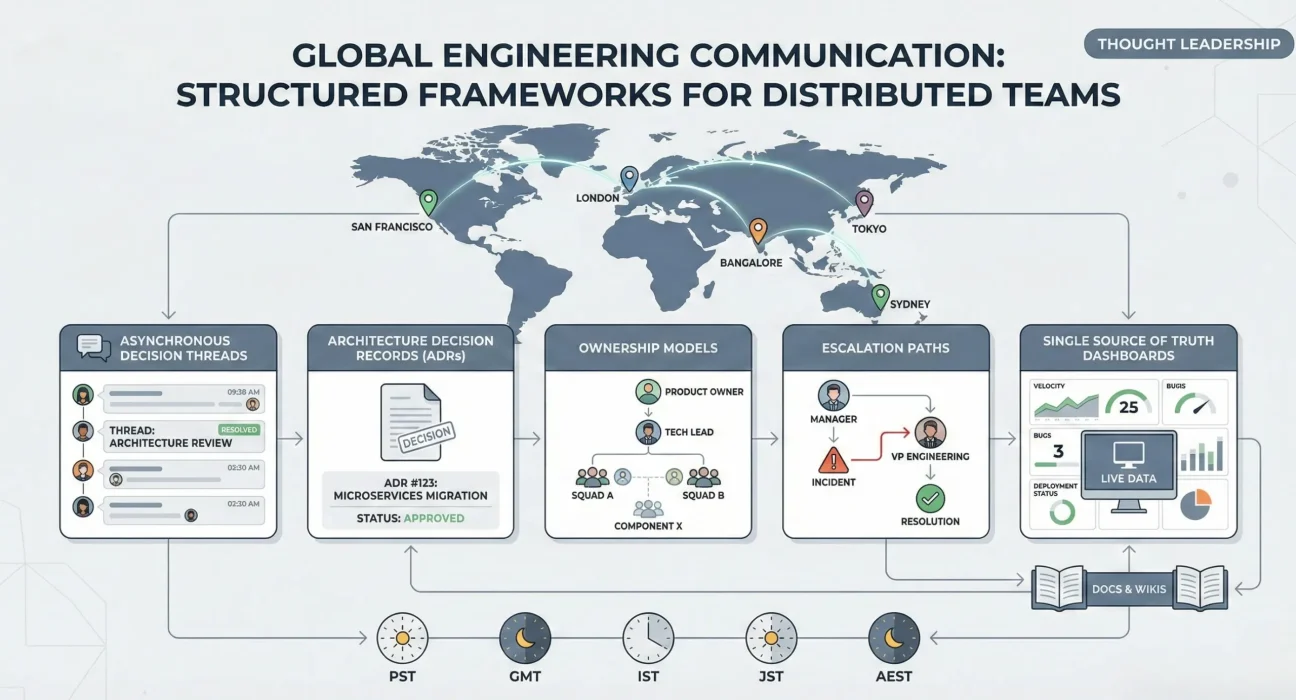
1. Structured Decision-Making and Recording
Every meaningful technical decision needs to be captured in a lightweight, searchable format. Not long documents. Not extensive specification sheets. Just enough context: what was decided, why, what alternatives were considered, who was involved.
Architecture Decision Records (ADRs) are one approach. The specific format matters less than the discipline. When your team in Pune makes a call about how to handle authentication, that decision and its reasoning need to be visible to your team in Gurgaon and your vendor partner in Vietnam.
This isn’t overhead. This is how you prevent rework. This is how new team members are onboarded in weeks instead of months. This is how you avoid relitigating the same decisions every quarter.
2. Clear Ownership and Decision Rights
In distributed teams, ambiguity about who owns what kills velocity. When something spans multiple teams or geographies, everyone assumes someone else will handle it. Or worse, multiple teams handle it in incompatible ways.
Your framework needs to make ownership explicit:
- Who owns each service or component?
- Who has decision rights on cross-cutting concerns?
- Who is the final escalation point when teams disagree?
- Who is accountable for integration points between teams?
This doesn’t mean command-and-control. It means clarity. When your infrastructure team and your application team disagree about observability strategy, someone needs to have the authority to make the call and move forward.
3. Asynchronous-First Communication
When your team spans multiple time zones, synchronous communication is expensive. Every meeting that requires people from Bangalore and Boston means someone is on a call at 11 PM.
The most effective distributed teams communicate asynchronously by default. Design documents in shared repositories. Technical discussions in threaded channels. Decision proposals that people can review and respond to on their own schedule.
This requires a culture shift. It means writing things down instead of talking them through. It means being explicit instead of relying on shared context. It means waiting for responses instead of expecting immediate answers.
It’s slower in the moment. It’s dramatically faster over time.
4. Structured Sync Points with Clear Purposes
The goal isn’t to eliminate meetings. It’s to make every meeting purposeful.
Your framework should define what gets discussed synchronously and what doesn’t:
- Strategic sync: Monthly or quarterly alignment on priorities, roadmap shifts, and major architectural decisions. Senior leadership and tech leads.
- Cross-team coordination: Weekly or bi-weekly sync on integration points, dependencies, and blockers that span teams. Keep it small and focused.
- Team-level planning: Sprint planning, backlog refinement, retrospectives within each team.
- Incident response: Real-time coordination when systems break. Don’t schedule these.
Everything else should default to asynchronous. Status updates belong in dashboards, not meetings. Progress reviews belong in documents, not slide decks presented live.
5. Single Source of Truth for State
In large programs, everyone needs to be able to answer basic questions without asking around:
- What’s the current roadmap and how is it changing?
- What decisions have been made and why?
- What are the active priorities and who owns them?
- What’s blocked and what’s the plan to unblock it?
- How are we tracking against timelines and budget?
This requires discipline about where information lives. Not scattered across email, Slack, Jira, Confluence, SharePoint, and someone’s laptop. One place for each type of information. Everyone knows where to look.
This sounds obvious. It’s surprisingly rare.
The Role of Leadership in Making This Work
Here’s an uncomfortable truth: communication frameworks fail because leadership doesn’t actually follow them.
You institute a decision-recording process, but senior leaders continue making calls in hallway conversations. You ask teams to communicate asynchronously, but executives expect immediate responses on Slack. You create a single source of truth, but the real decisions still happen in PowerPoint decks prepared for the board.
If you want distributed teams to communicate effectively, leadership has to model the behaviour:
Write things down. When you make a strategic decision, document it. When you shift priorities, make it visible. When you need input, put it in a format people can respond to thoughtfully, not just react to in the moment.
Respect the framework. If the framework says technical decisions get recorded as ADRs, don’t bypass it when you’re in a hurry. If it says cross-team coordination happens in a specific forum, don’t route around it because it’s more convenient to ping someone directly.
Protect focus time. Your engineers can’t build complex systems if they’re context-switching every hour. Respect asynchronous communication. Don’t expect instant responses. Don’t schedule meetings during designated focus blocks.
Enforce accountability. When things aren’t documented, send them back to be documented. When ownership is unclear, stop the work until it’s clear. When decisions get made outside the framework, make them visible inside it.
This feels like slowing down. In reality, it’s the only way to move fast at scale.
What Success Actually Looks Like
When communication frameworks work, you don’t notice them. Things just flow.
New engineers onboard faster because the context is written down and accessible. Cross-team dependencies get identified early because planning is visible. Decisions don’t get revisited because the reasoning is captured. Escalations happen quickly because ownership is clear.
You spend less time in meetings because people can find information themselves. You spend less time on rework because teams are building aligned solutions. You spend less time firefighting because problems surface before they become crises.
But here’s what matters more to the C-suite: you actually deliver.
Projects finish closer to their estimates. Quality is more consistent. Technical debt is managed instead of accumulated. When you scale the team, productivity scales with it instead of grinding to a halt under coordination overhead.
This is what execution maturity looks like. Not perfect processes. Not zero defects. Just a system that allows smart people to collaborate effectively even when they’re not in the same room, same time zone, or same organisation.
Choosing Partners Who Understand Enterprise Realities
Many technology partners talk a good game about delivery. They show you impressive case studies and slick capabilities decks. But when the program starts, the communication gaps become apparent.
The vendor team doesn’t understand your governance requirements. They’re used to building greenfield products, not integrating with 15-year-old core banking systems. They commit to timelines without accounting for compliance reviews, security assessments, or change control processes. They optimise for velocity but not for the kind of visibility and traceability you need.
When you’re running a large-scale digital transformation, you need a partner who has actually done this before in enterprise environments. Someone who knows that enterprise delivery isn’t just about writing good code. It’s about navigating organisational complexity, managing stakeholder expectations, maintaining alignment across distributed teams, and building systems that will run reliably for the next decade.
This is where partners like Ozrit make a difference. Not because they have better developers, though that matters, but because they understand enterprise program execution. They know how to communicate in environments where decisions involve legal, compliance, risk, operations, and technology. They know how to maintain velocity while respecting governance. They know how to work across cultures, time zones, and organisational boundaries.
That understanding doesn’t come from a playbook. It comes from experience.
Making It Stick: Implementation Realities
Implementing a communication framework isn’t a one-time effort. It’s a continuous practice.
Start small. Pick one area where communication is clearly breaking down, maybe cross-team dependencies, maybe technical decision-making, maybe status visibility. Implement a lightweight framework. Get one or two teams to actually use it. Learn what works. Adjust. Expand.
Don’t try to solve everything at once. Don’t impose a 47-page process manual. Don’t buy a suite of tools and expect them to fix cultural problems.
Do invest in helping people understand why this matters. Your senior engineers are smart. If you explain that this framework exists to protect their focus time and reduce rework, they’ll adopt it. If it feels like bureaucracy for bureaucracy’s sake, they’ll resist.
Do measure what matters. Not how many ADRs are written or how many meetings are eliminated. Measure time-to-onboard new team members. Measure how often you discover integration issues late. Measure how long it takes to escalate and resolve cross-team blockers.
Do adjust based on feedback. If something isn’t working, change it. If a particular sync point isn’t adding value, kill it. If people are working around a process, understand why before you enforce compliance.
And most importantly, give it time. Cultural change is slow. Teams that have been operating one way for years won’t transform overnight. That’s fine. Progress matters more than perfection.
The Real Competitive Advantage
Here’s what separates enterprises that successfully execute large technology programs from those that struggle:
It’s not the budget. It’s not technical talent. It’s not cutting-edge tools.
It’s the ability to coordinate complex work across distributed teams without collapsing under coordination overhead.
The enterprises that get this right move faster. They waste less money on rework and misalignment. They retain engineering talent because people aren’t drowning in meeting overhead. They scale their teams without watching productivity plummet.
This capability is what allows you to actually execute on your digital transformation strategy, not just talk about it in board meetings.
Communication frameworks aren’t glamorous. They’re not going to be featured in tech blogs or conference keynotes. But they’re the foundation that makes everything else possible.
Because in the end, enterprise software delivery isn’t about technology. It’s about people working together effectively to build systems that solve real business problems. And when those people are distributed across geographies, organisations, and time zones, the quality of your communication framework determines whether that collaboration succeeds or fails.
Get this right, and everything else becomes easier.
Get this wrong, and nothing else matters.