
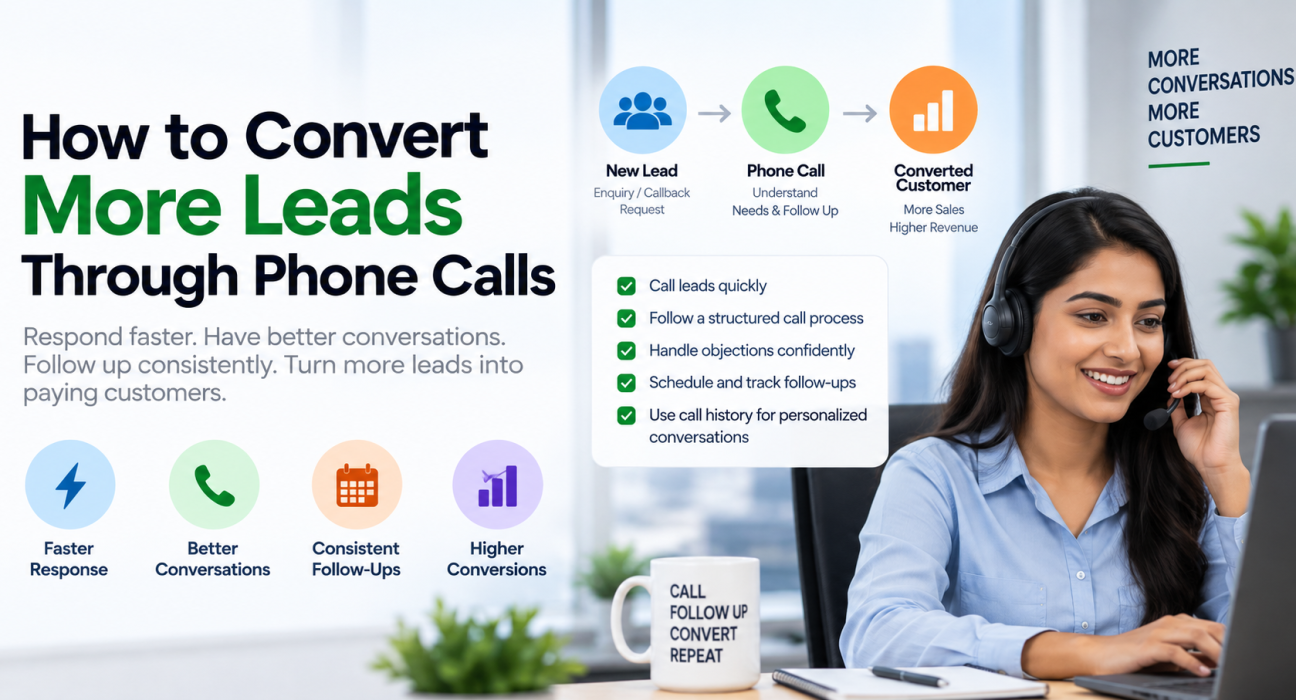
How to Convert More Leads Through Phone Calls
Most sales teams don’t have a lead problem. They have a conversion problem.
Marketing brings in enquiries every day, but only a small percentage turn into paying customers. The leads are not the issue — what happens after the lead comes in, especially on the phone, decides whether it converts or goes cold.
This is where lead conversion through calling becomes the real battleground for sales teams. Speed of response, quality of follow-up, and how organised the calling process is — these three things matter far more than the number of leads you generate. Businesses that struggle here often lack a system for managing this process; a proper lead management software can bring structure to lead assignment, follow-up scheduling, and call tracking so fewer leads are lost between the first call and the final decision.
This article breaks down what actually drives phone-based lead conversion, the common mistakes that quietly kill deals, and practical steps any sales team — big or small — can apply.
What Does “Lead Conversion Through Calling” Actually Mean?
Lead conversion through calling is the process of turning a phone enquiry, callback request, or inbound lead into a paying customer through structured, well-timed phone conversations.
It is not just “making more calls.” It includes:
- How fast you respond to a new lead
- How well the call is structured
- How consistently follow-ups happen
- How well objections are handled
- How the lead’s information is tracked and used in later calls
A lead that is called once and never followed up rarely converts, no matter how good that first call was.
Why Most Leads Don’t Convert on the First Call
Very few customers buy on the first call. This is true across industries — real estate, insurance, education, finance, and B2B sales all show the same pattern.
Common reasons leads don’t convert immediately:
- They need time to think or compare options
- They are not reachable at the first attempt
- They have budget or approval constraints
- They are talking to multiple vendors
- The salesperson didn’t build enough trust in one call
This is why follow-up is not optional — it is the actual conversion engine. Data from typical outbound sales operations consistently shows that a large share of conversions happen only after three or more touchpoints, not the first call.
The Core Framework for Better Call Conversion
Instead of chasing more calls, focus on improving these five areas.
1. Speed of First Response
Leads lose interest quickly. A lead that submitted an enquiry on a property portal, insurance ad, or education form is often speaking to 3–4 companies at the same time.
Calling within the first few minutes — rather than hours later — significantly increases the chance of a meaningful conversation, simply because the lead’s interest and memory of the enquiry are still fresh.
Practical step: Route new leads to an available agent immediately instead of manual assignment. Delayed distribution is one of the most common (and avoidable) reasons leads go cold before the first call even happens.
2. Structured, Not Scripted, Calls
A rigid script sounds robotic. But calling with no structure at all wastes time and misses key information.
A good call structure covers:
- A short, natural opening (not a sales pitch immediately)
- Understanding the customer’s actual need or problem
- Relevant information sharing (not everything at once)
- Addressing concerns honestly
- A clear next step — not a vague “I’ll get back to you”
Every call should end with a decided next action: a follow-up date, a document to be shared, or a decision timeline.
3. Consistent Follow-Up Discipline
This is where most conversion is lost.
A lead that shows interest but isn’t followed up on time often ends up buying from a competitor — not because the competitor was better, but because they followed up first.
Common follow-up mistakes:
| Mistake | Impact |
|---|---|
| No fixed follow-up date after a call | Lead goes cold within days |
| Follow-up depends on agent’s memory | Inconsistent, easy to forget |
| No reminder for overdue follow-ups | Leads silently slip through |
| Same pitch repeated every follow-up | Feels pushy, not helpful |
A basic lead follow-up software helps by scheduling reminders automatically after every call, so follow-up doesn’t depend on an individual agent remembering it manually.
4. Using Call History Instead of Starting Fresh Every Time
Nothing frustrates a lead more than repeating information they already gave. If an agent doesn’t know what was discussed last time, the lead feels like just another number.
Every follow-up call should ideally start with context: what was discussed earlier, what concerns were raised, and what was promised. This is one of the biggest practical advantages of using proper sales calling software instead of personal notebooks or scattered spreadsheets — call notes and history stay attached to the lead, visible to whoever calls next.
5. Tracking What’s Actually Working
Without visibility into call outcomes, teams keep repeating the same mistakes.
Useful metrics to track:
- Connection rate (how many dials actually connect)
- Follow-up completion rate
- Average number of calls before conversion
- Conversion rate by lead source
- Conversion rate by agent
Tracking by source is particularly useful. A business running ads on multiple platforms often finds that leads from one source convert far better than another — information that changes where the next month’s budget should go.
Real-World Example: Applying This in Practice
Consider a real estate business receiving leads from property portals and Facebook ads.
Without a system, leads sit in a spreadsheet, get called whenever an agent has time, and follow-ups are remembered — or forgotten — inconsistently. Conversion stays low despite a steady stream of enquiries.
With a structured process — immediate lead assignment, a consistent call structure, and scheduled follow-up reminders — the same number of leads typically convert at a noticeably higher rate, simply because fewer leads are dropped between the first call and the decision stage.
This pattern repeats across industries:
- Education: Admission counsellors calling inbound enquiries need timely follow-up before the admission window closes.
- Insurance: Policy enquiries often need 2–3 follow-up calls addressing specific concerns before a decision is made.
- Finance/Loan services: Approval timelines mean follow-up has to be tracked precisely, or the lead moves to another lender.
These are illustrative examples of common patterns, not case studies of specific businesses.
Common Mistakes That Hurt Call Conversion
- Calling too late. Even a same-day delay can lower interest significantly.
- No ownership of leads. When a lead isn’t clearly assigned to one agent, it often gets ignored by everyone.
- Overloading the first call with information. Customers switch off when given too much detail before they’ve decided they’re even interested.
- No follow-up cadence. Random, inconsistent follow-up feels careless to the customer.
- Ignoring call data. Not reviewing what’s working means repeating avoidable mistakes month after month.
- Manual dialing at scale. When agents dial numbers by hand, time is lost between calls that could otherwise be spent talking to more leads.
How CRM Systems Support Better Call Conversion
A telecalling software or CRM for telecallers doesn’t replace good sales conversations — but it removes the operational friction that causes leads to be lost.
Typical ways this helps:
- Automatic lead assignment, so new leads reach an agent quickly instead of sitting unassigned
- Follow-up scheduling and reminders, reducing dependence on individual memory
- Call history stored against each lead, so any agent has full context
- Basic reporting, showing which sources and which follow-up patterns convert better
For teams evaluating a telecaller CRM, TeleCallingCRM provides lead management, follow-up scheduling, and call tracking built specifically for outbound calling teams — useful for businesses that currently manage leads through spreadsheets or manual processes and want more structure around calling and follow-up.
That said, a CRM is a support tool. It works best alongside good calling discipline, not as a replacement for it.
FAQs
What is the biggest reason leads don’t convert on calls?
Delayed or inconsistent follow-up is usually the biggest reason. Most customers don’t decide on the first call, and if follow-up isn’t timely and structured, interest fades and they move to a competitor who followed up sooner.
How many calls does it usually take to convert a lead?
This varies by industry and lead source, but most conversions happen after multiple touchpoints, not the first call. Treating the first call as the start of a conversation — not the whole sale — leads to better outcomes.
Does calling speed really affect conversion?
Yes. Leads generated through ads or online forms are often reaching out to several companies at once. Calling within the first few minutes, while interest is still fresh, generally leads to more meaningful conversations than calling hours later.
Is a CRM necessary for better call conversion, or can a spreadsheet work?
A spreadsheet can work for very small volumes, but it becomes hard to manage follow-ups, call history, and lead assignment as the number of leads grows. A CRM automates reminders and keeps call context in one place, reducing leads lost to poor tracking.
What should a good follow-up call include?
It should reference what was discussed earlier, address any specific concerns raised previously, and end with a clear next step — whether that’s another follow-up date, a document shared, or a final decision timeline.
How do I know if my team’s calling process needs improvement?
Signs include: leads sitting uncalled for hours, no fixed follow-up schedule, agents unaware of previous conversations with a lead, and no visibility into which lead sources convert best.
Conclusion
Improving lead conversion through calling isn’t about making more calls — it’s about making the calls you already make count. Fast response, structured conversations, disciplined follow-up, and visibility into what’s working are the real levers.
For teams still managing this manually, moving to a proper telecaller CRM can remove much of the friction that causes good leads to go cold, giving agents more time to focus on the conversation itself rather than the admin around it.