
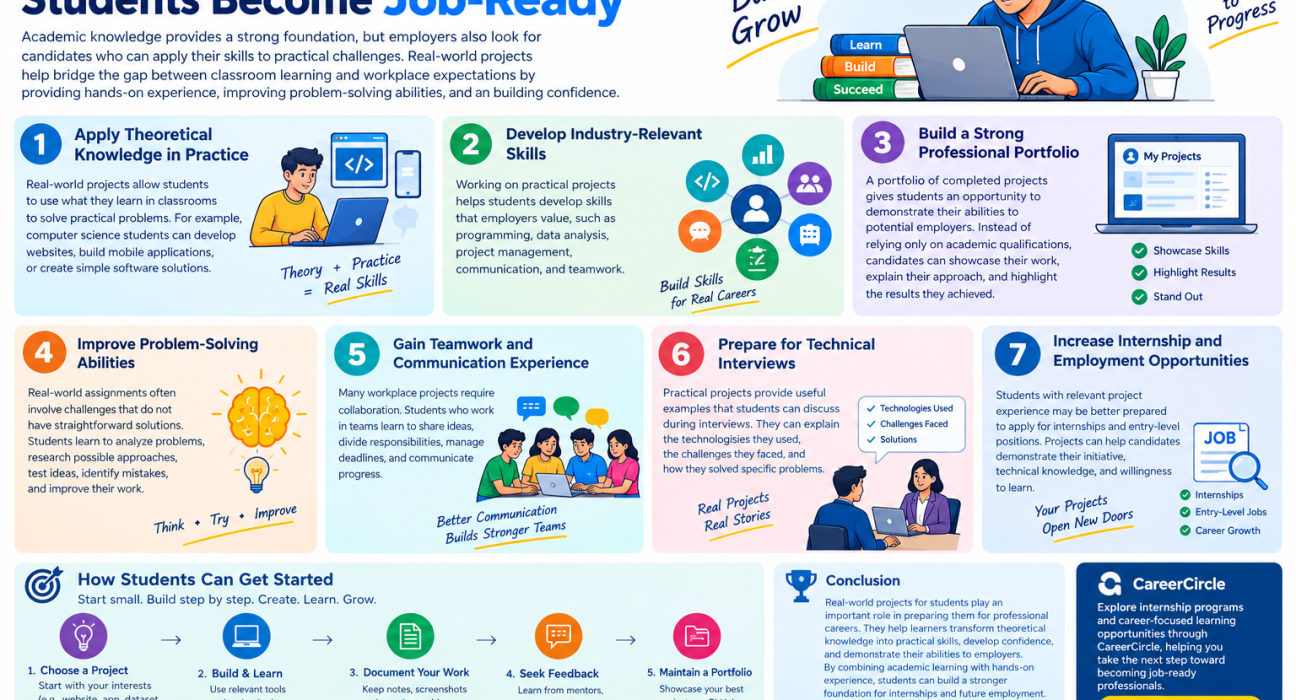
Academic knowledge provides a strong foundation, but employers also look for candidates who can apply their skills to practical challenges. Real-world projects for students help bridge the gap between classroom learning and workplace expectations by providing hands-on experience, improving problem-solving abilities, and building confidence.
1. Apply Theoretical Knowledge in Practice
Real-world projects allow students to use what they learn in classrooms to solve practical problems. For example, computer science students can develop websites, build mobile applications, or create simple software solutions. These activities help them understand how technical concepts work in real situations.
2. Develop Industry-Relevant Skills
Working on practical projects helps students develop skills that employers value, such as programming, data analysis, project management, communication, and teamwork. Depending on their career goals, students can choose projects that match the requirements of their preferred industry.
3. Build a Strong Professional Portfolio
A portfolio of completed projects gives students an opportunity to demonstrate their abilities to potential employers. Instead of relying only on academic qualifications, candidates can showcase their work, explain their approach, and highlight the results they achieved. A strong portfolio can support job applications and interview discussions.
4. Improve Problem-Solving Abilities
Real-world assignments often involve challenges that do not have straightforward solutions. Students learn to analyze problems, research possible approaches, test ideas, identify mistakes, and improve their work. These experiences prepare them to handle responsibilities in professional environments.
5. Gain Teamwork and Communication Experience
Many workplace projects require collaboration. Students who work in teams learn to share ideas, divide responsibilities, manage deadlines, and communicate progress. These soft skills are important for adapting to professional teams and contributing effectively to organizational goals.
6. Prepare for Technical Interviews
Practical projects provide useful examples that students can discuss during interviews. They can explain the technologies they used, the challenges they faced, and how they solved specific problems. This demonstrates their understanding and ability to apply knowledge in practical situations.
7. Increase Internship and Employment Opportunities
Students with relevant project experience may be better prepared to apply for internships and entry-level positions. Projects can help candidates demonstrate their initiative, technical knowledge, and willingness to learn. Combining project experience with interview preparation and career guidance can further improve job readiness.
How Students Can Get Started
Students can begin with small projects related to their interests and gradually move toward more complex assignments. Building a personal website, developing a student management system, analyzing a real dataset, or creating a basic business application are useful starting points. Students should document their work, seek feedback, and maintain a portfolio that highlights their contributions.
Conclusion
Real-world projects for students play an important role in preparing them for professional careers. They help learners transform theoretical knowledge into practical skills, develop confidence, and demonstrate their abilities to employers. By combining academic learning with hands-on experience, students can build a stronger foundation for internships and future employment.
Students who want structured practical training can explore internship programs and career-focused learning opportunities through CareerCircle, helping them take the next step toward becoming job-ready professionals.