
Starting a professional career can be challenging for fresh graduates, especially in the competitive technology industry. While academic qualifications provide a strong foundation, employers also look for practical knowledge, problem-solving abilities, and industry-relevant skills. Learning the right technical skills for freshers can help candidates improve their resumes, prepare for interviews, and become more confident when applying for entry-level jobs.
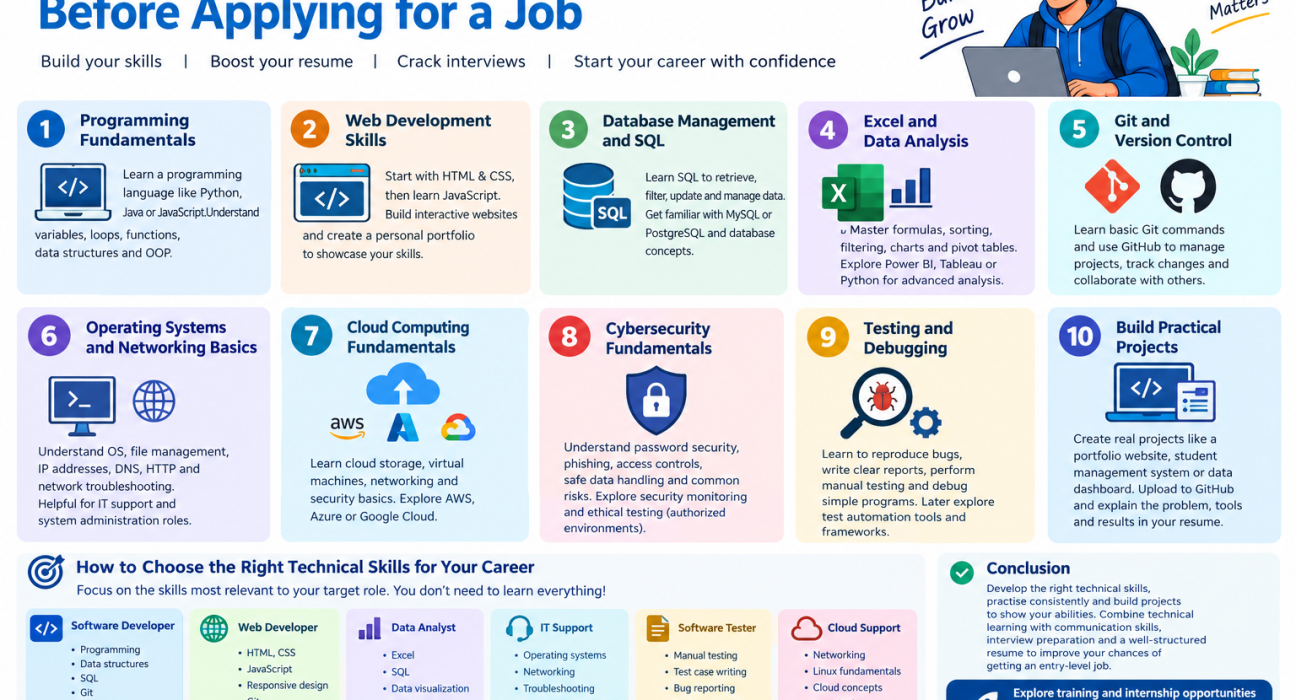
1. Programming Fundamentals
Learning a programming language is a valuable first step for freshers interested in software development. Languages such as Python, Java, and JavaScript are widely used in different areas of technology. Understanding variables, loops, functions, data structures, and object-oriented programming can help candidates develop a strong technical foundation.
2. Web Development Skills
Web development is a useful skill for freshers who want to pursue careers in software development or website design. Start with HTML and CSS to understand webpage structure and styling, then learn JavaScript to build interactive websites. Creating a personal portfolio or a simple website can demonstrate practical knowledge to potential employers.
3. Database Management and SQL
Many organizations rely on databases to store, manage, and analyze information. Learning SQL helps freshers retrieve data, filter records, update information, and perform basic database operations. Familiarity with database concepts and tools such as MySQL or PostgreSQL can be beneficial for software development, data analysis, and IT support roles.
4. Excel and Data Analysis
Microsoft Excel is useful across several industries, including IT, finance, operations, and business management. Freshers should understand formulas, sorting, filtering, charts, and pivot tables. Candidates interested in data-related roles can also explore Power BI, Tableau, or Python libraries for data analysis.
5. Git and Version Control
Git helps developers track code changes, manage project versions, and collaborate with other team members. Learning basic Git commands and using platforms such as GitHub can help freshers organize their projects and demonstrate their work to recruiters.
6. Operating Systems and Networking Basics
Understanding operating systems, file management, IP addresses, DNS, HTTP, and basic network troubleshooting is helpful for IT support, system administration, and networking roles. These fundamentals can also prepare freshers for technical assessments and entry-level IT interviews.
7. Cloud Computing Fundamentals
Cloud computing knowledge can be useful for freshers interested in cloud support, development, and infrastructure roles. Start by understanding cloud storage, virtual machines, networking, and basic security concepts. Beginners can explore introductory learning resources from AWS, Microsoft Azure, or Google Cloud.
8. Cybersecurity Fundamentals
Cybersecurity awareness is increasingly relevant across technology roles. Freshers should understand password security, phishing, access controls, safe data handling, and common security risks. Candidates interested in cybersecurity careers can gradually explore networking, security monitoring, and ethical security testing in authorized environments.
9. Testing and Debugging
Software testing helps identify errors and improve application quality. Freshers should learn how to reproduce bugs, write clear bug reports, perform basic manual testing, and debug simple programs. Those interested in software testing can later explore test automation tools and frameworks relevant to their chosen roles.
10. Build Practical Projects
Learning technical concepts is important, but applying them to real projects helps demonstrate your abilities. Create projects such as a portfolio website, a student management system, a data dashboard, or a simple application. Upload suitable projects to GitHub and explain the problem, tools used, and results in your resume.
How to Choose the Right Technical Skills for Your Career
Freshers do not need to learn every technology before applying for jobs. Instead, identify your target role and focus on the skills most relevant to it.
- Software developer: Programming, data structures, SQL, Git, and debugging.
- Web developer: HTML, CSS, JavaScript, responsive design, and Git.
- Data analyst: Excel, SQL, data visualization, and basic statistics.
- IT support: Operating systems, networking, troubleshooting, and security fundamentals.
- Software tester: Manual testing, test case writing, bug reporting, and basic automation.
- Cloud support: Networking, Linux fundamentals, cloud concepts, and security basics.
Conclusion
Developing the right technical skills for freshers can make the transition from education to employment easier. Focus on building a strong foundation, practising consistently, and creating projects that demonstrate your knowledge. Combine technical learning with communication skills, interview preparation, and a well-structured resume to improve your readiness for entry-level opportunities.
Explore career-oriented training and internship opportunities at CareerCircle to develop practical skills and prepare for your next career step. Choose a learning path that matches your goals and start building your professional future today.