
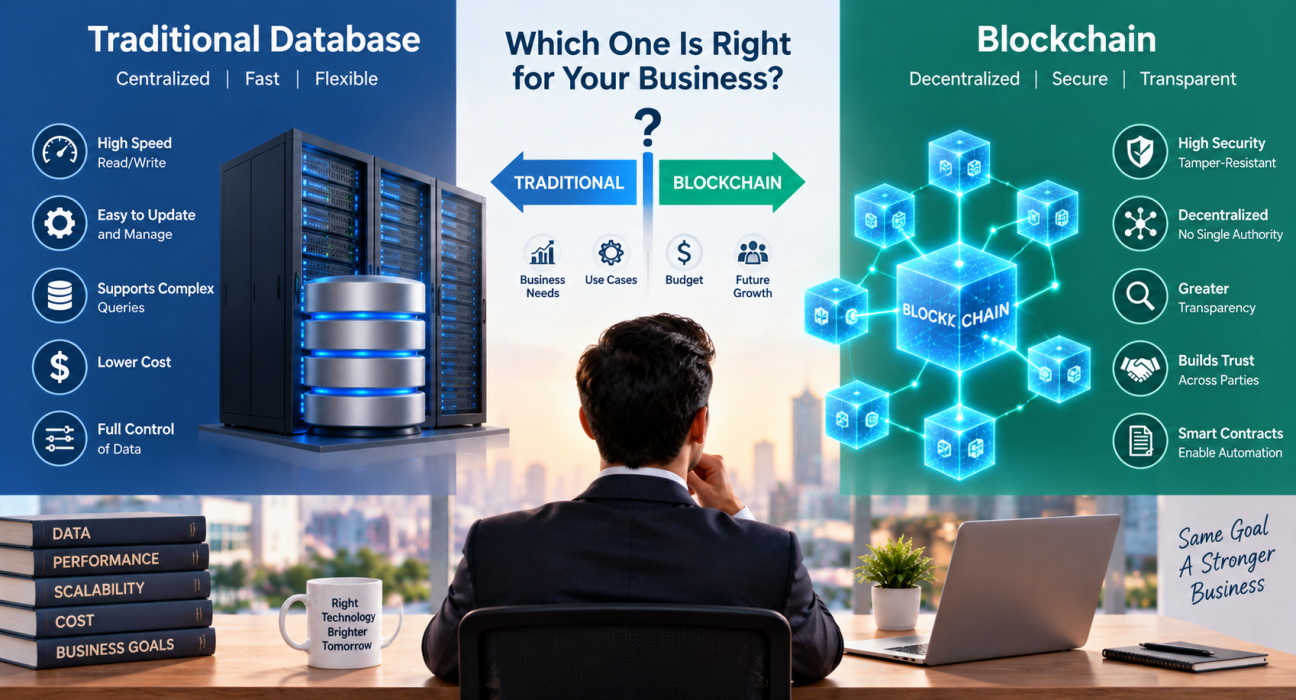
If you’re evaluating new systems for your business, you’ve probably run into the blockchain vs traditional database debate. Blockchain draws a lot of attention for its security and transparency, while traditional databases still power almost every business application in use today. So which one actually fits your needs?
The honest answer: it depends on what you’re trying to solve. Blockchain isn’t a replacement for databases – it’s a different tool that solves a different set of problems. Understanding how each one works, and where each one excels, will help you avoid an expensive, unnecessary migration or a system that can’t scale with your business.
This guide breaks down the real differences between blockchain and traditional databases, explains when each makes sense, and shows you how to decide which one fits your project.
What Is a Traditional Database?
A traditional database is a centralized system that stores, organizes, and retrieves data. A single authority – usually your IT team or a cloud provider – manages it and optimizes it for speed, flexibility, and ease of use.
Common types include:
- Relational databases (MySQL, PostgreSQL, SQL Server) – structured data in tables with defined relationships
- NoSQL databases (MongoDB, Cassandra, DynamoDB) – flexible schemas for unstructured or semi-structured data
- Cloud-managed databases (Amazon RDS, Google Cloud SQL, Azure SQL) – fully managed infrastructure with built-in scaling
Traditional databases handle high-speed reads and writes, complex queries, and centralized control. This makes them the standard choice for websites, mobile apps, CRMs, inventory systems, and most business software.
What Is Blockchain?
Blockchain is a distributed, decentralized ledger that stores data across a network of computers (nodes) rather than in one central location. Once you write data to a blockchain, almost nothing can alter it – each new entry (or “block”) links cryptographically to the one before it.
Key characteristics of blockchain:
- Decentralization – no single party controls the data
- Immutability – the network rarely allows anyone to change confirmed records
- Transparency – participants can often verify transactions independently
- Consensus-based validation – network participants must agree on changes; no single administrator approves them
Cryptocurrency systems originally built blockchain, but businesses now use it for supply chain tracking, digital identity, smart contracts, and any scenario where multiple parties need to trust shared data without relying on a single intermediary.
Blockchain vs Traditional Database: Key Differences
| Factor | Traditional Database | Blockchain |
|---|---|---|
| Control | Centralized (one owner/admin) | Decentralized (shared across nodes) |
| Speed | Very fast reads/writes | Slower, due to consensus requirements |
| Data changes | Teams can update or delete records easily | Almost impossible to alter once recorded |
| Trust model | Relies on trusting the database owner | Relies on network consensus, not one party |
| Scalability | Scales well for large transaction volumes | Can face scalability challenges |
| Cost | Generally lower to build and maintain | Often higher due to infrastructure and complexity |
| Best for | Standard business applications | Multi-party transactions requiring trust and transparency |
| Query complexity | Supports complex queries and joins easily | Offers limited query capabilities |
When a Traditional Database Is the Right Choice
For most businesses, a traditional database is still the better fit. It makes sense when you need:
Fast, High-Volume Transactions
E-commerce platforms, SaaS products, and mobile apps need near-instant read/write speeds that traditional databases deliver efficiently.
Full Control Over Your Data
If your business owns the data outright and doesn’t need to share verification responsibilities with external parties, a centralized database keeps things simpler and cheaper.
Complex Queries and Reporting
Traditional databases excel at filtering, joining, and analyzing large datasets – something blockchain doesn’t handle well.
Lower Development and Maintenance Costs
Building and hosting a traditional database generally costs less and is easier to staff, since the talent pool for SQL and NoSQL databases is much larger than for blockchain development.
Data That Needs Frequent Updates
Customer records, inventory counts, and pricing data change constantly. A traditional database lets your team make quick edits; blockchain doesn’t allow that.
When Blockchain Makes Sense
Blockchain is worth considering when your business problem involves trust between multiple independent parties, not just internal data storage. Good use cases include:
Supply Chain and Provenance Tracking
When multiple companies (manufacturers, shippers, retailers) need to verify the same data without relying on one party’s records, blockchain creates a shared, tamper-resistant history.
Financial Transactions and Smart Contracts
Blockchain enables automated, self-executing agreements between parties who may not fully trust each other.
Digital Identity and Credentialing
Verifiable, tamper-proof records support certifications, ownership records, and identity verification systems.
Auditability and Compliance
Industries with strict regulatory requirements sometimes use blockchain to create an audit trail that no one can quietly alter.
Decentralized Applications (dApps)
If your product removes a central authority by design – such as decentralized finance (DeFi) platforms – blockchain often serves as the foundational technology, not an add-on.
Blockchain vs Traditional Database: Performance and Cost Considerations
Performance
Traditional databases optimize for speed. A well-indexed relational database can handle thousands of transactions per second. Blockchain networks, by contrast, require consensus among nodes before confirming a transaction, which naturally slows things down. Public blockchains like Ethereum, for example, process far fewer transactions per second than a typical business database.
Cost
Blockchain development typically costs more upfront due to:
- Specialized developer talent
- Network infrastructure and node maintenance
- Smart contract auditing (critical for security)
- Ongoing gas fees or transaction costs on public networks
Traditional databases benefit from mature tooling, cloud-hosting options, and a much larger pool of experienced developers, which generally keeps both build and maintenance costs lower.
Security
Both systems can deliver strong security, but the security model differs. Traditional databases rely on access controls, encryption, and administrative safeguards. Blockchain relies on cryptography and distributed consensus, which makes it harder for a single bad actor to alter historical data – but smart contract vulnerabilities and network-level attacks remain real risks that require specialized expertise to manage.
How to Decide: A Quick Checklist
Ask these questions before choosing a technology:
- Does my data need sharing and trust across multiple independent organizations? If yes, blockchain may add value. If no, a traditional database is likely sufficient.
- Do I need to frequently update or delete records? Traditional databases handle this far more easily.
- How much transaction volume and speed do I need? High-volume, low-latency needs favor traditional databases.
- Does regulatory auditability drive my requirements? Blockchain can help, but well-designed audit logs in a traditional database can too.
- What’s my budget and available talent? Blockchain development typically requires more specialized (and costlier) expertise.
For most standard business applications – websites, internal tools, CRMs, e-commerce platforms – a traditional database remains the practical choice. Blockchain earns its place when trust, transparency, and decentralization drive the core business problem, not just a technical preference.
Choosing the Right Development Partner
Whether you choose a traditional database architecture or a blockchain-based solution, the technology choice is only part of the equation. Execution matters just as much. A development team with direct experience in your chosen technology – and in your industry – reduces the risk of costly rework down the line.
Businesses researching software development companies, blockchain developers, or database specialists can use GoFirms to compare technology and service providers based on their expertise, service offerings, and areas of focus. This can help narrow the search before reaching out for proposals or consultations.
FAQs
Is blockchain a type of database?
Not exactly. Blockchain is a distributed ledger technology, while a traditional database is a centralized data storage system. Blockchain can store data, but it structures that data very differently, prioritizing decentralization and immutability over speed and flexibility.
Is blockchain more secure than a traditional database?
Blockchain’s distributed, consensus-based structure offers strong protection against unauthorized data changes. However, “more secure” depends on the use case – traditional databases can also deliver high security with proper access controls, encryption, and monitoring.
Can blockchain replace traditional databases entirely?
No. Blockchain fits specific scenarios that involve multi-party trust and transparency, not general-purpose data storage. Most businesses will keep relying primarily on traditional databases, turning to blockchain only when it solves a specific trust-related problem.
Is blockchain more expensive to implement than a traditional database?
Generally, yes. Blockchain development requires specialized skills, careful smart contract auditing, and often ongoing network costs, which makes it more expensive to build and maintain than a standard database system.
What industries benefit most from blockchain?
Industries with multi-party transactions and a need for verifiable trust – such as supply chain, finance, healthcare records, and digital identity – tend to benefit most from blockchain technology.
Should a small business consider blockchain?
Most small businesses don’t need blockchain for standard operations like managing customers, inventory, or sales data. It’s worth considering only if the business model specifically involves decentralized trust, such as verifying transactions between unrelated third parties.
How do I know which technology is right for my project?
Start by identifying your core challenge: data trust between multiple parties (a potential fit for blockchain) or efficient storage and retrieval of your own business data (a fit for traditional databases). Consulting an experienced development team can help clarify the right approach for your specific use case.
Conclusion
The blockchain vs traditional database decision isn’t about which technology is “better” – it’s about which one matches your business problem. Traditional databases remain the right choice for the vast majority of business applications because they deliver speed, flexibility, and lower cost. Blockchain earns its place in specific situations involving multi-party trust, transparency, and tamper-resistant records.
Before committing to either technology, clearly define your data requirements, transaction volume, and trust model. If you need help identifying and comparing development teams with the right expertise, platforms like GoFirms can help you research and evaluate technology partners suited to your project.