
Quick answer: Look for a company with relevant project experience, a clear discovery and development process, strong UX and technical skills, transparent pricing, good communication, and reliable post-launch support. The right partner should understand your business goals, not just write code.
Choosing among custom website development companies is a high-stakes decision. After all, your website is often the first place customers judge your business, and a poorly built one can mean slow load times, security gaps, missed deadlines, and expensive rework. On the other hand, a good partner can build a site that scales with you.
This guide covers what a custom website development company does, the qualities that matter most, red flags to avoid, and a practical way to shortlist and compare providers.
What Is a Custom Website Development Company?
A custom website development company designs and builds websites from scratch, or heavily tailors them, to fit a specific business’s requirements. Instead of relying on a pre-made template, the team plans the structure, features, design, and integrations around your goals.
Most providers offer some mix of:
- Discovery and requirements analysis
- UI/UX design
- Front-end and back-end development
- CMS or e-commerce development
- Third-party integrations (CRM, payment, ERP, analytics)
- Testing and quality assurance
- Hosting support, maintenance, and updates
When Do You Need a Custom Website Instead of a Template?
A template or website builder is often enough for a simple brochure site. However, custom development makes more sense when:
- You need unique functionality, such as customer portals, booking engines, or complex product configurators.
- You must integrate with internal systems or third-party APIs.
- Performance, security, or compliance requirements are strict.
- Your brand needs a distinctive experience that templates can’t deliver.
- You expect traffic, content, or features to grow significantly.
If your needs are simple and your budget is tight, a customized template may be the smarter choice. In fact, a good agency will tell you that honestly.
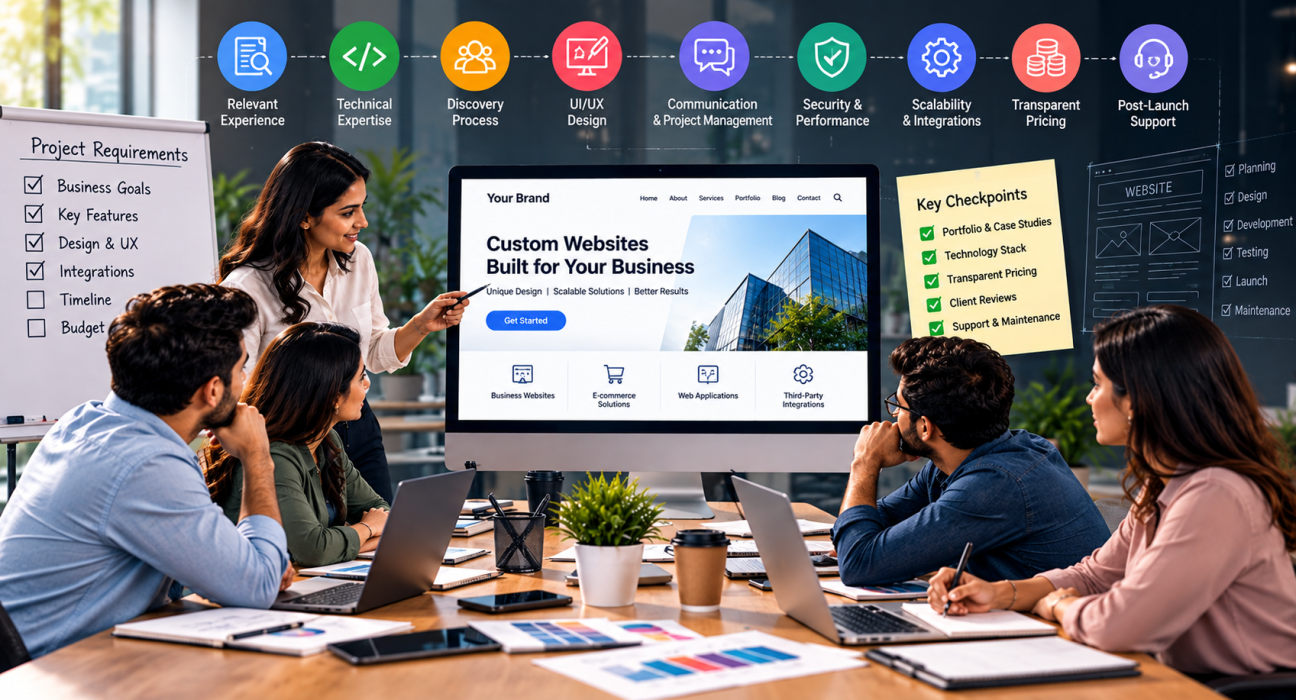
9 Things to Look for in a Custom Website Development Company
1. Relevant Portfolio and Experience
Start by reviewing past work closely. Look for projects similar to yours in industry, complexity, or functionality. For example, a company that has built multi-vendor marketplaces is better prepared for your e-commerce platform than one that only builds small brochure sites.
In addition, ask for case studies that explain the problem, the solution, and the outcome, not just screenshots.
2. Technical Expertise That Fits Your Project
The company should be comfortable with the technologies your project requires, whether that’s WordPress, Shopify, Laravel, React, Node.js, .NET, or a headless CMS. However, more important than a long list of technologies is whether they can explain why a specific stack suits your project.
Ask them:
- Why do you recommend this technology for us?
- How will it affect scalability, maintenance, and hiring later?
- Will we own the source code?
3. A Structured Discovery Process
Strong agencies don’t jump straight into design. Instead, they start by learning about your users, business goals, competitors, and technical constraints. Typically, you should expect stakeholder workshops, requirement documents, sitemaps, wireframes, and a defined scope.
In fact, a weak discovery phase is one of the most common causes of scope creep and budget overruns.
4. Strong UI/UX Capabilities
A custom site should be easy to use, not just good-looking. For this reason, check whether the team does user research, wireframing, prototyping, and usability testing. Also, ask how they design for mobile, accessibility, and conversion.
5. Clear Communication and Project Management
In fact, delivery problems are often communication problems. To avoid them, ask about:
- Who your day-to-day contact will be
- How often you’ll get progress updates
- Which project management tools they use
- How they handle change requests
- Whether they work in agile sprints or fixed phases
Time zone overlap also matters, especially if you plan to work with an offshore or nearshore team.
6. Security and Performance Practices
Ideally, a custom website should be built with security and speed in mind from day one. To check this, ask how the company handles:
- Secure coding practices and vulnerability testing
- Data protection and privacy requirements relevant to your market
- Page speed optimization and Core Web Vitals
- Backups, SSL, and access controls
Moreover, if your site handles payments or personal data, this deserves extra scrutiny.
7. Scalability and Integration Skills
Your website should support future growth. Therefore, a good partner plans for new features, higher traffic, additional languages, and integrations with tools like CRM, marketing automation, ERP, or payment gateways.
8. SEO and Analytics Readiness
Many websites launch well but then struggle to get found. To avoid this, look for a company that builds in technical SEO basics: clean URL structure, fast loading, mobile responsiveness, schema markup support, proper redirects, and analytics setup. Additionally, if you’re migrating an existing site, ask how they’ll protect your current search rankings.
9. Post-Launch Support and Maintenance
A website isn’t finished at launch. For that reason, ask about warranty periods, bug-fix policies, maintenance plans, response times, and how updates and security patches are handled. Also confirm who owns the code, design files, and hosting accounts when the project ends.
Green Flags vs. Red Flags
| Area | Green Flags | Red Flags |
|---|---|---|
| Discovery | Asks detailed questions about goals and users | Sends a quote after one short call |
| Portfolio | Relevant case studies with real outcomes | Only generic screenshots |
| Pricing | Itemized, with assumptions stated | Vague lump sum, or a price far below others |
| Process | Defined phases, milestones, and testing | “We’ll figure it out as we go” |
| Communication | Named contacts, regular updates | Slow or inconsistent replies |
| Ownership | Clear IP and code ownership terms | Unclear or restrictive terms |
| Support | Defined post-launch plan | No mention of maintenance |
How to Choose a Custom Website Development Company: Step by Step
Step 1: Define Your Goals and Requirements
Write down what the website must achieve. Include business goals (leads, sales, bookings), must-have features, integrations, target audience, timeline, and budget range. Once written, even a simple brief helps you compare providers fairly.
Step 2: Build a Shortlist
Aim for three to six companies. For instance, you can find candidates through referrals, search, and directories. Business directories like GoFirms let you research and compare web development companies by services and other criteria, which can save time in the early screening stage. Use any directory as a starting point, then verify details directly with each company.
Step 3: Review Portfolios and Client Feedback
Check case studies, client reviews, and independent feedback. Where possible, speak to past clients directly. In those conversations, ask about deadlines, communication, surprises, and how problems were handled.
Step 4: Ask Focused Questions
Prepare the same questions for every company so answers are comparable. For example, good ones include:
- What does your discovery process look like?
- Who will actually work on our project?
- How do you handle changes in scope?
- What happens if we’re unhappy with a deliverable?
- What are the post-launch support options?
Step 5: Compare Proposals, Not Just Prices
A proposal should describe scope, deliverables, timeline, team, technology, assumptions, and payment milestones. However, the lowest quote may leave out testing, SEO setup, or integrations that others have included, so compare like for like.
Step 6: Start Small if Possible
If you’re unsure, consider a paid discovery phase or a small pilot project. That way, you see how the team works before you commit to a larger contract.
What Affects the Cost of Custom Website Development?
Pricing varies widely, so be cautious of anyone quoting a fixed number without understanding your needs. The main cost drivers are:
- Scope and complexity: number of pages, features, user roles, and integrations
- Design requirements: custom illustrations, animations, and design systems
- Technology choices: CMS, framework, and hosting architecture
- Team location and seniority: rates differ by region and experience level
- Timeline: rushed projects usually cost more
- Ongoing needs: maintenance, hosting, and future feature development
Finally, ask for a breakdown so you can see where the money goes and what can be phased in later.
Common Mistakes to Avoid
- Choosing on price alone. A cheap build can become expensive if it needs to be rebuilt.
- Skipping a written scope. Otherwise, ambiguity leads to disputes.
- Ignoring content. Delays often come from missing copy, images, or approvals on the client side.
- Overlooking ownership. Confirm you’ll own the code, designs, and domain.
- Forgetting post-launch needs. After all, every website needs updates, monitoring, and security patches.
Frequently Asked Questions
How do I choose the right custom website development company?
Start by defining your goals and budget, then shortlist providers with relevant portfolios. Compare their process, technical expertise, communication, pricing transparency, and support terms. Speak with past clients when possible. Ultimately, the best fit is a team that understands your business objectives, not only the technical requirements.
How much does custom website development cost?
Cost depends on scope, features, design complexity, integrations, technology, and the team’s location and experience. For example, a simple custom site costs far less than a complex platform with user accounts and integrations. Therefore, request itemized proposals from several companies so you can compare what each includes.
How long does it take to build a custom website?
Timelines depend on complexity, content readiness, and how quickly your team gives feedback. A smaller site may take a few weeks, while complex platforms can take several months. For that reason, ask each company for a phased timeline with milestones rather than a single delivery date.
What is the difference between custom and template websites?
A template website uses pre-built layouts and features, making it faster and cheaper to launch. In contrast, a custom website is designed and developed around your specific requirements, giving more flexibility in design, functionality, performance, and integrations, usually at higher cost and longer timelines.
What questions should I ask a web development company before hiring?
Ask about relevant experience, who will work on your project, their discovery and testing process, how they handle scope changes, security practices, code ownership, and post-launch support. Also ask for client references and a clear breakdown of the timeline and costs.
Should I hire a freelancer or a custom website development company?
Freelancers can suit small, well-defined projects with limited budgets. In contrast, companies typically offer broader skill sets, such as design, development, QA, and project management, plus more continuity if a team member leaves. As a result, a company is often the safer choice for complex or business-critical sites.
Can I find custom website development companies on GoFirms?
GoFirms is a platform where businesses can discover, research, and compare technology and digital service companies, including web development providers. It’s a useful starting point for building a shortlist, but you should still review portfolios and speak to providers directly before deciding.
Conclusion
The best custom website development companies combine technical skill with business understanding. Focus on relevant experience, a structured process, clear communication, security and performance practices, transparent pricing, and dependable post-launch support. Finally, compare proposals on substance rather than price alone, and confirm ownership and support terms in writing.
If you’re ready to start your search, you can research and compare web development providers on GoFirms to build a shortlist that matches your project’s needs.